Gateway to the grasslands
 |
|
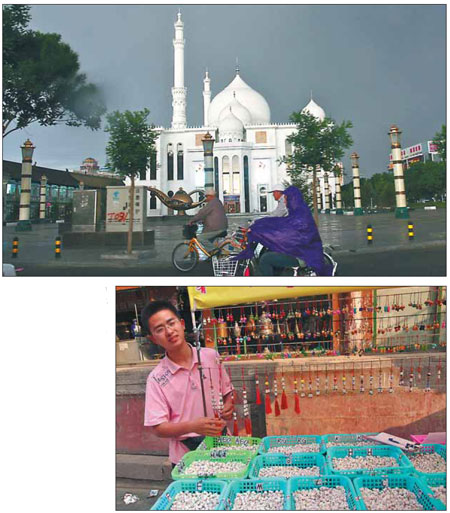
Muslim Cultural Street offers rich Islamic culture, from serene white mosques to golden domed buildings that are lit up at night; while nearby Saishang Old Street presents an opportunity to browse curio shops. Photos by Jules Quartly / China Daily |
While Hohhot has plenty of history, it's also coming of age.
Just an hour away by plane from Beijing, the center for rare earths and energy is expanding at a frenzied rate, causing the infrastructure to creak somewhat when it comes to the roads, but also sprouting new museums, hotels and businesses.
The capital of Inner Mongolia autonomous region is relatively well off and as a result is now beginning to emphasize its tourism potential as the gateway to the grasslands in summer, and a skiing destination during the winter months.
|
Related: |
While the population of 2.9 million people is 88 percent Han, the Mongolian (9 percent) and Hui (2 percent) ethnic groups have a disproportionate influence.
You will note this everywhere you go, since all store signs have to be in Mongolian, as well as Chinese, and practically every building has some kind of architectural flourish that harks back to its past, or some kind of Islamic influence, such as Arabic scripts.
Housing developments typically have huge bronze statues of Mongolian warriors astride horses, while there are mosques dotted around the city.
One of the city's main attractions is the downtown lightshow at night, in which bright beams pick out the buildings' pointed arches and domes.
A friend, Yang Qing, who was born and bred in Hohhot says whenever she mentions where she comes from, it is assumed that she rode to school on a horse.
Not true, obviously, but though ethnically Han, she explains Mongolian culture is a part of whom she is.
"There is a mix of influences and though I'm not Mongolian, the culture affects us and our character. I would describe it as very friendly and outgoing."
These ethnic influences are reflected in the locals' love for music and dining, which emphasizes lamb or mutton, beef, pork not so much (due to Muslim sensibilities) and very few vegetables. Hot pot and shaomai dumplings are other specialties, washed down with butter tea, or white liquor.
Founded by Altan Khan around 1580 - a descendant of the empire-building Kublai Khan - Hohhot is known as the "Blue City" in Mongolian, but it also has some pleasant green spaces, such as the jade-colored lake in the center of Qingcheng Park, which also has a Ferris wheel.
Most visitors head first for Da Zhao Temple, a 1579 stepping-stone into the past and a center for Tibetan Buddhism that has one of the largest silver Buddhas in China.
The surrounding area has stupas, statues and a large plaza, while nearby Saishang Old Street is a vibrant place to peruse art shops and examine hordes of Mongolian curios. Also not far away is Muslim Cultural Street, which as the name suggests, celebrates the religion's influence, from serene white mosques to golden and green domed buildings.
A short sojourn outside Hohhot is the Tomb of Princess Wang Zhaojun, which celebrates the story of one of China's top four beauties, who brokered peace between the Han and Xiongnu, or Hun, ethnic groups in 33 BC. The Hun ruled part of Inner Mongolia around this time.
Meanwhile the Inner Mongolia Museum is an impressive artificial turf-covered structure that introduces in an entertaining and informative way the history and culture of the region, from before the dinosaurs to the future of space travel - the Shenzhou IV space module landed about 60 km outside the city in 2003.
I guess all these attractions and a few others, such as the sleepy Wu Ta Temple Cultural Antiques Market, won't take much more than a few days, which is why the amiable general manager of the Shangri-La Hotel, Huhhot, Victor Ng, emphasizes the city as a gateway to the grasslands.
"Next to the beach and the sea, the grasslands are the next best thing."
Ng says, "You can't get enough of clear blue skies and vistas of green grass. It gives you a carefree feeling."
julesquartly@chinadaily.com.cn