An ancient settlement's present place in time
 |
|
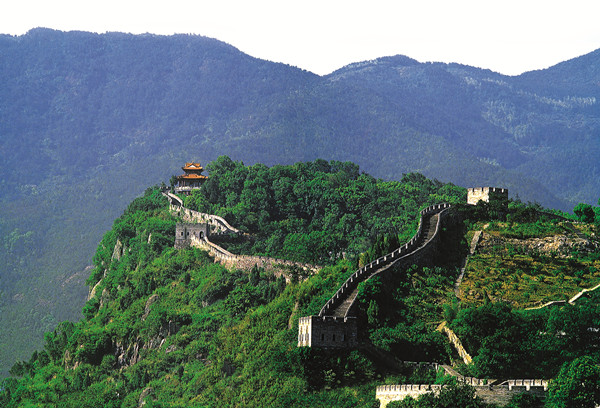
Linhai's Great Wall, built 1,600 years ago, is called the Jiangnan Great Wall because of its location in the southern part of the country.??[Photo by Shen Wenjin/For China Daily] |
Linhai's Great Wall once fended off Japanese pirates but today brings in outside incursions-of tourists, that is.
They besiege the bulwark not only to explore the fortification but also the well-preserved city it was built to protect. (The wall guarded not only against raiders but also floods.)
Yet the charm of the settlement in Zhejiang province is that it isn't overwhelmed with visitors. And it has conserved not only its ancient architecture but also its customs.
It's no coincidence the 1,600-year-old Jiangnan Great Wall, constructed on the Beigu Mountains along the Lingjiang River, looks like Beijing's.
Ming Dynasty (1368-1644) general Qi Jiguang heightened and thickened the Jiangnan Great Wall and conceived the idea of constructing two-story towers. He later did the same to Great Walls in northern China, such as Beijing's Badaling and Mutianyu, after he was sent there upon being promoted.
Jiangnan's fortification takes about two hours to climb. Trekkers are rewarded with panoramic views of downtown.
Ziyang Street's cobblestone streets wind past traditional homes decorated with stone carvings and gray tiles. Two stone wells in the center of the street are still used to provide daily water needs and fire protection. They're carved with "a thousand Buddhas" to remind users water is a divine gift.
The Zhang Xiujuan Papercut Art Museum is run by the Zhang family, who has passed the folk tradition through generations for more than six centuries.
The museum is near the Yongli Steel Scales Store, founded in 1861.
Yongli has survived the proliferation of electric scales, although business has declined, 61-year-old shopkeeper Cai Xuezhen says.
Some local fruit vendors still use the traditional tools.
"You can't operate electric scales outside if it rains. And the ancient kind never runs out of battery," she says.
Cai also sells small models as souvenirs.
She started studying scale-making at age 23. Her father insisted she inherit the skill. It's labor-intensive, low-profit work.
Cai's only child is unwilling to learn the trade, and she has no other apprentice.
Monks and elderly devotees at Linhai's Longxing Temple chant the Lotus Sutra, a pillar of Buddhism's Tiantai School. It became a platform for religious exchanges between China and Japan in the Tang Dynasty (AD 618-907).
From 743 to 754, Situo, a monk from the temple, followed his master, Jianzhen, to Japan six times to propagate Buddhism there. In 804, the Japanese monk Saicho studied Tiantai there for 140 days. When he returned to Japan, he founded the Tendai School based on the Chinese Tiantai tradition.
Guohua Abacus Museum is China's only museum dedicated to the antiquated calculators. The small establishment, founded in 1993, displays more than 1,300 abacuses and mathematical instruments from the country and overseas.
Displays range from abacuses set on a jade ruyi (an S-shaped ornament) to one affixed to a soldier's waistband. The smallest is a half-centimeter silver abacus, while the largest is over 6 meters and can be used by 15 people simultaneously.
The city is surrounded on three sides by mountains and on one side by the East China Sea. It has 227 kilometers of coastline.
Outside of town, the Linhai National Geopark hosts volcanic formations forged 65-95 million years ago.
Pentagonal and hexagonal lava columns shape the landscape like a beehive flanked by 13 patches of green wetlands in different sizes and shapes separated by the Taojing River.
They show Linhai's natural environment is as perfectly preserved as its cultural legacies.
If you go
It takes about two hours from Zhejiang's capital Hangzhou and three hours from Shanghai to Linhai by high-speed train. You can also fly to Taizhou Luqiao Airport or Ningbo Lishe International Airport, which are respectively 50 and 150 km from Linhai.
Related: