 |
|
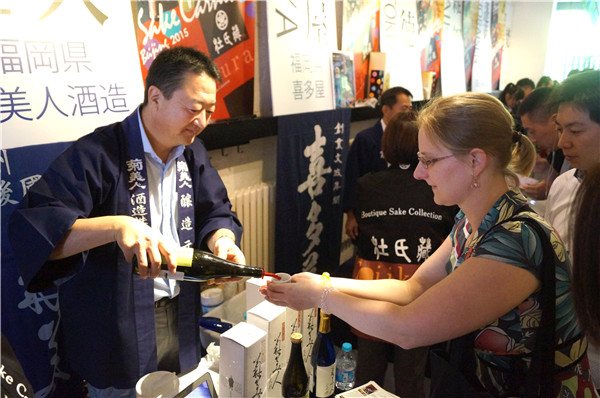
A sake tasting event in Beijing. [Photos Provided To China Daily] |
"Unfortunately, even some supposedly good Japanese restaurants in Beijing store good sakes at room temperature," Yamamoto says.
Normally sake can keep well for about three years after being bottled and put onto the market. Once it is opened, it is more forgiving than wine, and will be good for about a month if stored properly in a fridge. Most sake does not age well, and usually the fresher, the better, he says.
Sake lacks the alcoholic punch of other spirits, being half the strength of most whiskeys and vodkas. Many sake varieties have alcoholic content of 13-17 percent, slightly higher than that of white wine (usually 10-13 percent), the Japan Sake and Shochu Makers Association says.
One problem for novices choosing a bottle is to be acquainted with sake terminology, with labels often being in Japanese or translated into other languages. Yamamoto says that such people should at least know the Japanese word seimaibuai, meaning the rice milling or polishing rate.
The two primary ingredients of sake are rice and water. White rice kernels are milled or polished to remove the rough part of the outer layers in which fats and proteins are predominantly found, then washed and steamed to be molded, and then fermented with water.
The seimaibuai is the proportion of rice that remains after milling. For example, seimaibuai 60 percent means that 40 percent of the rice has been ground away, the lower the seimaibuai percentage, the finer the sake is.
Just as wine has different grape varieties, such as riesling, sauvignon blanc and chardonnay, sake falls into various categories, such as junmai, ginjo and daiginjo. The amount of rice-milling is a basic criterion for categorizing the drink.
For honjozo and junmai (meaning pure sake, no brewing alcohol), at least 30 percent of the rice kernel is polished away. In normal sake, seimaibuai is more than 70 percent.
Ginjo and junmai-ginjo are higher grades, at least 40 percent of the rice kernel being polished away. Daiginjo and junmai-daiginjo grades are higher still, using only the core of its white rice, milling to 50 percent or less of the original grain.
As with wines, too, there are certain dishes that are said to go particularly well with sake. Sake connoisseurs will say that it is the natural accompaniment to sushi and sashimi and in that regard is better than white wine. Sake is also said to go well with most seafood and many other cuisines, but usually not with curries and other spicy dishes.
On the question about whether to serve it warm or chilled, again, like wine, it depends on the sake you are drinking and the circumstances in which you are drinking it. Different grades of sake have different styles. Heated sake gives a warm alcoholic buzz, closer to the palate, and is a wonderful sip in cold weather.
High-grade sakes are served cold, to let out their nuanced and subtle aromas.
Ginjo and daiginjo have to be served cold, between 5 C and 10 C, Yamamoto says. Others can be served either warm or cold, between 30 C and 60 C.
In Japan there is special sake for special occasions. When families welcome in the new year on Jan 1 they sit together drinking sake, betokening good luck, he says.
"As with baijiu in China, drinking sake is a social ritual. Etiquette dictates that you pour for others and that they refill your cup."
There are health benefits in drinking sake, too, he says, such as preventing cirrhosis, and reducing the risk of cancer.
"For ladies there's another good thing: It keeps your skin moist and soft."
|
|
|
|
|
|
|
|

Copyright 1995 - . All rights reserved. The content (including but not limited to text, photo, multimedia information, etc) published in this site belongs to China Daily Information Co (CDIC). Without written authorization from CDIC, such content shall not be republished or used in any form. Note: Browsers with 1024*768 or higher resolution are suggested for this site.
License for publishing multimedia online 0108263 Registration Number: 20100000002731 






















 Raymond Zhou:
 Pauline D Loh:
 Hot Pot
 Eco China
 China Dream
 China Face