 |
|
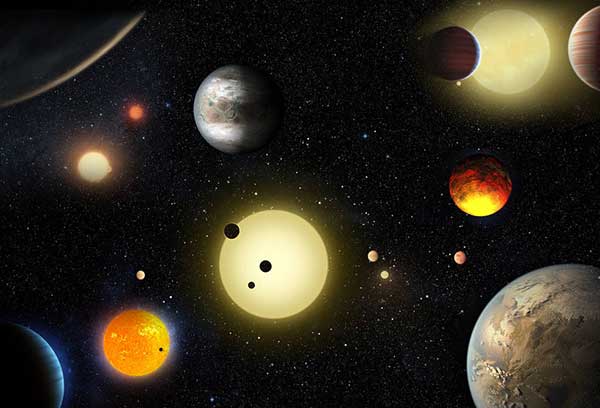
An artist's depiction of select planetary discoveries made by the Kepler mission. In May the mission announced that it had verified 1,284 new planets, the single largest finding of planets.[Photo by W. Stenzel/Nasa] |
Chinese scientists have their eyes and ears fixed on the heavens, waiting for a sign that may come soon - or a lot later
When the NASA spacecraft Juno arrived at Jupiter this week after a journey of nearly 3 billion kilometers, the scientists who had toiled in relative obscurity over many years to make it happen finally got the chance to fete their great success before the world.
But for space scientists like Mao Shunde, those kinds of public accolades may never come. Instead he must have the patience to devote his all to a task that may well prove fruitless in his own lifetime.
If Mao is pessimistic on that score he barely shows it, instead exuding a quiet confidence that the tools at his disposal are increasing his chances of realizing his dream - to find life elsewhere in the universe.
"We are lucky to be in a special era, with the next generation of giant telescopes on the way," says Mao, director of the Center for Astrophysics at Tsinghua University in Beijing. "There may be some exciting discoveries in the next 10 to 20 years."
Our galaxy has hundreds of billions of stars, many with solar-like planetary systems, and there are hundreds of billions of galaxies in the universe. So in the scientific world it is generally regarded as reasonable to infer that Earth-like planets may be common, and that the universe may teem with life.
"I think primitive life is likely to be abundant, but intelligent life may be rarer," says Mao, also director of the Galaxy and Cosmology Division of the National Astronomical Observatories of China at the Chinese Academy of Sciences.
The next generation of giant telescopes may help astronomers resolve some long-standing issues, such as analyzing the spectrum of distant planets, making it possible to detect biomarkers of life.
Biomarkers are certain elements that suggest the existence of life. An important biomarker, oxygen molecules, without supporting life, can only last for a short time compared with the 13.7 billion-year history of the universe. Oxygen easily reacts with other elements, and Mars appears red as a result of oxidation.
|
|
|
|
|
|
|
|

Copyright 1995 - . All rights reserved. The content (including but not limited to text, photo, multimedia information, etc) published in this site belongs to China Daily Information Co (CDIC). Without written authorization from CDIC, such content shall not be republished or used in any form. Note: Browsers with 1024*768 or higher resolution are suggested for this site.
License for publishing multimedia online 0108263 Registration Number: 20100000002731 


























 Raymond Zhou:
 Pauline D Loh:
 Hot Pot
 Eco China
 China Dream
 China Face