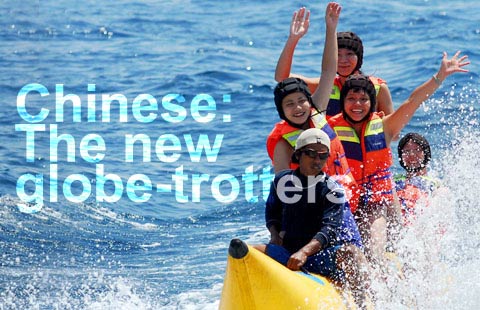
Christine Cayol founded the Paris-based firm Synthesis in 1994. Since 2003 she has lived in Beijing, where she created Yishu 8 - a Chinese incarnation of the Villa Medicis, where artists develop their talents. Her most recent book Pourquoi les Chinois ont-ils le Temps? (Why Do the Chinese Have Time?), she shows us how to turn the clock into an ally by drawing inspiration from the Chinese perception of time
With all you've got going on, how did you find the time to write a book about time?
Living in Beijing, it became apparent to me that most of the difficulties, obstacles and problems that we (non-Chinese) encounter with the Chinese came down to the relationship with time. Sometimes we find them too slow, while they feel that we go too fast - and sometimes it's the other way round. We can't seem to get the time right for one another!
I learned to play around with what I call the agility of Chinese time.
Is this agile approach specifically Chinese?
The Chinese have a rigorous, almost scientific, awareness of clock time. They also take liberties with time. I call this having a yin mode and a yang mode.
In China, time isn't slow or fast - it's slow and fast. Time isn't scientific or romantic - it's both. This perception of time is something I found and continue to find very rewarding.
Could that be related to the fact that the Chinese buy so many luxury watches nowadays?
Ever since the Jesuits came to China, the Chinese have been fascinated by the measurement of time. And it was in this way, with clocks, watches and the mechanics of time, that the Jesuits succeeded in winning over the imperial court. At the same time, the Chinese clearly sense the aesthetic aspect of time passing. It's about the enjoyment of the moment and the measurement of continuity.
What message are you trying to convey in your book and to whom is it addressed?
My message is for all those whose obsession with time has become a sickness - and I count myself among them. I'm not offering recipes or remedies with this book, but rather directions, notions and attitudes that will help us in our efforts to suffer less from this disease.
So there's a therapy for this?
Indeed there is. You have to know how to vary between different kinds of time. Meaning that if I'm a slave to one kind of time - speedy time - then I have to learn to slow down. If I'm someone who only feels comfortable going slow, I have to learn to accelerate. It's like eating a balanced diet - you have to balance different kinds of time. There's no such thing as time - what does exist is times, in the plural. So we have to be able to go from free time to constrained time, from a very demanding kind of time to time that's a bit mad, a bit improvisational. We have to know how to shift from fast to slow, and from sensibility to logic.
Is this easier to do in China?
It's much easier in China because the Chinese have this very natural ability to juggle these different kinds of time. They're capable of being very quick to react, of being in digital time - WeChat time - and they're also capable of sitting at the table for three hours and allowing time to flow when they're in friendship time, relationship time, sharing time. I call this the ability to play around with different kinds of time. In business, in the way things get done, the Chinese have very fast response times and at the same time, they have a real sense of patience.
Has this patience been some what forgotten in the West?
We're insanely impatient. I'm truly convinced that patient people are the ones who build things, who create things, who win in negotiations.
We should borrow this patience from Buddhism, Taoism and the Zen approach of the Chinese, because it's also an acceptance of the imponderability of time.
And finally, time undeniably comes to an end ...
Questioning our relationship with time means questioning our relationship with life - and thus with death. When I was writing this book, what seemed important to me was having a more peaceful relationship with time. To not chase after time with the idea that it's going to end, but on the contrary, to make the most of it with the idea that it's going to continue.
In the end, what counts is being totally present in what we are doing. This quality of presence means preparing ourselves to leave one kind of time to adopt a more spiritual kind of time. The question of time is the question of eternity. In fact, we have all the time in the world.
|
|
|
|
|
|
|
|

Copyright 1995 - . All rights reserved. The content (including but not limited to text, photo, multimedia information, etc) published in this site belongs to China Daily Information Co (CDIC). Without written authorization from CDIC, such content shall not be republished or used in any form. Note: Browsers with 1024*768 or higher resolution are suggested for this site.
License for publishing multimedia online 0108263 Registration Number: 20100000002731 





















 Raymond Zhou:
 Pauline D Loh:
 Hot Pot
 Eco China
 China Dream
 China Face