It's tempting to blame big food companies for America's big obesity problem.
After all, they're the folks who Supersized fries, family-portioned potato chips
and Big Gulped sodas. There's also the billions they've spent keeping their
products ever on people's minds and in their mouths.
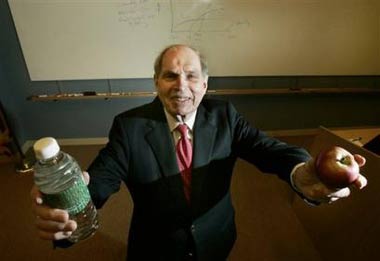
James Tillotson, a business and food policy
professor at Tufts' Friedman School of Nutrition, shows an apple and water
as examples of important nutrients Friday, Feb. 24, 2006, in his classroom
in Boston. Tillotson, who studies the food industry's role in causing and
resolving the obesity epidemic says that most efforts to assign blame fail
to account for how overwhelmingly complex an issue obesity is. [AP
Photo] |
Likened by some to the way tobacco companies seduced smokers, such practices
have made the food industry the target of lawsuits and legislation seeking to
yank junk food from schools and curb advertising to children.
But some experts say neither the problem nor the solution is nearly so
simple.
"You don't have the collusion or the cover-up you had in smoking," says James
Tillotson, a business and food policy professor at Tufts' Friedman School of
Nutrition. "We want to blame somebody, but the thing is, we're all a part of
it."
Sure, companies set the stage with cheap, calorie-dense foods.
But the US government also has propped up agribusiness, the medical community
was slow to take on obesity and good nutrition, and consumers seem determined to
move less and eat more, says Tillotson, a former food industry executive.
How much of that burden of blame belongs to the food industry can be
difficult to answer.
Personal responsibility
The food industry emerged at a time when malnutrition was the nation's chief
dietary concern. But at some point food became too plentiful, a change that
altered the culture of the American diet.
Yale obesity expert Dr. David Katz says that's because companies aggressively
peddle food to people who don't need it.
Food industry officials prefer to call it consumer choice.
"We don't think the food industry has done anything particularly wrong in
this regard," says Robert Earl of the Food Products Association, a lobbying
group that prefers to indict sedentary lifestyles and poor choices.
Companies have tried to help people make better choices, he says, offering
healthier products and more nutrition data. But people can't be forced to make
the right choice and consumer disinterest doomed many of those products.
He's right. Consumers bear much responsibility for their weight and the fact
that two-thirds of Americans are overweight or obese. It's not the industry's
fault that people don't get exercise, or that schools have cut physical
education, or that people prefer the taste of Twinkies (500 million sold a year)
to tofu (much less).
But critics call Earl's assessment disingenuous. Personal responsibility has
limits in the face of a multibillion-dollar marketing whirlwind pushing
countless high-calorie treats.
"They (food companies) are putting $36 billion into directing those choices,"
says Marion Nestle, a nutrition professor at New York University and critic of
the food industry. "And their methods are very effective."
Meanwhile, efforts to market the healthier products Earl spoke of
historically have been lackluster, acknowledges Brock Leach, an executive for
new products at PepsiCo Inc.
As for nutrition data, it isn't always helpful. And attempts to standardize
or clarify labeling still meet resistance.
Personal responsibility also falters when it comes to children, who are
bombarded by junk food ads that undermine parents.
Everything from child-friendly merchandizing of sugary cereals to cartoon ads
is designed to give companies more sway over what children eat, says Dr. Susan
Lynch, a child obesity doctor and wife of New Hampshire Gov. John Lynch.