If Arnold Schwarzenegger had migrated to Mexico instead of the United States,
he couldn't be a governor. If Argentina native Sergio Villanueva, firefighter
hero of the Sept. 11 attacks, had moved to Tecate instead of New York, he
wouldn't have been allowed on the force.
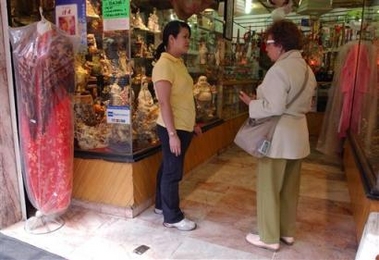
Lixa Zhu, left, who
moved to Mexico City seven months ago from Kaiping City, China, helps a
customer in the entrance of a shop in Mexico City's chinatown, Friday, May
19, 2006. Mexico is pushing Washington to implement a comprehensive
immigration reform but foreign born immigrants living in Mexico also face
limitations. [AP] |
Even as Mexico presses the United States to grant unrestricted citizenship to
millions of undocumented Mexican migrants, its officials at times calling U.S.
policies "xenophobic," Mexico places daunting limitations on anyone born outside
its territory.
In the United States, only two posts - the presidency and vice presidency are
reserved for the native born.
In Mexico, non-natives are banned from those and thousands of other jobs,
even if they are legal, naturalized citizens.
Foreign-born Mexicans can't hold seats in either house of the congress.
They're also banned from state legislatures, the Supreme Court and all
governorships. Many states ban foreign-born Mexicans from spots on town
councils. And Mexico's Constitution reserves almost all federal posts, and any
position in the military and merchant marine, for "native-born Mexicans."
Recently the Mexican government has gone even further. Since at least 2003,
it has encouraged cities to ban non-natives from such local jobs as
firefighters, police and judges.
Mexico's Interior Department, which recommended the bans as part of "model"
city statutes it distributed to local officials could cite no basis for
extending the bans to local posts.
After being contacted by The Associated Press about the issue, officials
changed the wording in two statutes to delete the "native-born" requirements,
although they said the modifications had nothing to do with AP's inquiries.
"These statutes have been under review for some time, and they have, or are
about to be, changed," said an Interior Department official, who was not
authorized to be quoted by name.
But because the "model" statues are fill-in-the-blanks guides for framing
local legislation, many cities across Mexico have already enacted such bans.
They have done so even though foreigners constitute a tiny percentage of the
population and pose little threat to Mexico's job market.
The foreign-born make up just 0.5 percent of Mexico's 105 million people,
compared with about 13 percent in the United States, which has a total
population of 299 million. Mexico grants citizenship to about 3,000 people a
year, compared to the U.S. average of almost a half million.
"There is a need for a little more openness, both at the policy level and in
business affairs," said David Kim, president of the Mexico-Korea Association,
which represents the estimated 20,000 South Koreans in Mexico, many of them
naturalized citizens.
"The immigration laws are very difficult ... and they put obstacles in the
way that make it more difficult to compete," Kim said, although most foreigners
don't come to Mexico seeking government posts.
J. Michael Waller, of the Center for Security Policy in Washington, was more
blunt. "If American policy-makers are looking for legal models on which to base
new laws restricting immigration and expelling foreign lawbreakers, they have a
handy guide: the Mexican constitution," he said in a recent article on
immigration.
Some Mexicans agree their country needs to change.
"This country needs to be more open," said Francisco Hidalgo, a 50-year-old
video producer. "In part to modernize itself, and in part because of the
contribution these (foreign-born) people could make."
Others express a more common view, a distrust of foreigners that academics
say is rooted in Mexico's history of foreign invasions and the loss of territory
in the 1847-48 Mexican-American War.
Speaking of the hundreds of thousands of Central Americans who enter Mexico
each year, chauffeur Arnulfo Hernandez, 57, said: "The ones who want to reach
the United States, we should send them up there. But the ones who want to stay
here, it's usually for bad reasons, because they want to steal or do drugs."
Some say progress is being made. Mexico's president no longer is required to
be at least a second-generation native-born. That law was changed in 1999 to
clear the way for candidates who have one foreign-born parent, like President
Vicente Fox, whose mother is from Spain.
But the pace of change is slow. The state of Baja California still requires
candidates for the state legislature to prove both their parents were native
born.
