JERUSALEM - Israeli Prime Minister Ehud Olmert endorsed an emerging Mideast
cease-fire deal late Friday, after a day of dramatic day brinksmanship including
a threat to expand the ground war in Lebanon.
The agreement calls for the deployment of 30,000 Lebanese and U.N. troops
along the Israel-Lebanon border. It falls short of some of Israel's demands,
including a strong mandate for the U.N. forces to take on Hezbollah guerrillas.
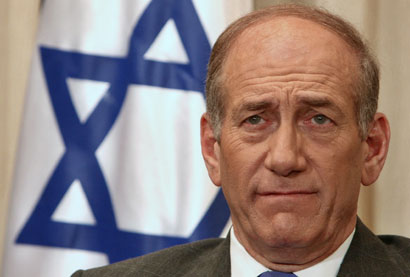
Israeli Prime Minister
Ehud Olmert attends a joint news conference with Israeli President Moshe
Katzav in Jerusalem in this August 8, 2006 photo.
[Reuters] |
However, the draft is the best chance yet for peace after more than four
weeks of war that has killed more than 800 people, destroyed Lebanon's
infrastructure and inflamed tensions across the Middle East.
Neither the Lebanese government nor Hezbollah has said publicly whether they
would sign on to the deal, but it was widely assumed that they did not object to
it. Plans to take the resolution to a vote were announced in New York shortly
after U.S. Mideast envoy, Assistant Secretary of State David Welch, met for a
second time Friday with Lebanese Prime Minister Fuad Saniora.
Israeli officials said Israel would not halt fighting until Israel's Cabinet
has approved the cease-fire deal in its weekly meeting Sunday. It was not
immediately clear whether the military would expand its ground offensive in the
time remaining, or would only hold existing positions.
Only six hours passed from an initial decision by Olmert to broaden the
ground offensive to his acceptance of the cease-fire deal. The zigzag reflected
Israel's dilemma after a month of inconclusive fighting.
Israel has been unable to defeat Hezbollah and was concerned about growing
Israeli casualties, as well as international condemnation, if the war continued.
However, Olmert also feared that accepting a deal that does not rein in the
guerrillas could lead to another war down the road and hurt him politically.
Olmert's initial order to send troops deeper into Hezbollah territory came
even as U.N. Security Council negotiations reached the final stretch in New
York.
Several hours later, France and the United States reached agreement on a
final draft, to be put to a vote later Friday. The draft would authorize the
deployment of 15,000 U.N. peacekeepers in south Lebanon, along with 15,000
Lebanese troops, into the region "as Israel withdraws."
The Security Council, repeatedly accused of taking too long to come up with a
response to fighting, would leave out several key demands from both Israel and
Lebanon in efforts to come up with a workable arrangement.
"You never get a deal like this with everybody getting everything that they
want," Britain's Foreign Secretary Margaret Beckett said. "The question is, has
everybody got enough for this to stick and for it to be enforceable? Nobody
wants to go back to where we were before this last episode started."
Despite Lebanese objections, Israel will be allowed to continue defensive
operations, and a dispute over the Chebaa Farms area along the
Syria-Lebanon-Israel border will be left for later. Israel won't get its wish
for an entirely new multinational force separate from the U.N. peacekeepers that
have been stationed in south Lebanon since 1978.
There is also no call for the release of Lebanese prisoners held by Israel or
a demand for the immediate withdrawal of Israeli troops. Although the draft
resolution emphasizes the need for the "unconditional release" of the two
Israeli soldiers whose July 12 capture by Hezbollah sparked the conflict, that
call is not included in the list of steps required for a lasting cease-fire.
The ongoing fighting has killed more than 800 people - including at least 732
Lebanese and 122 Israelis.
After nightfall, there were some signs of troop movement on the
Israel-Lebanon border. Battle-ready soldiers carrying heavy backpacks marched
near the border as tanks assembled nearby. In south Lebanon, there were no
reports of increased troop activity. Israeli officials gave conflicting
assessments on whether a wider campaign was under way.
More than 10,000 Israeli troops are already fighting Hezbollah guerrillas in
south Lebanon. In the new phase, Israeli forces would push toward Lebanon's
Litani River, some 18 miles from the Israel-Lebanon border, attempting to
capture more than twice as much territory as they hold now.
Olmert has faced growing criticism at home for the army's inability to halt
the rocket barrages; Hezbollah has fired more than 3,500 rockets in the
monthlong war. Polls also indicated that his initially approval rating, high at
the start of the war, was slipping.
Commentators have suggested Olmert's political career was at stake, and that
he might even be forced to step down. Many Israelis believe defeating Hezbollah
is essential for their country's long-term security.
In Lebanon, Israeli airstrikes pounded south Beirut and border crossings to
Syria, killing at least 15 people as ground fighting picked up intensity in the
south of the country.
In the Bekaa Valley, an Israeli drone fired missiles into a convoy of
refugees fleeing attacks in the southern town of Marjayoun, killing at least six
people and wounding 16 others, an Associated Press photographer said.
The Israeli military said it had no knowledge of the incident. The army noted
that it had imposed a travel ban on south Lebanon, and had received no request
to coordinate a convoy in that area.
Throughout the day, civilians had been fleeing fighting in the Christian town
of Marjayoun in long convoys after Israeli forces entered earlier this week.
Lutfallah Daher, the photographer, was with the convoy when it was hit near
the town of Chtaura, about 30 miles north of the Litani River. Israel had warned
it would attack any vehicle on roads south of the Litani, assuming it was
carrying Hezbollah weapons or fighters.
Daher said the convoy consisted of more than 600 civilian vehicles and others
carrying a detachment of 350 Lebanese soldiers and police when it left the area
around Marjayoun. He said very few of the vehicles had left the convoy when it
was hit.
