Memoir of comfort woman tells of 'hell for women'
(AP)Updated: 2007-07-06 10:52 TATEYAMA, Japan - Sister Michiko Amaha leads the way down into the basement of a little hilltop chapel overlooking the grounds of a shelter for women who, for one reason or another, can't live on their own.
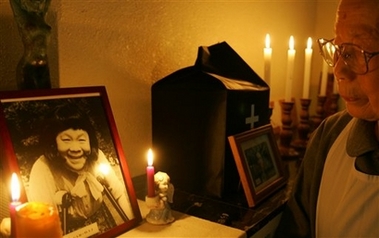 Sister Michiko Amaha looks at a photograph of a woman who is known by her pen name Suzuko Shirota at the basement of a little chapel in Tateyama, east of Tokyo, May 24, 2007. [AP]  |
The woman in the photo is smiling a bright smile, with bangs hanging down over her forehead like a little girl.
Her name - or the name she is known by - was Suzuko Shirota.
Sold by her father into prostitution at age 17, she followed Japan's troops around the Pacific during World War II. After Japan's surrender, she returned and US troops became her clientele. She became a drug addict, was destitute and institutionalized for decades.
Though historians believe there were perhaps tens of thousands more Japanese like her, Shirota is the only Japanese "comfort woman" to have come forward and tell her story.
Now, Japan's government is subtly trying to revise that story.
Sixty-two years after Japan's surrender in 1945 brought an end to the official sanction of thousands of frontline brothels - a tragedy that has been called one of the largest cases of human trafficking in the 20th century - Prime Minister Shinzo Abe has questioned a key element of an apology Tokyo offered the women in 1993.
Abe and many Japanese conservatives claim that, "in the narrow sense," the women weren't coerced.
No one, for example, held a gun to Shirota's head.
But, then again, no one needed to.
Shirota lived a relatively quiet life until she was 14 and her mother died, in 1935. Her family bakery went bankrupt, and her father began gambling. To pay off his debts, he sold her to a brothel.
Prostitution was legal back then in Japan, and Shirota's was a common fate. With no other choice, she accepted it with resignation.
At first, Shirota worked as an assistant, helping the older women with their clothes and makeup. But gradually, she was brought into the reality of the brothel. When she was 18, she was ordered to serve her first customer. Locked in a room, she was raped. She was bedridden for days, and underwent treatment for syphilis.
Her father continued to gamble, and took out loans from the brothel.
A broker in Yokohama sold her to another brothel in Taiwan. By then, Japan was well down its path toward all-out war in Asia. Taiwan and Korea were colonies, and the Japanese empire was spreading rapidly throughout the region.
So was forced prostitution. Japan established its first "comfort stations" in China in 1932 to serve as a steam valve for the troops, preventing rapes that would generate local resentment and resistance, and to slow the spread of venereal diseases through medical supervision of the brothels.
The women - she recalls taking a boat to Taiwan with Koreans, Okinawan and other Japanese - were closely controlled.
In Taiwan, Shirota was kept under lock and key. Though privately run, her brothel served Japan's military and the government was closely involved in keeping the women from escaping. Papers were required to leave her brothel, and police kept tabs on her movement.
"I became, in name and reality, a slave," she wrote in her little-known memoir, "In Praise of Mary." "On Saturdays and Sundays, there would be a line and men would compete to get in. It was a meat market, with no feeling or emotion. Each woman would have to take 10 or 15 men."
Shirota managed to con a customer into paying off her debt by promising to marry him. She returned to Japan, but found that her family had scattered. With nowhere to turn, she borrowed enough money to go to the Pacific island of Saipan, where a large number of Japanese troops were stationed. From there, she island-hopped to Truk and Palau, where she eventually found work keeping the books for a comfort station.
Narrowly escaping death when the island was bombed and liberated in 1945, she was repatriated to Japan, but, again, had few alternatives. She bounced around from city to city, developing an addiction to methamphetamines. She found her way to the port city of Hakata, and took up work at a brothel frequented by US troops.
Here, too, there was no dearth of work.
"It was like a war," she wrote of the crowds jostling for the women's services. "It was a whole new world for me."
She began living with an American soldier and started to have hopes of a future. But he left her behind.
She tried to kill herself as her life became more desperate. During a visit to her mother's grave, she learned that her sister had committed suicide.
Then she saw an article in a magazine about a shelter for women like herself. It was 1955, the year before prostitution was formally banned.
Using a pen name, Shirota broke her silence in 1971 with her memoir, which was published by the same Christian group that helps run the shelter in this town east of Tokyo where she would spend more than two decades until her death. It is long out of print; even the publisher no longer has any copies.
A rare copy of the book, which has never been translated, was reviewed by The Associated Press at Japan's National Diet Library.
Just before Shirota died in 1993, the "comfort women" tragedy became an international issue.
Historians say up to 200,000 Asian women were forced to service millions of
Japanese troops.
| 1 | 2 |  |
|
|
|
||
|
||
|
|