WORLD> America

|
WORLD> America
|
|
Autopsies suggest Air France jet broke up in sky
(Agencies)
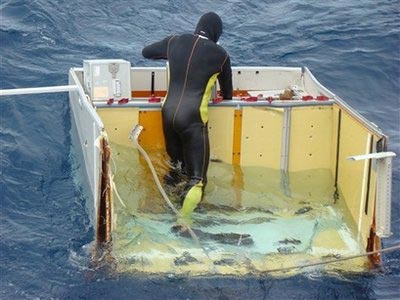
Updated: 2009-06-18 08:22 SAO PAULO – Autopsies have revealed fractures in the legs, hips and arms of Air France disaster victims, injuries that — along with the large pieces of wreckage pulled from the Atlantic — strongly suggest the plane broke up in the air, experts said Wednesday.
French investigators are beginning to form "an image that is progressively less fuzzy," Paul-Louis Arslanian, who runs the French air accident investigation agency BEA, told a news conference outside Paris. "We are in a situation that is a bit more favorable than the first days," Arslanian said. "We can say there is a little less uncertainty, so there is a little more optimism. ... (but) it is premature for the time being to say what happened." A spokesman for Brazilian medical examiners told The Associated Press on Wednesday that fractures were found in autopsies on an undisclosed number of the 50 bodies recovered so far. The official spoke on condition he not be named due to department rules. "Typically, if you see intact bodies and multiple fractures — arm, leg, hip fractures — it's a good indicator of a midflight break up," said Frank Ciacco, a former forensic expert at the U.S. National Transportation Safety Board. "Especially if you're seeing large pieces of aircraft as well."
That lack of clothing could be significant, said Jack Casey, an aviation safety consultant in Washington, D.C., who is a former accident investigator. "In an in-air break up like we are supposing here, the clothes are just torn away." Casey also said multiple fractures are consistent with a midair breakup of the plane, which was cruising at about 34,500 feet (10,500 meters) when it went down. "Getting ejected into that kind of windstream is like hitting a brick wall — even if they stay in their seats, it is a crushing effect," Casey said. "Most of them were long dead before they hit the water would be my guess." When a jet crashes into water mostly intact — such as the Egypt Air plane that hit the Atlantic Ocean after taking off from New York in 1999 — debris and bodies are generally broken into small pieces, Ciacco said. "When you've had impact in the water, there is a lot more fragmentation of the bodies. They hit the water with a higher force." Lack of burn evidence would not necessarily rule out an explosion, said John Goglia, a former member of the U.S. National Transportation Safety Board. If something caused the lower fuselage to burn or explode, "passengers would not be exposed to any blast damage" and the plane would still disintegrate in flight," Goglia said. "These are scenarios that cannot be ruled out." Searchers from Brazil, France, the United States and other countries are methodically scanning the surface and depths of the Atlantic for signs of the Airbus A330 that crashed May 31 after running into thunderstorms en route from Rio de Janeiro to Paris. All 228 people aboard were killed. Brazilian Air Force Col. Henry Munhoz said in a news conference Wednesday that several body parts, as well as pieces of the plane and luggage were found in the search area by the French amphibian ship, Mistral. Munhoz did not provide further details, and Brazilian Capt. Giucemar Tabosa Cardoso said "a significant" number of body parts had been retrieved from the ocean. Still missing are the plane's flight data and voice recorders, thought to be deep under water. French-chartered ships are trolling a search area with a radius of 50 miles (80 kilometers), pulling U.S. Navy underwater listening devices attached to 19,700 feet (6,000 meters) of cable. The black boxes send out an electronic tapping sound that can be heard up to 1.25 miles (2 kilometers) away, but these locator beacons will begin to fade after just two more weeks. U.S. Air Force Col. Willie Berges, commander of the American military forces supporting the search, said the black boxes emit beacons at a unique frequency, virtually guaranteeing that any signal detected would be from the pingers. "The question becomes if the black box is with the pinger, because they can get separated," Berges said. "If a signal is located, the French would then send down a robotic vehicle that is in the area to look at it, confirm that it is the black box and bring it up." Without the black boxes to help explain what went wrong, the investigation has focused on a flurry of automated messages sent by the plane minutes before it lost contact; one suggests external speed sensors had iced over, destabilizing the plane's control systems. Arslanian said most of the messages appear to be "linked to this loss of validity of speed information." He said when the speed information became "incoherent" it affected other systems on the plane that relied on that speed data. But he stressed that not all the automated messages were related to the speed sensors. The automated messages were not alarm calls and no distress call was picked up from the plane, he said. Air France has replaced the sensors, called Pitot tubes, on all its A330 and A340 aircraft, under pressure from pilots who feared a link to the accident. Arslanian said a French doctor from the BEA was not allowed to participate in autopsies done so far on some Flight 447 bodies by Brazilian authorities, and those autopsy results have not been released to the BEA. He said he was "not happy" with this situation. However, he added that French judicial authorities, who are conducting a parallel criminal probe, were present at the autopsies. Brazil's Federal Police and state medical authorities in Recife who are overseeing the autopsies said in a statement that two French investigators, a dental expert and a doctor, had been following the examinations as observers since June 10. The French are leading the crash investigation, while the Brazilians are leading the rescue operation. |