WORLD> America

|
WORLD> America
|
|
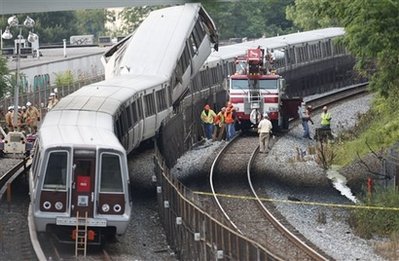
Computer failure may have caused D.C. train crash
(Agencies)
Updated: 2009-06-24 14:49 WASHINGTON: Investigators looking into the deadly crash of two Metro transit trains focused Tuesday on why a computerized system failed to halt an oncoming train, even though there is evidence that the operator tried to slow it down.
At the time of the crash, the train was also operating in automatic mode, meaning it was controlled primarily by computer. In that mode, the operator's main job is to open and close the doors and respond to emergencies.
Hersman said it wasn't clear when the button was pressed or how it got that way. She also said there was evidence of braking on the train's rotors, indicating it was likely that the operator tried to slow down. The train plowed into a stopped train ahead of it at the height of the Monday evening rush hour, killing nine people and injuring more than 70 in the deadliest accident in the 30-year history of the Metro. Crews spent Tuesday pulling apart the wreckage and searching for bodies. Authorities also worked to determine why the train's safeguards apparently did not kick in. "That train was never supposed to get closer than 1,200 feet, period," said Jackie Jeter, president of a union that represents Metro workers. All Metro trains were running on manual control Tuesday as a precaution against computer malfunction. The cars in the moving train were some of the oldest in the transit network, dating to the founding of the system. Federal officials had sought to phase out the aging fleet because of safety concerns, but the transit system kept the old trains running, saying it lacked money for new cars. Hersman said that the NTSB had warned in 2006 that the old fleet should be replaced or retrofitted to make it better able to survive a crash. Neither was done, she said, which the NTSB considered "unacceptable." Metro General Manager John Catoe said the agency expected to receive proposals "over the next month or so" to replace the old cars, but new trains were still years away from being installed. He insisted the existing cars were safe. This isn't the first time that Metro's automated system has been questioned. In June 2005, Metro had a close call because of signal troubles in a tunnel under the Potomac River. A conductor noticed he was getting too close to the train ahead of him even though the system indicated the track was clear. He hit the emergency brake in time, as did the operator of a train behind him. Shortly afterward, Metro attributed the problem to a defective communications cable. The signal relays that control trains were replaced after a serious safety warning in May 2000 by the Federal Railroad Administration. The warning came after failed relays were detected on the system, formally known as the Washington Metropolitan Area Transit Authority. The operator of the train that barreled into the stopped cars Monday was identified as Jeanice McMillan, 42, of Springfield, Va., according to Metro officials. McMillan was hired in January 2007 as a bus driver and was tapped to become a train operator in January 2009, the NTSB said. McMillan completed training and began working as an operator in March. Metro officials say employees start out as bus drivers before moving to trains. Investigators want McMillan's cell phone and texting records to determine whether she was distracted before the crash, Hersman said. Safety officials also are investigating a passenger's statement that the train had stopped briefly then started again before the crash. Iyesha Thomas, a Metro employee who worked with McMillan, said McMillan would often work the late shift. She did not have a car and if she was unable to get a ride home, she would sleep at Metro's offices, take the first train to Franconia, Va., and return to work later that day. A neighbor, Aicha Mezlini, said McMillan was killed driving the first train on her 4 p.m.-to-11 p.m. shift. She said McMillan normally worked Tuesday and Wednesday, but last week Metro changed her shift to Monday. "There is no evidence whatsoever that this driver has done anything to cause this accident," Catoe said Tuesday. The crash occurred on the red line near the D.C. and Maryland border, in an area where higher train speeds are common because there is a longer distance between stops. Trains can go 55 to 59 mph, though it was not clear how fast the train that crashed was traveling. Meanwhile on Tuesday, emergency crews cut away the top of the train that jackknifed on top of a stopped train. They removed the debris with help from a crane brought in overnight. "The scene that I witnessed was one that no one should have to see," Catoe said. "It was unbelievable destruction." Later, his voice choked with emotion as he addressed hundreds of employees at a prayer vigil Tuesday. He told them the agency will find out what caused the accident and develop a solution. "We cannot afford to lose any more of our own, or any more of our customers," Catoe said. "I need your prayers. This agency needs your prayers." |
||||||