Global General
Birth pangs of new nation
By Zhang Haizhou (China Daily)
Updated: 2011-04-26 07:07
 |
Large Medium Small |
 |
|
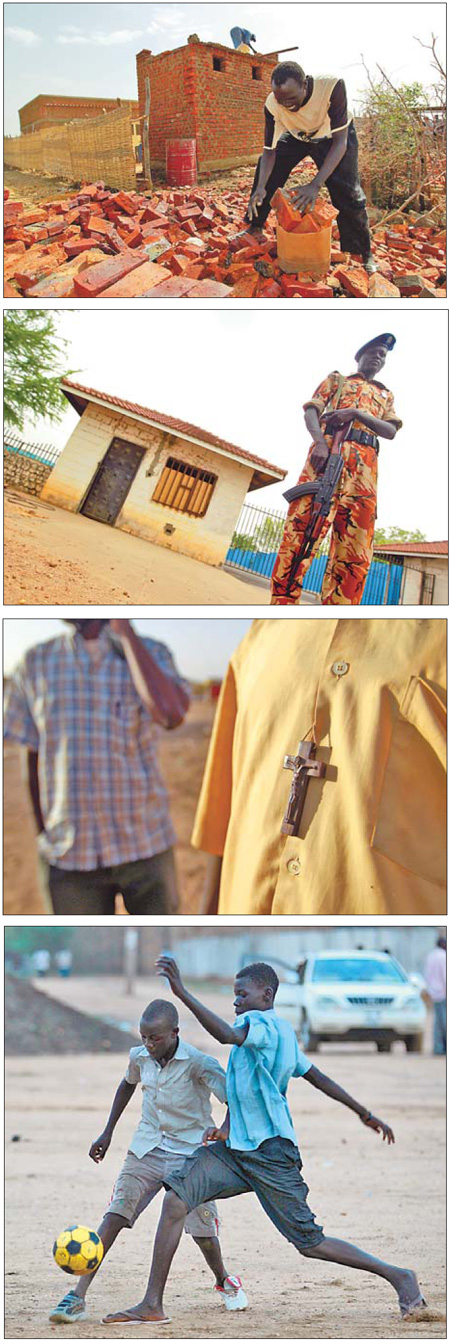
From top to bottom: A man builds a home in Abyei, a disputed area between south and north Sudan, on March 23; A security guard on duty near the parliament building in Juba, southern Sudan, on March 27; Jerome Ganago, from southern Sudan, wears a crucifix while chatting with his friends in Khartoum on March 28; Two teenagers play soccer in Juba on March 21. [Photo/China Daily] |
While Fursha was chatting about his family life and his views on the new country in a residential area of Gonya in northern Juba on a late March afternoon, his wife was crouching meters away, preparing dinner on a stone hearth.
Their dinner was just a pot of stewed green beans with some pitta bread, a typical main course for southern Sudanese.
Fursha said his monthly pension could only manage to cover the family's total expenses for a week.
The lucky thing for the Fursha family is that Bakheit's father-in-law has a small farm in suburban Juba, from where they can get some vegetables.
For those who don't have access to a farm, life can be hard even though they may have a better-paid job.
Another resident of Gonya, Alice Keje, 54, can earn up to $105 a month as a civil servant.
But her life is no easier than that of the Fursha family as she has seven children to feed, including a 15-year-daughter who already has twin boys.
Keje said her big family normally has one meal a day, and she does some part-time jobs to earn extra money.
"We are hungry," Keje responded, when asked what her biggest challenge is.
Relieving hunger is definitely on the agenda of south Sudan's leading party, the Sudan People's Liberation Movement (SPLM).
The party, at a five-day Economic Reform Workshop in mid-March, urged the people of southern Sudan to change their attitudes toward certain jobs, adding that it's time to focus on agriculture.
The agricultural sector is the cornerstone of the SPLM's three strategic policies of poverty eradication, sustainable economic growth and integration into the regional and global economies, according to a south Sudan document.
Lacking domestic infrastructure, south Sudan depends mainly on food imported from neighboring countries.
"We have enormous resources, and agricultural resources that need to be revived," said south Sudan Information Minister Barnaba Marial Benjamin, the government's spokesman.
"There is fertile land, which requires a lot of organic farming. There's tea, coffee, tobacco and rice."
Hunger is not the only challenge facing south Sudan, with little infrastructure left undamaged by the war, no government supply of water and electricity, and insufficient healthcare and schooling.
Developing agriculture is not only a big task for the government of south Sudan, it's an important starting point for this war-devastated economy.
Developing agriculture is not just about alleviating hunger, but "how to diversify its economy after oil", said Daniel Large, a Sudan expert at the School of Oriental and African Studies in London.
"Oil will not last forever," Large said. "Agriculture is the main sector right now, and will be important in the future."
Oil currently accounts for 98 percent of south Sudan's total revenue. Benjamin also sees the necessity to diversify the economy once independence is proclaimed in July.
Apart from agriculture, Benjamin said south Sudan urgently needs better infrastructure.
"Building infrastructure here is a challenge. Renovation of buildings, obtaining tables and chairs, setting up a government and civil service, all of this. We have great challenges," he said, adding that the region needs to build roads to connect its towns.
The only tarmac road in south Sudan is a 68-km stretch around Juba and, apart from there, it's hard to find another airport with a tarmac runway.
In Juba, even the biggest hotel is a prefabricated structure, while the tallest building in south Sudan is a six-story hotel.
Despite the major economic challenges facing south Sudan, Benjamin is optimistic about the future, saying that it is a "rich territory".
When Sudan splits, about 80 percent of its oil, according to Benjamin, will be in the south. Apart from agriculture, he said the land has "enormous" water resources as the Nile flows through it.
"We have got a great deal of wildlife. We have to build tourism," Benjamin said.
He added that south Sudan is a "virgin land", adding that the government welcomes international investment and the future country's economic policy will be "liberal".
| 分享按鈕 |