Tale of two immigrant cities
Updated: 2013-01-25 11:57
By Todd Balazovic(China Daily)
|
|||||||||||


|
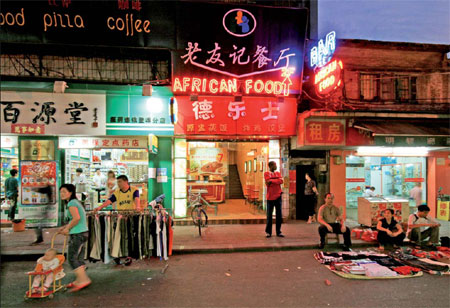
An African restaurant in a Guangzhou community. Jorgen Carling / for China Daily |
A sociologist digs deep to find migration patterns in Cape Verde and china
While working as a scholar in Cape Verde more than a decade ago, Heidi Haugen, a sociologist, began noticing a strange increase in the number of Chinese business owners cropping up around the country.
It was 2001, just six years after the first Chinese shops or lojas Chines, as the locals call them, started making an appearance in West Africa.
Curiosity piqued, the 36-year-old Norwegian went to read more but found nothing - despite a large population of Chinese workers living in Cape Verde, there was very little documentation about the community.
"All of sudden we noticed there were lots of Chinese migrants there who had opened shops for consumer goods," she says, speaking from her office at the University of Oslo, where she has just completed a PhD in sociology and human geography.

"As with many other people in African countries, we thought, 'Maybe these are people who are sent by the Chinese government to expand Chinese markets'."
Her initial impression turned out to be wrong. But it was the first of many questions she would begin asking.
Chasing the answer, Haugen, who was working as a teaching assistant at the University of Oslo, began, with her husband, a researcher at the International Peace Research Institute, conducting short field interviews with Cape Verde's Chinese residents.
"Of course, it turns out that they were not sent by the Chinese government and that they arrived in Cape Verde in much the same way that Chinese migrants had arrived in Eastern Europe at that time."
In addition to not being sent by the government, she found the roots of many were in China's Fujian and Zhejiang provinces and that they had come of their own accord.
"It had grown so fast," she says, attributing the reason for such rapid expansion to chain migration, meaning family members inviting other family members until a large community had formed.
It is much the same driving factor that led to well-known ethnic enclaves in the US such as Chinatown in San Francisco or Little Italy in New York.
"The business model is what had compelled people to invite more people over who then invited even more people over."
Haugen and her husband went on to publish their findings in On the Edge of the Chinese Diaspora: The Surge of Baihuo Business in an African City, one of the earliest and most cited research works on the cross-cultural migration patterns between China and Africa.
It was the start of a decade-long quest to understand one of China's most important business relationships of modern times.
"A couple of years later there was a lot of interest in Sino-African relations," Haugen says.
With trade figures between the two booming, the sudden interest is no surprise.
In 2001, when Haugen first began studying the fledgling trade relationship, trade levels between China and Africa hovered around $6 billion a year.
The number of Chinese living and working in African nations during the time was in the tens of thousands.
Last year trade hit an estimated $200 billion, and the number of Chinese workers living in Africa is close to 1 million.





Hot Topics
Scholars from Beijing and Moscow called for emerging economies to make their voice heard more at the G20 summit, as they exchanged views in a telephone conversation.
Editor's Picks

|

|

|

|

|

|

