Comments
  Print
Print  Mail
Mail  Large Medium Small

China is actively mapping out its "financial diplomacy", underlined by its recent initiatives to launch regional and global development banks, to cast off the drawbacks of the traditional international financial order and to safeguard the stable growth of emerging markets, observers said.
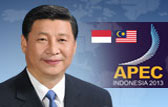
In early October, during his trip to Southeast Asia, President Xi Jinping proposed setting up an Asian infrastructure investment bank to help facilitate regional connectivity. The bank would provide financial support for infrastructure construction in regional developing economies, especially member states of the Association of Southeast Asian Nations.
"The bank will collaborate with the existing multilateral development banks within and outside the region, complementing each other and ensuring sustained stability of development of the Asian economy," Xi said.
Earlier this year, China made progress by persuading member states to create development banks within the framework of the Shanghai Cooperation Organization and BRICS.
Observers said China will be one of the major funding parties, considering its colossal economic volume, robust capital base and, most importantly, its proactive behavior.
"Beijing's initiative is especially eye-catching, as Asian developing economies are severely challenged by economic downturns and financial turbulence," said Jin Canrong, a professor of international affairs at Renmin University of China.
"The pledge, among others, has shown China's efforts to drive the whole region's development and integration with its own 'engine'," he said.
Infrastructure construction has also served as a fundamental guarantee of regional interconnection and economic integration. Although it contains the world's fastest -growing economies, Asia's present infrastructure conditions relatively lag behind.
The Asian Development Bank estimated $8 trillion of infrastructure investment is needed for Asian economies by 2020, and another $300 billion on interregional infrastructure construction.
Johannes Linn, nonresident senior fellow of Global Economy and Development at the Brookings Institution, said China is looking increasingly toward multilateral institutions to channel its financial support regionally and globally, as its economic and financial clout has increased dramatically over the last decade.
"Multilateral development banks offer technical and financial strength in their lending practices and the potential for China to leverage its own resources with those of other partners, while lowering the potentially negative perception in recipient countries of heavy direct Chinese engagement," Linn said.
Beijing's global financial reach has increased since the global financial crisis struck.
Launched in March 2010, the Chiang Mai Initiative — a multilateral currency swap arrangement among China, the Republic of Korea, Japan and ASEAN states, drawn from a foreign exchange reserves pool worth $120 billion, of which China (including Hong Kong) contributed $38.4 billion — included Japan for the first time.
The initiative aims to build a regional financial safety net to curb contagion during a crisis and manage risks. In 2012, along with the expansion of the pool to $240 billion, China doubled its input amount.
Experts said these regional cooperation models complement the existing multilateral financial institutions such as the World Bank and the International Monetary Fund, making up for their structural defects and subjective policymaking.
Linn, who was also former World Bank vice-president for Europe and Central Asia, said China's voice and vote in those institutions has not grown in line with its current economic and financial power.
"The World Bank, along with the IMF, remains dominated by Europe and the US, while Japan continues to play the lead role in the Asian Development Bank," Linn said.
John Paulson, head of the European Institute of the London School of Economics and Political Science, said more competition should be introduced to the World Bank and the IMF, as they nearly monopolize global financial activities.
"China is now economically and politically strong, so it's quite natural (for China) to engage in financial diplomacy, which countries like the US have been doing for many decades. It's very good for China, also good for the world economy," he said.
China also proposed to launch a development bank within the framework of the Shanghai Cooperation Organization in 2010, to explore new ways of joint funding and common benefits among the member states of China, Kazakhstan, Kyrgyzstan, Russia, Tajikistan and Uzbekistan. China will sponsor $8 billion of the initial $10 billion start-up capital.
In September, during the SCO Bishkek summit in Kyrgyzstan, China urged the organization to expedite studies on setting up the development bank to resolve financing difficulties and address international financial risks.
Linn said China's interest in the SCO Bank appears to be driven mainly by its regional agenda in Central Asia and its perception that there is a lack of effective regional financing instruments.
BRICS, which includes China, Russia, India, Brazil and South Africa, agreed to set up a development bank with an initial size of $50 billion and a contingent reserve arrangement of $100 billion during March's summit in Durban, South Africa. China is expected to contribute $10 billion to the BRICS Bank and $41 billion to the reserve arrangement.
The bank would be effective in funding infrastructure development and the reserve arrangement would help BRICS countries forestall short-term liquidity pressures and further strengthen financial stability.
China also joined the Inter-American Development Bank in 2009 and established several funds, including the China Co-financing Fund for Latin America and the Caribbean.
In another development, by early October, China's central bank, the People's Bank of China, had signed bilateral currency swap agreements of $407 billion with 23 countries and regions, to minimize exchange risk and boost investment.
In early October, China signed a 350 billion yuan ($57.4 billion) currency swap agreement with the European Union, marking the latest step in the renminbi's internationalization.
"China's financial diplomacy mainly focuses on neighboring economies, emerging markets and developing countries, to guard against financial risks and spur economic growth," Jin said.
"One can perceive the principle of inclusive development and the consciousness of 'a common destiny' from China's financial diplomacy," he added.
Fu Jing in Brussels and Xinhua contributed to this story.

 200th anniversary of the Battle of the Nations
 30 people killed in Syrian suicide blast
 Train carrying oil, gas derails in Canada
 Indian PM starts visit to Russia
 Eating champion gobbles 48 boxes of poutine
 London mayor visits Hong Kong
 Kennedy's rocking chair up for auction
 'Bionic man' makes debut at museum in Washington

Copyright 1995 - . All rights reserved. The content (including but not limited to text, photo, multimedia information, etc) published in this site belongs to China Daily Information Co (CDIC). Without written authorization from CDIC, such content shall not be republished or used in any form. Note: Browsers with 1024*768 or higher resolution are suggested for this site.
License for publishing multimedia online 0108263 Registration Number: 20100000002731