 |
|
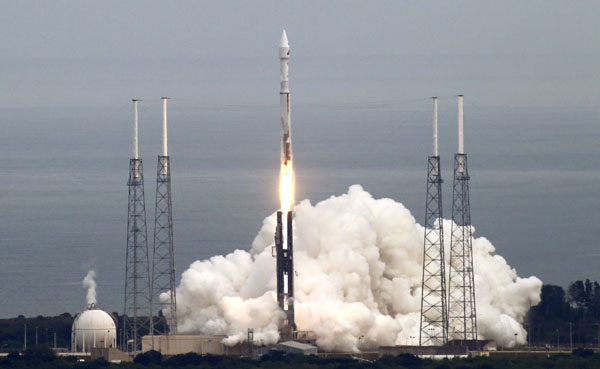
An Atlas 5 United Launch Alliance rocket lifts off from the Cape Canaveral Air Force Station carrying NASA's Mars Atmosphere and Volatile Evolution (MAVEN) spacecraft in Cape Canaveral, Florida November 18, 2013. The unmanned Atlas 5 rocket blasted off from Cape Canaveral Air Force Station in Florida on Monday, sending a Mars orbiter on its way to study how the planet most like Earth in the solar system lost its water. [Photo/Agencies] |
CAPE CANAVERAL, Florida - NASA's newest robotic explorer, Maven, rocketed toward Mars on Monday on a quest to unravel the ancient mystery of the red planet's radical climate change.
The Maven spacecraft is due at Mars next fall following a journey of more than 440 million miles (700 million kilometers).
Scientists want to know why Mars went from being warm and wet during its first billion year to cold and dry today. The early Martian atmosphere was thick enough to hold water and possibly support microbial life. But much of that atmosphere may have been lost to space, eroded by the sun.
"We want to know: What happened?" said Michael Meyer, NASA's lead Mars scientist.
To help solve this environmental puzzle, Maven will spend an entire Earth year measuring atmospheric gases once it reaches Mars on September 22, 2014.
This is NASA's 21st mission to Mars since the 1960s. But it's the first one devoted to studying the Martian upper atmosphere.
The mission costs $671 million.
Maven, short for Mars Atmosphere and Volatile Evolution, with a capital "N" in EvolutioN, bears eight science instruments. The spacecraft, at 5,410 pounds (2,450 kilograms), weighs as much as an SUV. From solar wingtip to wingtip, it stretches 37.5 feet (11.4 meters), about the length of a school bus.
A question underlying all of NASA's Mars missions to date is whether life could have started on what now seems to be a barren world.
"We don't have that answer yet, and that's all part of our quest for trying to answer, 'Are we alone in the universe?' in a much broader sense," said John Grunsfeld, NASA's science mission director.
Unlike the 2011-launched Curiosity rover, Maven will conduct its experiments from orbit around Mars.
Maven will dip as low as 78 miles (125 kilometers) above the Martian surface, sampling the atmosphere. The lopsided orbit will stretch as high as 3,864 miles (6,218 kilometers).
Curiosity's odometer reads 2.6 miles (4.2 kilometers) after more than a year of roving the red planet. An astronaut could accomplish that distance in about a day on the Martian surface, Grunsfeld noted.
Grunsfeld, a former astronaut, said considerable technology is needed, however, before humans can fly to Mars in the 2030s, NASA's ultimate objective.
Mars remains an intimidating target even for robotic craft, more than 50 years after the world's first shot at the red planet.
Fourteen of NASA's previous 20 missions to Mars have succeeded, beginning with the 1964-launched Mariner 4, a Martian flyby. The US hasn't logged a Mars failure, in fact, since the late 1990s.
That's a US success rate of 70 percent. No other country comes close. Russia has a poor track record involving Mars, despite repeated attempts dating back all the way to 1960.
India became the newest entry to the Martian market two weeks ago with its first-ever launch to Mars.
An estimated 10,000 NASA guests descended on Cape Canaveral for the afternoon liftoff of the unmanned Atlas V rocket carrying Maven, including a couple thousand from the University of Colorado at Boulder, which is leading the effort.
"We're just excited right now," said the university's Bruce Jakosky, principal scientist for Maven, "and hoping for the best."
|
|
|
|
|
|
|
|

Copyright 1995 - . All rights reserved. The content (including but not limited to text, photo, multimedia information, etc) published in this site belongs to China Daily Information Co (CDIC). Without written authorization from CDIC, such content shall not be republished or used in any form. Note: Browsers with 1024*768 or higher resolution are suggested for this site.
License for publishing multimedia online 0108263 Registration Number: 20100000002731 















 Op Rana
 Berlin Fang
 Zhu Yuan
 Huang Xiangyang
 Chen Weihua
 Liu Shinan