|
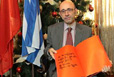
Retired Indian diplomat P. A. Nazareth comes to China to promote the Chinese edition of his book and exchange views with scholars and students about seeking change without violence. Photos provided to China Daily |
|
Universities in China have shown great interest in jointly setting up the Center for Gandhian Studies to spread Gandhi's message. |
Spreading Gandhi's message of tolerance and harmony is a labor of love for P.A. Nazareth, Mike Peters reports.
The retired Indian diplomat P. A. Nazareth, back in Beijing for the first time in decades, has been taken aback at the changes.
"Amazing," he says. "It's a completely different place."
But if times and places change, other things don't, Nazareth tells an audience at Peking University. One constant, he says, is the relevance of the father of modern India, Mohandas K. Gandhi.
Nazareth's trip to Beijing, Shanghai and Guangzhou was designed not just to promote the Chinese edition of his book, Gandhi's Outstanding Leadership, published by the Beijing-based Commercial Press, but also to exchange views with scholars and students about seeking change without violence.
Now, he says, "Shanghai University has made a formal proposal to our consul general in Shanghai to set up a Center for Gandhian Studies. The South China Normal University and Sun Yat-sen University at Guangzhou have also shown interest in jointly setting up such a center. Professor Quanyu Shang of SCNU, who translated my book into Chinese, and professor Huan Yinghong of SYSU are now jointly translating the Selected Works of Mahatma Gandhi into Chinese, which Yunnan Publishing House has undertaken to publish."
Spreading Gandhi's message has become a labor of love. After his retirement from the Indian foreign service in 1994, Nazareth has been a guest lecturer around the world. In 1995, he became a founder and managing trustee of Sarvodaya International Trust, which is dedicated to promoting Gandhi's ideals of truth, nonviolence, communal harmony, humanitarian service and peace.

"As a young officer in the foreign service, I had proudly proclaimed at all my foreign posts that religious tolerance was India's gift to the world," he says.
"In the latter part of my career, I was horrified by the worst types of religious animosities which had spawned in India. Fanned by rabid communal outfits closely connected to one of our then-minor political parties, this strategy was paying handsome dividends. Within 10 years of the destruction by them of a historic mosque in December 1992, this political party's parliamentary strength skyrocketed from just four seats in 1984 to 170 by 1998."
After the Bharatiya Janata Party came to power that year, communal clashes and massacres occurred in various parts of India, he says. He decided to do all he could to revive and promote Gandhi's enlightened approach to inter-religious understanding and communal harmony.
"An old aunt had told me many years ago that it always better to light a candle than curse the darkness!"
Noting that China and India both endured colonial rule, Nazareth says Gandhi was always "full of sympathy" towards China.
"After the Japanese invaded China, Gandhi immediately wrote an open letter to the Japanese people," Nazareth says.
Gandhi wrote: "I must first acknowledge that I have no malice towards you. However, I intensely dislike your aggression against China ... You will not be able to realize this ambition, and will instead become the instigator of Asian disintegration."
"It's easy to think of Gandhi as a pacifist," Nazareth says. "That is a complete misunderstanding of the man. He was a revolutionary, a warrior. He simply didn't take up the tools of violence and war to achieve his goals."
Courage and self-assurance enabled Gandhi and his followers to "remain unruffled even when false accusations and ridicule were being hurled at them". After journalists tut-tutted when Gandhi visited King George V and Queen Mary to have tea wearing his loincloth and sandals, he was accosted by a group of youngsters who shouted "Hey, Gandhi, where's your trousers?" Nazareth writes that Gandhi responded with a hearty laugh and replied, "You people wear plus-fours, mine are minus fours!"
Nazareth says he most keenly admires the endearing humility of Gandhi, who liked to say, "I have nothing new to teach the world. Truth and nonviolence are as old as the hills." Critics such as Christopher Hitchens, on the other hand, have seen arrogance in the Indian leader's eagerness to mediate international disputes and in a scolding letter he wrote to Hitler at the outbreak of World War II.
Nazareth, however, finds scores of examples to define and defend the strength of Gandhi's leadership, from his ability to embrace Muslim and Christian Indians to his effective use of the basic needs of the poor - salt and clothing - to rally the masses to peaceful resistance.
Today, Nazareth says, "China's economic development has brought about some deleterious social effects. China is currently facing extreme consumerism. China has many shining cities but it also has distress in the countryside." Gandhi's philosophy, he says, offers hope to bridge such a divide.
"Three-fourths of the miseries and misunderstandings in the world would disappear," he quotes, "if we step into the shoes of our adversaries and understand their standpoint." Nazareth invokes independent India's first president, Jawaharlal Nehru, to describe Gandhi's impact: "His voice was somehow different from the others. It was quiet and low and yet it could be heard above the shouting of the multitude; it was soft and gentle and yet there seemed to be steel hidden away somewhere in it ...We did not quite know what to make of it but we were thrilled."
Contact the writer at michaelpeters@chinadaily.com.cn.
(China Daily 04/20/2014 page26)
Copyright 1995 - . All rights reserved. The content (including but not limited to text, photo, multimedia information, etc) published in this site belongs to China Daily Information Co (CDIC). Without written authorization from CDIC, such content shall not be republished or used in any form. Note: Browsers with 1024*768 or higher resolution are suggested for this site.
License for publishing multimedia online 0108263 Registration Number: 130349