 |
|
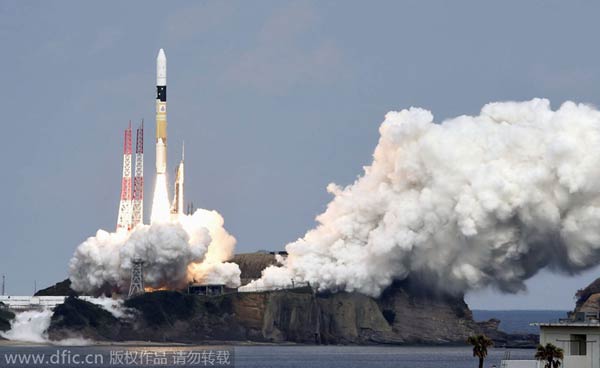
Photo taken on Dec 3, 2014 shows the launch of an H-2A rocket carrying the Hayabusa2 asteroid explorer from the Tanegashima Space Center in southwestern Japan. [Photo/IC] |
TOKYO -- Japan launched its second-generation asteroid explorer Hayabusa2 on Wednesday, kicking off the country' s second asteroid sample return mission.
Mitsubishi Heavy Industries Ltd. and the Japan Aerospace Exploration Agency (JAXA) announced the launch of Hayabusa2, which separated from the rocket at 3:09 p.m. local time (0609 GMT) as scheduled, and entered the orbit successfully.
The Hayabusa2 aboard the H-2A Launch Vehicle No.26 (H-2A F26) blast off at 1:22 p.m. local time (0422 GMT) on Wednesday from Tanegashima Space Center in Japan's southwestern Kagoshima prefecture.
An H-2A rocket has never attempted such a lengthy coast period during any of the booster's 25 previous flights.
The space explorer was supposed to be launched on Nov. 30, but was delayed twice due to adverse weather conditions.
The 600-kg Hayabusa2 is to explore one of the C-type asteroids called 1999 JU3 in the universe, retrieve materials and bring them to Earth, said JAXA in a statement.
First observed in 1999, the nearly spherical asteroid 1999 JU3 is about 900 meters in diameter. The rock of C-type asteroids is considered to contain organic matter and water. Scientists expect the mission to shed light on the origins of the solar system and life on Earth.
"Hayabusa2 explores the mystery of the origin of the sea water and the life on the earth in addition to the mystery of the earth' s formation," said JAXA.
After arriving at the target asteroid, Hayabusa2 will observe by a variety of remote-sensing instruments, small lander and rover, which will be released from the probe and will land on the asteroid, before performing observations of the surface of asteroid in detail.
The Hayabusa2 will then touch down and collect samples from asteroid surface. Furthermore, with an impactor which is newly developed, it will create an artificial crater by the impactor and will collect samples from the crater, "which means that we can obtain the subsurface material of asteroid," said JAXA.
The probe will initially park itself 20 km from the asteroid for a comprehensive survey with a set of spectrometers, cameras, and other sensors to map the tiny world.
Then scientists will start to look for suitable sites on the asteroid to put down four diminutive landing drones and scoop up samples for return to Earth.
The total flying distance of the probe during the six-year journey is estimated to be 5.2 billion km.
Its predecessor Hayabusa (MUSES-C), launched in 2003, returned to Earth after a seven-year mission, during which it landed on an asteroid and collected sample material.
While establishing a new navigation method using ion engines, Hayabusa brought back samples from the asteroid "Itokawa" to help explain the origin of the solar system.
"Hayabusa2 will target a C-type asteroid '1999 JU3' to study the origin and evolution of the solar system as well as materials for life by leveraging the experience acquired from the Hayabusa mission," said JAXA.
"While Hayabusa has recorded a number of world's first achievements, Hayabusa2 is aimed at enhancing the reliability of asteroid exploration technologies," it said.
At the same time, Hayabusa2 will attempt to obtain new technologies, such as creation of artificial craters, high-speed communications in deep space, and new observation instruments, it said.
"It should arrive at the C-type asteroid in mid 2018, staying around there for one and half years before leaving the asteroid at the end of 2019 and returning to Earth around the end of 2020," said the Japanese space agency.

Copyright 1995 - . All rights reserved. The content (including but not limited to text, photo, multimedia information, etc) published in this site belongs to China Daily Information Co (CDIC). Without written authorization from CDIC, such content shall not be republished or used in any form. Note: Browsers with 1024*768 or higher resolution are suggested for this site.
License for publishing multimedia online 0108263 Registration Number: 130349