|
|
A student looks at the exhibition of photos and other art work showing ancient Chinese sports at Brazil's first Portuguese-Chinese bilingual high school on April 27.[Photo by Zhao Yan/ For China Daily] |
Photographs of Chinese Cuju, martial arts and chess, along with drawings showing ancient Chinese sports, have been on display at Brazil's first Portuguese-Chinese bilingual high school with the goal of promoting cultural exchange between China and Brazil before next year's Olympic Games in Rio.
The exhibition sponsored by the Confucius Institute at Rio's Pontifical Catholic University opened on April 27.
Qiao Jianzhen, dean of the Confucius Institute and a promoter of the bilingual high school, said to learn Chinese culture foreigners should not only study Chinese language, but also understand China's culture.
“The Confucius Institute in Rio will hold such a Chinese cultural show every two or three months. As the Rio Olympics are next year, I believe today's display will attract more Brazilian students. It will play a catalytic role in the cultural exchange between the two countries,” said Qiao.
The institute will continue to organize different activities around Chinese culture to help people of Brazil better understand China, Qiao added.
Organized by Rio de Janeiro’s education department and China's Hebei Normal University, the Portuguese-Chinese bilingual high school in Niteroi, a city across Guanabara Bay from Rio, welcomed its first class with an enrollment of 72 students on Feb 9.
Named after Brazil’s famous mathematician, Joaquim Gomes de Sousa, the school focuses on teaching mathematics as well as Portuguese, Chinese and English.
Joselim, one of the school’s students, said the sports exhibition gave her a better understanding of Chinese sports.
“Because of our school’s Chinese characteristics, our physical education particularly adds some traditional Chinese sports, such as chess, dragon dance and tai chi, which are very popular among us,” she added. “The photos let us understand the origin and evolution of modern sports and sports in China.”
In Brazil, the Confucius Institute plays an active role in promoting Chinese language and culture. This month, Brazil’s eighth Confucius Institute was opened at the State University of Campinas. It was co-organized by the Beijing Jiaotong University (BJTU) and the University of Campinas (UNICAMP).
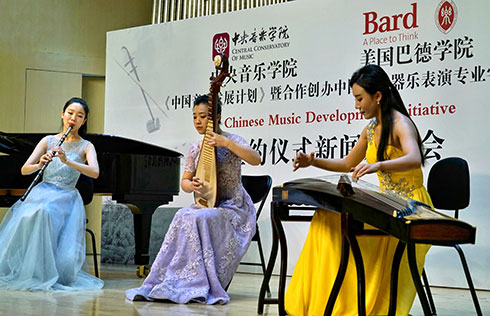
To celebrate the opening of the institute, an art troupe from BJTU put on a Chinese music show in Niteroi’s Oscar Niemeyer People Theater. Student performers introduced the Brazilian audience to traditional Chinese musical instruments such as the erhu, flute and Pipa. In addition, they also performaned songs from Chinese opera and put on a display of martial arts.
Mariana Giowana, a 15-year-old Brazilian girl, was invited to participate in the teaching of martial arts during the show. “I really like this interactive experience. I watched Chinese martial arts movies before and used to take some classes, but I had to stop because my leg was hurt at that time. Today’s show reignites my interest toward martial arts.”
Gao Hongyan, dean of the UNICAMP Confucius Institute, hoped that through such performances Brazilians will have a better understanding of China, and that they will increase their interest in learning Chinese language and culture.
There are eight branches of the Confucius Institute in Brazil, with two Confucius classrooms at other institutions. Most are in the southeastern region, where Chinese presence is greater.
There are also Confucius institutes in Brasilia, Porto Alegre and Recife, showing the increased demand in the country for learning Chinese and a desire to understand the culture. Some local language schools also offer Chinese language classes.

Copyright 1995 - . All rights reserved. The content (including but not limited to text, photo, multimedia information, etc) published in this site belongs to China Daily Information Co (CDIC). Without written authorization from CDIC, such content shall not be republished or used in any form. Note: Browsers with 1024*768 or higher resolution are suggested for this site.
License for publishing multimedia online 0108263 Registration Number: 130349