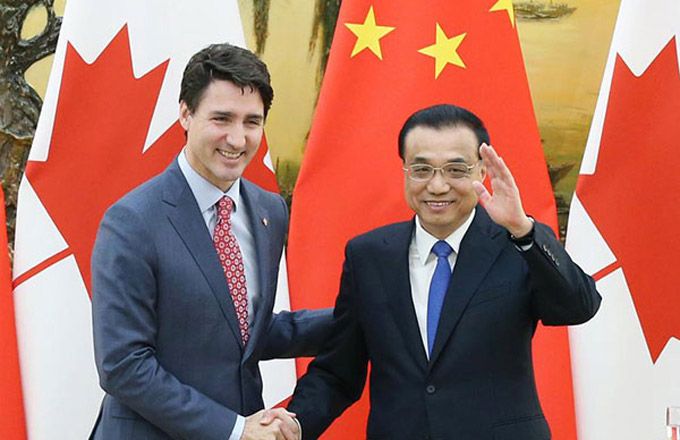
Premier Li Keqiang's visit to Colombia has again attracted nationwide, even global, attention to this Latin American country. Having established formal diplomatic relations for 35 years, mutual trade and other positive economic interaction have so flourished that China is now Colombia's second-largest trade partner, as well as its fourth-largest investor in the Asia-Pacific region.
Further, data shows that mutual trade reached $15.5 billion in 2014, up from $10 billion in 2013, or over 700 times of that 35 years ago.

The fast rise has much to do with their complementary economic structures — Colombia is rich in mineral and agricultural resources while China has plenty of funds and needs huge amounts of minerals and agricultural products. In the future, their cooperation will exceed the old mode and find the points where their strategic interests match each other, thus providing a solid basis for broader cooperation.
Both sides are rendering efforts to that end. The Colombian government has listed mining, construction, agriculture, infrastructure and innovation among its strategic industries to promote its economy, and expressed hope of attracting Chinese investors in those fields. Besides, within the framework initiated by China, investment, trade and financial cooperation are three new driving forces for cooperation, with the six key areas being energy, infrastructure, manufacturing, technological innovation and IT.
In the future, it is expected that loans with favorable interest rates will be issued specially for the development of infrastructure, agriculture and other projects. These constitute a precious opportunity for Colombia and China not only to develop certain industries, but also to upgrade their cooperative mechanisms.
Besides these, modern bilateral mechanisms between China and Colombia date back to 2012, when the two nations signed a memorandum of understanding on the feasibility of a bilateral free trade agreement.
Widely considered a new step in deepening their trade and economic relations, the memorandum offers people in both nations hope that Colombia might become the fourth Latin American nation to sign a free trade agreement with China. However, progress is slow and some are asking whether a free trade zone will be established at all.
All FTZs must go through certain procedures before they are realized: primary contacts, feasibility studies, and the start of official negotiations. Even in the last stage, there might be obstacles that drag the whole process down.
In the case of Colombia and China, some Colombian experts have long pointed out that difficulties exist in agriculture and other fields. Fortunately, research shows that the free trade agreement under discussion, if successfully signed, will benefit both sides. It will give the Colombia economy a major boost and promote the investment and labor efficiencies of both countries. Colombian officials have repeatedly shown that they would welcome a China-Colombia FTZ.
In recent years, Colombia has laid special emphasis on forming international FTZs as part of its economic strategy. For that purpose, it not only continues deepening coordination with Mexico, Chile and Costa Rica within the Pacific Alliance, but also more positively seeks a role in the Trans-Pacific Partnership. Both moves are aimed at joining the Asia-Pacific economic region and playing a bigger role in it. There is no reason not to strengthen cooperation with China.
A look at history shows that it was during Colombian President Juan Manuel Santos Calderón's visit to China in 2012 that the two countries started a feasibility study of an FTZ. When Zhang Dejiang, chairman of the National People's Congress Standing Committee, visited Colombia last November, the two countries expressed willingness and readiness to deepen cooperation.
Premier Li's visit to Colombia is likely to help solve problems and propel the process a giant step forward, too.
And there is a huge potential for mutual economic cooperation. Despite being the fourth-largest economy in Latin America, Colombia is only China's eighth-largest trade partner in the region. China is Colombia's second-largest trade partner globally, but it lags far behind the United States, which is Colombia's top trader. According to data from Colombian authorities, their trade volume with China was $17.6 billion in 2014, compared to $32.3 billion with the United States.
Another deficiency of mutual trade is its over-reliance on one or two industries. Mineral products account for over 92 percent of Columbia's total exports to China. Partly for this reason, there is a trade imbalance and China finds itself the main source of Colombia's trade deficit.
These problems might curb the stability and sustainability of trade growth in the long run. Worse still, Colombian businesspersons and residents might pressure their government to subsidize trade to China.
With China's economic restructuring and the establishment of a general cooperative platform, China and Colombia could get rid of the over-reliance on trade in their economic cooperation. Trade is not the only element defining their economic relations. Rather, it is one of the three engines that propel mutual economic relations in the future, with the other two being investment and financial cooperation.
In both fields there is huge potential. Colombia has enjoyed stable economic growth and politics over the past 10 years, which grant it a good investment environment and good prospects of economic growth.
A trend is emerging among Chinese enterprises to enter this land of hope and opportunity. The Chinese government is also enhancing its strategy of economic cooperation with Latin America as a whole, and Colombia will play an ever-increasing role.

Copyright 1995 - . All rights reserved. The content (including but not limited to text, photo, multimedia information, etc) published in this site belongs to China Daily Information Co (CDIC). Without written authorization from CDIC, such content shall not be republished or used in any form. Note: Browsers with 1024*768 or higher resolution are suggested for this site.
License for publishing multimedia online 0108263 Registration Number: 130349