 |
|
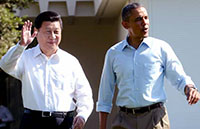
US President Barack Obama and Chinese President Xi Jinping rest during a tour at the Annenberg Retreat, California, June 8, 2013. [Photo/Xinhua] |
Seizing upon China's recent economic turbulence like sharks that have smelled blood, hypo-critical Republican presidential candidates are circling President Xi Jinping's state visit to the US this month, making a successful negotiation with US President Barack Obama less likely.
But for China's recent economic setbacks, these demagogues would still be tripping over each other in a race to the bottom on the immigration issue led by the buffoon in a bouffant. They call to mind what a disgraced US vice-president (Spiro Agnew) of a disgraced president (Richard Nixon) once said: a bunch of "nattering nabobs of negativism".
Former presidential candidate and ambassador to China, Jon Huntsman, rightly described our countries being in "the most complex and challenging relationship of the 21st century".We are the best of "frenemies" and will remain so. However, unlike all the already contentious bilateral issues, such as cyberspying, island disputes and human rights, for which expectations for progress are limited, the economic events of recent weeks do present added impetus to one item on the agenda whose negotiation has bogged down, and should and can be resuscitated: the Bilateral Investment Treaty.
Most BITs are generally limited to adjudicating routine investor disputes. But China has gone on record to negotiate the BIT with "high standards", indicating that it will include all stages of investment and all sectors. This is the first time China has agreed to do so with any country.
The US would benefit from increased access to the Chinese market, particularly in the service sector where it maintains a competitive advantage. It would also encourage greater investment from the Chinese side.
China would benefit from more consistent treatment of its investors in the US in addition to access to US workplace productivity tools and technologies inside China to improve its economic efficiency. The stability of the Chinese economy and stock market would result from lower volatility because of a higher ratio of more savvy institutional investors, as well as from advanced risk management techniques.
According to US Treasury Secretary Jack Lew, the agreement could, for the first time, include all phases of investment, including market access, and sectors of the Chinese economy (except for limited negotiated exceptions).
Lew said: "A high standard US-China BIT is a priority for the United States and is critical to leveling the playing field for American workers and businesses. A successful BIT negotiation would open up China's highly restrictive system to foreign investment and help create a wide range of opportunities for US firms to participate in the Chinese market...including greater market access, removal of investment barriers, protections against technology transfer, and increased transparency."
China's Commerce Minister Gao Hucheng has rightly said:"..investment is an important area of China-US economic cooperation. It is a mutual concern of both parties, and both parties need to have creative thinking in order to create convenient conditions for the mutually beneficial cooperation between businesses of the two countries."
Unfortunately, the US is balking because the so-called negative list of Chinese exclusions is far from limited. The talks appear to have screeched to a halt. Perhaps the Xi-Obama summit can revive them.
Regrettably, there are two caveats. In the heat (read: hot air) of the presidential primary season, ratification by the US Senate by the required two-thirds majority is impossible. It may not be so later depending on the makeup of the White House and Senate in 2017. And there are news reports that the US is poised to take draconian measures to stop Chinese cyberspying, including economic sanctions. If this occurs, the BIT may well go into the deep freeze, if not the scrapheap of history.
Few debate that the 19th century was the British century and that the 20th century was the American century. A spirited albeit not always objective debate surrounds whether our 21st century will be Chinese or American. While, as leading powers we will always have disagreements and remain "frenemies", there is enough of an optimist in me to imagine that this could be the Sino-American century, a unique bi-national cooperation of partners that sometimes agree to disagree.
The author is a senior adviser to Tsinghua University and former director and vice-president of ABC Television in New York.
(China Daily 09/03/2015 page9)
Related Stories
Copyright 1995 - . All rights reserved. The content (including but not limited to text, photo, multimedia information, etc) published in this site belongs to China Daily Information Co (CDIC). Without written authorization from CDIC, such content shall not be republished or used in any form. Note: Browsers with 1024*768 or higher resolution are suggested for this site.
License for publishing multimedia online 0108263 Registration Number: 130349