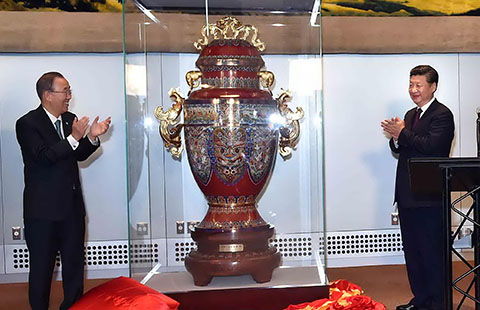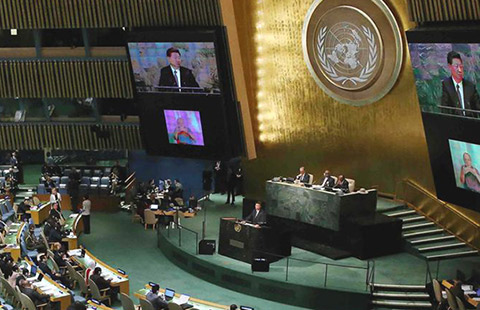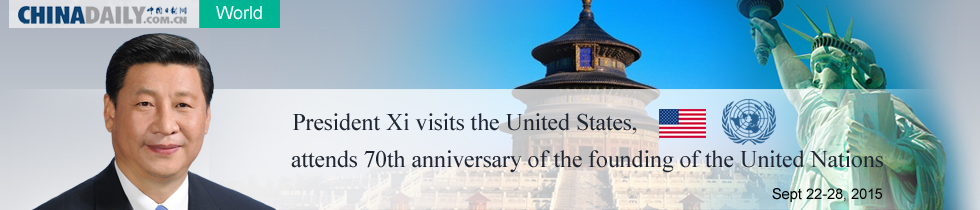
As Chinese President Xi Jinping travels to the United States for a summit with the President Barack Obama, the world political and economic situation has deteriorated substantially since they last met at the Sunnylands summit in 2014.
US rhetoric over China's construction in the South China Sea, and the ever more heated comments coming out of Washington regarding Russia and Russian President Vladimir Putin recall the tense days of the Cold War.
Indeed, the continued fighting in eastern Ukraine and the seeming lack of interest by the Ukrainian government in achieving a real ceasefire, has increased the danger of a war between major powers.
All of this is occurring in the context of the continued collapse of the international financial system, in which total debt has now reached several quadrillion dollars, an astronomical sum that can never be repaid.
And yet the demand for repayment by the creditors is already increasing the death toll in countries like Greece and Italy.
The only bright light shining at the moment comes from Asia, in spite of the negative repercussions of the crisis there. The One Belt, One Road perspective laid out by the Chinese president in September 2013 has created a spark of hope around the world, particularly in developing countries, as was clearly evident at the latest BRICS Summit in Fortaleza, Brazil.
Even the devastated European economy has seen potential benefit in this project. The lone exception to this optimism seems to be the United States, where every initiative by China is always met with skepticism and suspicion, no doubt reflecting old Cold War views which are difficult to eradicate.
But such an attitude by the United States is also self-defeating. The reality of the economic crisis could not be more vivid than when looking at the condition of the major cities of the US. The growing racial tensions in St. Louis and other places are largely fueled by the growing desperation among the poorer sections of the population, much of which encompasses the black population of the United States.
What the Belt and Road perspective offers is a way out of the dilemma. It is an attempt to initiate on a broad scale the type of infrastructural investment, i.e., roads, highways, high-speed rail, power plants, etc., which can form the basis for jump-starting the economies in the region.
The increased connectivity within the regions of Central, East and Southeast Asia will provide a growing market for each of the countries' products. It also will help to engender the type of cross-cultural understanding that can help reduce the religious and ethnic tensions that have become a major source of military conflict throughout the great swath of territory lying between the Mediterranean and the Pacific Ocean. It can also serve as an example for what could be accomplished on a global scale.
This is not some geopolitical scheme dreamed up by the Chinese government to assert the country's "hegemony" in the region. On the contrary, the Chinese president has repeatedly invited the US and the countries of Europe to take part in this project. It is a win-win situation. The Europeans, much to their credit, have acted positively, clearly seeing the benefits for themselves. The United States unfortunately is still sitting on the fence.
But if the United States would change its attitude toward this initiative, the Belt and Road could become a world land bridge, bringing together the nations of four continents. And keep in mind, the distance between Asia and America is only 55 miles. This can easily be bridged by a tunnel.
But it requires a bit of a new mindset among US political leaders, focusing more on the "common aims of mankind than on the one-upmanship of traditional geopolitics. The notion of a "common destiny" has been a recurrent theme with the Chinese President.
It also requires a rejection of the monetarist shibboleths that have led our governments to subordinate the needs of the people to the growing requirements of financing an out-of-control financial bubble that has characterized US policy for the last four decades. We need more concern for Main Street than for Wall Street. Indeed, the "`sins"' of the speculators should not become a liability for the working man.
The "common destiny"' should also include a more extensive collaboration between China and the US in the areas of science and technology. Recent breakthroughs by Chinese scientists in molecular biology show the benefit that such cooperation might have in overcoming disease. Such cooperation should also be expanded to that real frontier of science - outer space.
The author is Washington bureau chief of Executive Intelligence Review.
Copyright 1995 - . All rights reserved. The content (including but not limited to text, photo, multimedia information, etc) published in this site belongs to China Daily Information Co (CDIC). Without written authorization from CDIC, such content shall not be republished or used in any form. Note: Browsers with 1024*768 or higher resolution are suggested for this site.
License for publishing multimedia online 0108263 Registration Number: 130349