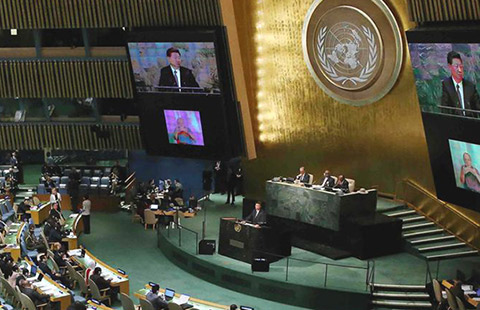
The speech given by Chinese President Xi Jinping on Tuesday in Seattle to a crowd of top diplomats and tech entrepreneurs touched on familiar themes and new topics as he defined a new era for the China-US relationship.
Unsurprisingly, the topic of cybersecurity, a recent flashpoint of tension between the two superpowers, played a prominent role in Xi's address.
Seeking to defuse rumors in the American press that China has been allegedly behind recent attacks on US government systems, Xi stated clearly that "China is a staunch defender of cybersecurity ... and a victim of hacking. The Chinese government will not ... engage in commercial theft or encourage or support such attempts by anyone."
He also stated that "China is ready to set up a high-level joint dialogue mechanism with the United States on fighting cybercrime."
In an interview with China Daily, Mexican academic and diplomat José Luis Leon-Manriquez addressed whether Xi's statement would help assuage those in the US who see China as a hacking threat.
"I do not see an easy solution to this,” he said. “In issues related to defense, there are entrenched groups in the American political system that ... have an interest in (keeping) certain topics alive with China," said the professor of East Asian studies at the National Autonomous University of Mexico.
"Therefore, there is an agenda of military pressure which the US will maintain on China and even on its own allies. However, even if the topic of cybersecurity seems difficult to resolve, dialogue is always necessary," he added.
Commentators also noted that Xi wove his speech with a personal tone, drawing on his own experiences to color his vision for modern China and his appreciation of the US as a partner. The Chinese president called upon his own experience in the 1960s, when he was sent to work as a farmer in a small village for seven years, to explain his wish to improve life for all Chinese people.
Xi's personal touch and experience in the US as a young official in his 30s have raised hopes that he will be able to communicate on a more personal level with the country's leaders.
In Xi's first official state visit to the US, many Latin American observers were keen to see which themes he would develop. After all, the traditional dynamic of China being the world's factory and the US being the world's customer has slowly been changing. As a region with close ties to both sides, Latin America's biggest economy, Brazil, may well have been waiting for a message of unity from Xi.
This message was delivered in an interview with The Wall Street Journal, also published on Tuesday, in which Xi stated "China has never been absent in efforts to promote world economic recovery, seek political settlement of international and regional hotspots and respond to various global problems and challenges. This is what the international community expects of China, and to do so is China's responsibility."
This news certainly fits China's strategy of helping friends around the world, especially among developing economies, thanks to its own development path in terms of railways, agriculture and energy among others.
While the economy of Brazil has been rattled of late due to the Petrobras corruption scandal, a devalued real and predictions of a contracting GDP, the announcement in May that China will invest $50 billion in Brazilian infrastructure was welcome news.
In response to Xi's speech and interview, Ronnie Lins, CEO of the Brazil-China Center, stated that "globalization leads to more transparency and cooperation, so that humankind as a whole moves in the direction of well-being".
"Countries can no longer be isolated without damaging consequences, so a better world does create a better China. President Xi knows well that a better China also created a better world," added Lins.
While the theme of cybersecurity may not be as crucial to Latin American leaders, fears of a slowing economy in China have led Latin American countries to seek to diversify their exports in China and rely less on vulnerable commodities and hydrocarbons.
However, China has helped to assuage these fears by becoming a regular investor in infrastructure across Latin America while also making the region a pillar of the internationalization of the yuan.
Last week, the Industrial and Commercial Bank of China was appointed as the first clearing bank in Argentina for transactions carried out in RMB. During a ceremony in Buenos Aires, ICBC Chairman Jiang Jianqing stated that "the move will allow the bank to fulfill its role as a bridge between the two nations". The fate of the Chinese currency proved to be a pillar of Xi's speech.
Xi stated that after depreciating the RMB to correct the exchange-rate deviation, there was no more basis for continuous depreciation of the RMB.
Specifically, he stated that, "We will stick to the purpose of our reform to have the exchange rate decided by market supply and demand and allow the RMB to float both ways. We are against competitive depreciation or a currency war. We will not lower the RMB exchange rate to stimulate export."
This will have been music to the ears of Latin American countries like Chile and Argentina, who have become pillars of China's economic growth in the region.
Speaking to China Daily, Jorge Castro, an Argentinean expert in international relations, stated that "Xi had the clear intention of improving confidence and advancing economic cooperation" with the U.S. He added that China and the U.S. could work together to build a new model for ties between superpowers, helping the entire world acheive stability and growth.
Copyright 1995 - . All rights reserved. The content (including but not limited to text, photo, multimedia information, etc) published in this site belongs to China Daily Information Co (CDIC). Without written authorization from CDIC, such content shall not be republished or used in any form. Note: Browsers with 1024*768 or higher resolution are suggested for this site.
License for publishing multimedia online 0108263 Registration Number: 130349