Study indicates air-polluting chemicals can travel far


SAN FRANCISCO - A new study indicates that tiny floating particles can grow semi-solid around pollutants, allowing them to last longer and travel much farther than what previous global climate models predicted.
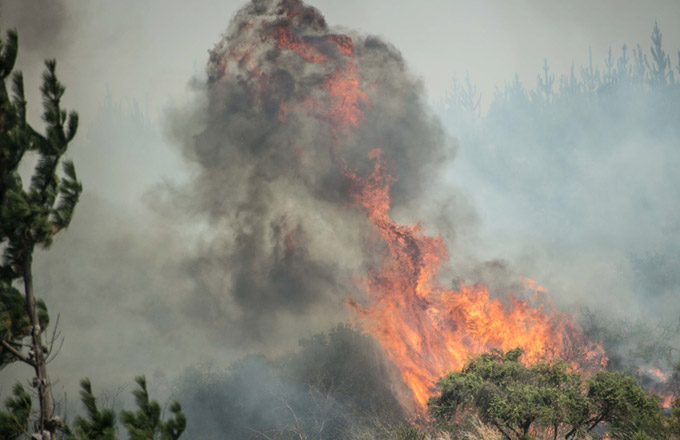
Pollutants from fossil fuel burning, forest fires and biofuel consumption include air-polluting chemicals known as polycyclic aromatic hydrocarbons, or PAHs. In the United States, the Environmental Protection Agency (EPA) has identified several PAHs as cancer-causing agents.
Done by researchers at Oregon State University (OSU), the U.S. Department of Energy's Pacific Northwest National Laboratory, or PNNL, and Peking University of China, the study stems from a new way of looking at how the pollutants ride through the atmosphere and estimated cancer risks around the world as a result.
"We developed and implemented new modeling approaches based on laboratory measurements to include shielding of toxics by organic aerosols, in a global climate model that resulted in large improvements of model predictions," said PNNL climate scientist Manish Shrivastava and lead author of the study published online this week in the Proceedings of the National Academy of Sciences.
PAHs have been difficult to represent in past climate models. Simulations of their degradation process fail to match the amount of PAH that is actually measured in the environment. To look more closely at how far PAHs can travel while riding shielded on a viscous aerosol, the researchers compared the new model's numbers to PAH concentrations measured by OSU researchers at the top of Mount Bachelor in the central Oregon Cascade Range.
"Our team found that the predictions with the new shielded models of PAHs came in at concentrations similar to what we measured on the mountain," Staci Simonich, a toxicologist and chemist in the College of Agricultural Sciences and College of Science at OSU, was quoted as saying in a news release. "The level of PAHs we measured on Mount Bachelor was four times higher than previous models had predicted, and there's evidence the aerosols came all the way from the other side of the Pacific Ocean."
These tiny airborne particles form clouds, cause precipitation and reduce air quality. A smidge of soot at their core, aerosols are tiny balls of gases, pollutants, and other molecules that coalesce around the core. Many of the molecules that coat the core are what's known as "organics." Other molecules such as pollutant PAHs also stick to the aerosol. Researchers long thought that PAHs could move freely within the organic coating of an aerosol. This ease of movement allowed the PAH to travel to the surface where ozone can break it down.
But understanding of aerosols has changed in the last five years or so. Recent experiments led by PNNL co-author Alla Zelenyuk show that, depending on the conditions, the aerosol coatings can be quite viscous. If the atmosphere is cool and dry, the coating can become as viscous as tar, trapping PAHs and other chemicals. By preventing their movement, the viscous coating shields the PAHs from degradation.
With a new way of representing PAHs in a global climate model, and running it to simulate PAH concentrations from 2008 to 2010, researchers examined one of the most carcinogenic PAHs in particular, called BaP. Simulations were compared to data from 69 rural sites and 294 urban sites worldwide, and showed that predictions from shielded PAHs were far more accurate than previous, unshielded ones.
To look at the impact globe-trotting PAHs might have on human health, Shrivastava combined a global climate model, running either the shielded PAH scenario or the previous unshielded one, with a lifetime cancer risk assessment model developed by co-authors Huizhong Shen and Shu Tao, both then at Peking University.
Globally, the previous model predicted half a cancer death out of every 100,000 people, which is half the limit outlined by the World Health Organization (WHO) for PAH exposure. But using the new model, which showed that shielded PAHs actually travel great distances, the global risk was four times that, or two cancer deaths per 100,000 people, which exceeds WHO standards.