Recently unearthed archaeological treasures give scientists a fascinating insight into mankind's origins, reports Zhang Yuchen in Beijing.
A large number of archaeological sites were unearthed in China last year.
Experts designated 48 as being particularly valuable and they are now being assessed for inclusion into the top 10 discoveries of 2011, sponsored by the Ministry of Culture and China Relics Press.
The six sites that provoked the most interest were those dating from the Old Stone Age, the Paleolithic period from two and half million years ago to 10,000 BC.
These were located in the provinces of Shaanxi, Henan, Fujian and Hunan, and the Inner Mongolia autonomous region.
Flint axes and masonry tools unearthed at Zhanghuokou in Shaanxi province, similar to those discovered at almost 300 similar sites over the past two decades, suggest a strong connection between the manufacturing methods of the East Asian Old Stone Age and the West's Acheulian culture from roughly the same period.
The connection is one of the main focuses of international academic research into ancient cultural ties between East and West.
Animal bone fragments, stone tools and cultural relics, along with the remains of campfires, were unearthed in the Grandma Temple in Zhengzhou, Henan province, all dating from the Old Stone Age.
Archaeologists believe the area may have been a prime area of ancient culture in Central China. The discoveries have reinforced the notion of continuous co-evolution between the population in China and the rest of East Asia.
The relics discovered in the Qihe Caves in Fujian province are considered a treasure trove in southeastern China.
Along with human remains, researchers found artifacts belonging to prehistoric inhabitants across a series of eras, including tools fashioned from stone and bone, pottery and other items indicating the transition from the Old to the New Stone Age.
Cultural ties were identified from the study of lifestyles on both sides of the Taiwan Straits.
Wulanmulun in the Inner Mongolia autonomous region is rich in cultural relics dating back between 30,000 and
70,000 years and provides important material for research into the migratory patterns of early humans in Northeast Asia and their adaptation to the glacial environment. The Xichuan and Daoshui discoveries in the same area provided evidence of large-scale migration to the West and proved that decorative stone leaf work extended to the hinterland of the Central Asian plains and China. The findings allow scholars greater scope for research into the transition between the Old and New Stone Ages and the origins of early agriculture.
A great many other discoveries do not appear on the list of nominated sites, but their importance is still immense. Excavations at Zhoukoudian in Beijing show clear signs of the controlled use of fire, while the Dayao relics in the Inner Mongolia autonomous region offer new perspectives on the prevailing culture.
The 2011 discoveries offer a window onto the world of Old Stone Age Chinese culture, and experts said they will almost certainly promote the integration of archaeological research between China and the rest of the world.
| ?GRANDMA TEMPLE RELICS |
Zhengzhou, Henan province |
  |
 |
|
(TOP) CHIPPED STONE. A tool made from quartzite during the Old Stone Age. This type of tool was easily manufactured, in addition to being easily sharpened and carried. ANIMAL BONES. Around 12,000 bone fragments from cattle, horses, pigs, antelopes and deer were discovered at the site. They were used as tools approximately 30,000 to 50,000 years ago. |
SIDE SCRAPER. A ridged type of tool, distinguished by a working edge on one side. Scrapers were used for working animal hides and wood about 45,000 years ago. |
| QIHE CAVE RELICS | Zhangping, Fujian province |
 |
 |
|
A stone adze, a tool used for smoothing or carving rough-cut wood by hand. |
A rock embellished with a symbol. These signs carved on stones are believed to be the original form of Chinese characters.? |
|
Both items were found in the third national excavation of cultural relics in December, 2008. They were used 7,000 to 17,000 years ago in the Qihe Cave area of Fujian province. The relics, believed to date from a period between the Old Stone Age and the early New Stone Age, have provided the biggest archaeological breakthrough in Southeast Asia during recent years, filling in the blanks about the transition between these prehistoric eras. Among the discoveries, archaeologists found the remains of stone-lined pits, characteristic of the Old Stone Age, and sites of inhabitation from the New Stone Age. The remains of human skulls, animal bones, shells, pottery vessels and tools made from stone and wood were also discovered. Archaeologists believe that all the artifacts will provide valuable material for future research into the health of early humans, the origins of agriculture, technological development and the use of pottery in ancient times. |
| YUJIA MOUNTAIN RELICS Yuhang | Zhejiang province (Liangzhu culture) |
 |
 |
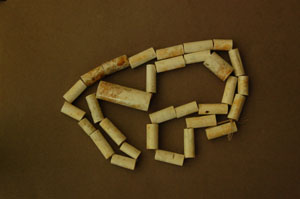
| Earthenware and jade, combined in what may have been a necklace. |
A bracelet-style cong, or armband. The pieces of various cong are among 4,000 jade items discovered since October 2008. They were used in religious ceremonies to honor the Earth God. These armbands are known to have been used in Liangzhu culture, famous for its use of jade and dating back to the New Stone Age, 5,300 to 4,200 years ago.
|
 |
4,000 jade items discovered on the site. The southeast corner of Ring Ditch 2 in Yuhang, Zhejiang province. There are six ring ditches in total, covering an area of 1 square kilometer. Five of the ditches have already been explored, across an area of 150,000 square meters. The ditches represent six related tribes and differences in burial locations and other factors indicate the status of each tribe within the grouping. |
|
Tongliao, Inner Mongolia autonomous region |
HAMIN PREHISTORIC SETTLEMENT RELICS |
 |
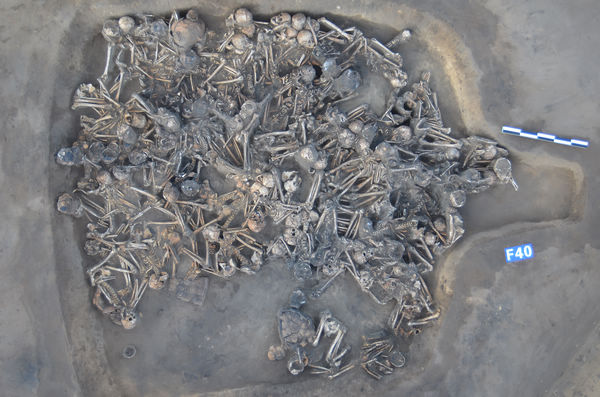
During the excavation process, archaeologists found a number of collapsed houses, wrecked by fire, the effects of which are clearly visible on the wooden structures and frames. Archaeologists believe that the large number of human remains indicates that the settlement was abandoned in the wake of a catastrophe. The discovery of the grave was a breakthrough in the exploration of the settlement's relics.? |
|
SHIZHU RELICS Yibin, Sichuan province A bronze sword from the Warring States Period. It was discovered along with a host of other items made of pottery, bronze, iron and stone. |
 |
|

MARQUIS TOMBS OF THE ZENG STATE Suizhou, Hubei province Zeng was a minor state during the Western Zhou Dynasty (c. 11th century-711 BC) Some 65 burials and one pit with sacrificial horses were discovered, together with 739 pieces of bronze, ceramic, porcelain, lacquer and wood, jade and stone, which are significant for research into the history of the Zeng State. The pictured rectangular cauldron was engraved with symbols, indicating that the item was made for a Zeng Marquis. |
 |
 |
|
A CEMETERY |
|
THE DAYUNSHAN MAUSOLEUM |
Jiangsu province, built for Marquis Liu Fei of the Western Han Dynasty (206 BC-AD 24)? |
 |
 |
|
During excavations between 2009 and 2011, three main tombs, 11 attendant tombs, two chariot pits and two weapon pits were exposed within the site, together with more than 10,000 fine artifacts. The pictures show a gold-decorated copper elephant and a copper animal-shaped supporting structure for a set of stone chimes. |
|
 |
 |
|
BEIJING-HANGZHOU GRAND CANAL RELICS Liaocheng, Shandong province A seven-layer pier discovered in the Shandong section of the Beijing-Hangzhou Grand Canal.The picture shows part of a lock structure at the pier. A carved stone animal, placed in the water to placate the gods, was found near the structure. |
 |
|
Hamin Prehistoric Settlement Relics, Tongliao, Inner Mongolia Autonomous Region 98 bodies in a mass grave: In the process of excavation, archaeologist found the site of collapsed houses caused by fire where left clear traces of wooden structure and frame. A shocking sight of 98 bodies in a mass grave proved that the settlement site was abandoned because of sudden incident. The Hamin relics culture is different from the New Stone Age cultures though it is proved to exist in the same prehistoric period. The discovery offers breaking through improvement in the settlement relics exploration. |


Copyright 1995 - . All rights reserved. The content (including but not limited to text, photo, multimedia information, etc) published in this site belongs to China Daily Information Co (CDIC). Without written authorization from CDIC, such content shall not be republished or used in any form. Note: Browsers with 1024*768 or higher resolution are suggested for this site.
License for publishing multimedia online 0108263 Registration Number: 130349 



