 |
|
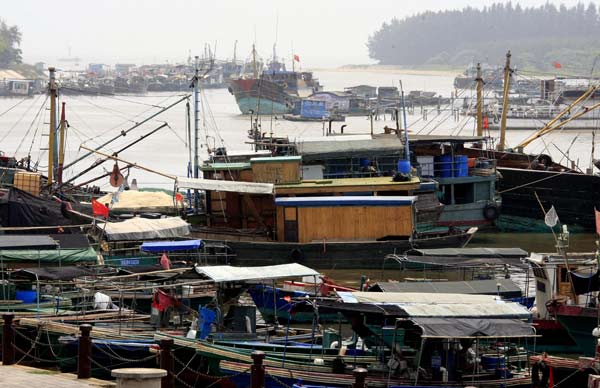
The bustling port of Tanmen in Hainan province. [Photo by Huang Yiming] |
Editor's note: This is the fourth (First,Second,Third) in a series of special reports in which our reporters will travel the length of China's 18,000-km-long coastline to detail the lives of the people whose existence is dominated, and often facilitated, by the waters that stretch from Bohai Bay in the north to the Zengmu shoal in the south.
Rising tension in the South China Sea is having repercussions back on land, Peng Yining reports from Tanmen, Hainan province.
|
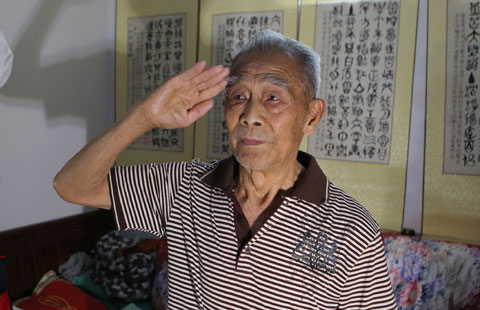
A tough, dangerous life Ding Zhile | First person Ding Zhile, head of Tanmen Fisheries Association If you've never been a fisherman, it's difficult to comprehend just how hard their lives are. In the 1990s, when I was still fishing in the South China Sea, I worked on a 10-meter-long wooden boat. I was allocated just one bucket of fresh water per day during each two-month voyage. It was barely enough for drinking purposes, not to mention bathing, or even brushing your teeth. Within a week of leaving port, all the vegetable rations were either exhausted or had rotted away in the humid weather, so we mostly ate salted eggs and fish that we caught. Fishing in deep waters is highly dangerous work. You could lose everything in a storm, even your life, so we worked day and night to catch fish, lobsters and sea cucumbers to maximize profits as much as we could. The rewards can be good, though - over the course of a decent season, I could earn 60,000 yuan ($9,600). That's a considerable income in a small town like ours. But it's not just about the money, because fishing is a long tradition in Tanmen. I learned the skills from my father, who learned them from his. In my generation, nets and fishing poles were the first toys children were given. Life as fishermen is extremely hard, and the disputes and unrest are making it harder. My daughter went to one of China's best universities and is now a journalist. My 20-year-old son is studying communication engineering in college. I'm thankful that they won't follow in my footsteps and work out on the ocean. Ding Zhile spoke with Peng Yining. |
The fishermen of Tanmen had returned to their home port, leaving their wooden boats riding at anchor in a colorful cluster, floating side by side on the busy waterfront in Hainan province.
Every boat flew the same red triangular flag bearing four Chinese characters in yellow: Yi Fan Feng Shun, or "May smooth sailing accompany your journey". The flags are a tradition among Chinese fishermen, a plea for safe passage during their long, dangerous voyages.
However, the picturesque scene masked a growing sense of unease in this small maritime community of 30,000 residents, spread along an 18-kilometer coastline. Unlike their peers whose boats ply other sections of the Chinese coast, Tanmen's fishermen face not only the perils of the open sea, but also the danger of an encounter with a foreign patrol boat.
To identify themselves as Chinese citizens, the fishermen hang national flags alongside their traditional prayer banners, hoping the combination of the two will protect them from bad weather and the unrest caused by a recent rise in political tensions between China and the Philippines.
Impounding
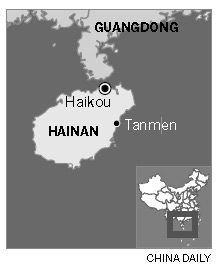
On May 6, the Philippine National Police intercepted a Tanmen-based fishing boat, Qiong Qionghai 09063, in the waters off Half Moon Shoal in the Nansha Islands, and detained all 11 members of the crew. The Philippine authorities claimed the fishermen had violated the country's anti-poaching laws by catching 500 endangered turtles in its "exclusive economic zone". Two fishermen, neither of whom is yet 18, were quickly released and returned to China, but the other nine have been charged with poaching.
In response, the Chinese authorities said the impounding of the boat violated international maritime law, and asserted that China has indisputable sovereignty over the Nansha Islands and the adjacent waters, including Half Moon Shoal.
Mai Miao's husband, Chen Yiquan, aged 38, and his father were on the impounded boat. They are now awaiting trial in the Philippines. "I talked to my husband on the telephone a few days ago. He said he wants to come home. We miss him a lot," she said. "I tried my best not to cry when we spoke, but..."
On May 21, the Philippine authorities released photos of the jailed fishermen. Mai said Chen and his father looked safe and well fed, but that hasn't lessened her concern. "The whole family depends on them and the boat. What can we do without them and the income they bring in?" asked the 38-year-old mother of two.
Fishermen are the first to sense any rise in tension in the South China Sea, according to Ding Zhile, head of the Tanmen Fisheries Association. "Information spreads faster among fishermen than the traditional news channels," he said. "Especially fishermen from Tanmen, because we operate on the maritime border."
"Tanmen is only a small fishing town, but it's very important because its residents work on the maritime frontier," said Ding. "Everything here is political."
President Xi Jinping visited Tanmen in April of last year. A huge photo of him talking to fishermen and shaking their hands now stands in the county's busiest street, near the port area.
According to the website of the county administration, Tanmen will be developed into the home port for all Chinese boats heading out into the South China Sea.
"Tanmen people have been fishing in the South China Sea, including the area around Huangyan Island, for generations," said Ding. "They are our home waters."
Fishing is the area's key industry. More than 170 of the boats in Tanmen are larger than 80 metric tons, and the local fishing industry employs more than 10,000 people, according to Ding, who said the county lacks alternative resources and has no industrial base, so the people's lives depend on the fish, crabs, lobsters and sea cucumbers they catch.
|
 |
| He Zijun, fishing boat captain, checks navigation equipment before a voyage. [Photo by Huang Yiming] |


Copyright 1995 - . All rights reserved. The content (including but not limited to text, photo, multimedia information, etc) published in this site belongs to China Daily Information Co (CDIC). Without written authorization from CDIC, such content shall not be republished or used in any form. Note: Browsers with 1024*768 or higher resolution are suggested for this site.
License for publishing multimedia online 0108263 Registration Number: 130349