Growing strategic rivalry distracts from cooperation









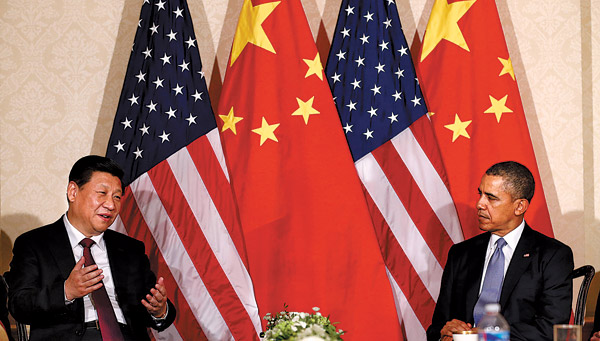 |
| President Xi Jinping meets with his US counterpart Barack Obama on the sidelines of the Nuclear Security Summit in The Hague on March 24, 2014. [Photo/Agencies] |
Returning to Washington this week after a month-long vacation in Shanghai, I found myself struggling to adjust, not only because of serious jet lag, but also because of the mood in this political town.
In a Senate Foreign Relations Committee hearing on Tuesday, two senior US officials from the State Department and Energy Department tried to convince lawmakers that renewing the bilateral civil nuclear cooperation agreement is in the best interest of the United States, but some lawmakers seemed unconvinced. They instead voiced their suspicions that China would apply US civil nuclear technology for military purposes and engage in nuclear proliferation.
Bilateral civil nuclear cooperation would be win-win cooperation helping China to develop its civil nuclear power to meet its energy needs and fight climate change, while creating many high-paying US jobs and helping US companies such as Westinghouse from becoming irrelevant to the vast China market.
However, some lawmakers were not aware of this at all.
On Wednesday, the same foreign relations committee held a hearing on the South and East China Seas with testimonies from Assistant Secretary of State Daniel Russel and Assistant Secretary of Defense David Shear. This time, officials and lawmakers were on the same page, a rare phenomenon in Washington: They all blamed China for the tensions in the region.
For Washington, it is only China that is the troublemaker in every dispute and problem. Although, even Shear admitted that some other countries in the region have built far more outposts in the Nansha Islands in the South China Sea.
The Chinese government has successfully solved border issues with 12 countries that share land boundaries with China, all through peaceful and diplomatic means and many with a major compromise by China. But most in the US don't believe that China and its maritime neighbors have the wisdom to solve their territorial disputes by themselves.
It is indeed foolish for anyone to suggest that China would threaten the freedom of navigation in the region, given that the country needs such freedom more than anyone else. Such deep suspicion and distrust of China's intentions have resulted in many books and essays in the US in the past months and years that call for tougher stance against China.
For example, in a 54-page report, Revising US Grand Strategy Toward China, the authors, Robert Blackwill of the Council on Foreign Relations and Ashley Tellis of Carnegie Endowment for International Peace, call on Washington to design a new grand strategy toward China that centers on balancing the rise of Chinese power rather than continuing to assist its ascendancy - pretty much a China containment policy.
To Tellis and Blackwill, China and the US are playing a zero sum game. But this is a huge distortion of the reality if you just look at the overall bilateral relationship, from the economy to student exchanges. There are a record of 270,000 Chinese students studying in US colleges and universities.
In Washington, it's often the paranoia about Chinese military modernization that overshadows or hijacks the much larger overall relationship. The same distrust of US intentions is also fast rising among Chinese who see the US as trying to encourage countries to gang up on China.
Lyle Goldstein, author of the book Meeting China Halfway: How to Defuse the Emerging US-China Rivalry, noted on Tuesday that if China and the US were on the same page, the two largest economies could do a lot of good things together to solve the world's problems.
The pledge made by Chinese President Xi Jinping and US President Barack Obama last November to fight climate change is clearly one such example. Yet the two nations' growing obsession with their strategic rivalry has prevented them from realizing the full potential of their relationship.
The author is deputy editor of China Daily USA. chenweihua@chinadailyusa.com