Engineers from China, Ecuador merge their minds









 |
| Construction of the Coca Codo Sinclair hydroelectric dam, the largest energy project in Ecuador, started in 2010.[Photo provided to China Daily] |
Disagreements were common for Chinese and Ecuadorean engineers during the research and design of the Coca Codo Sinclair hydroelectric dam, the largest energy project in Ecuador.
Disputes could last for an entire day, and some had to be shelved for resolution at a later date, according to Luo Xuannyu, who worked as a translator on the project between 2012 and 2014. Construction started in 2010.
However, it was through such heated discussions that both sides learned from each other, said Yin Dewen, director general of Yellow River Engineering Consulting Co's Overseas Project Engineering Institute.
Yin said the Ecuadoreans were introduced to new technologies, while the Chinese learned from their foreign colleagues' scientific approach to their work, reacting to circumstances one at a time instead of making judgments based on past experience, he said.
Yellow River Engineering is one of the companies behind the consortium that won the engineering, construction and procurement contract for the hydroelectric project in October 2009. The others are China's Sinohydro, Ecuador's Coandes and Italy's Geodato.
Yin said some technologies widely used in China for years failed initially to convince the Ecuadorean engineers. For example, he said, in building foundations, clay slurry is used in China to replace mud water in a drilled borehole so walls can be reinforced before concrete is injected. But the local experts were concerned that the clay might mix with the concrete and affect its hardness.
To convince local engineers, Chinese workers gave a demonstration. They also took Ecuadorean engineers to see hydroelectric projects in China to show them how some technologies are used, Yin said.
To smooth communications, Yellow River Engineering established the Coca Codo Sinclair Research and Design Institute, which employs more than 40 Ecuadorean engineers and helped with bridging differences in culture, language and technologies.
"It would have been hard to do the project without it," Yin said.
Christian Wladimir Cherrez Gavilanes has been with the research and design institute since 2010. Previously, he designed buildings with medium and low technical requirements and reviewed designs for low-rise buildings for the government.
He initially worked as an assistant to the Chinese engineers, but later as a member of the design team for key buildings in the Coca Codo Sinclair project, including the grit chamber, sluice gate and heliport.
"I'm thankful for the support and trust of Yellow River Engineering. Thanks to the rich knowledge and experience I got in the Coca Codo Sinclair project and support from Yellow River Engineering for my studies, I got my master's degree in civil engineering and will continue to study for an MBA, which will help qualify me in work related to technical management of major domestic and international projects," he said.
"We respect each other and have been cooperating well. The technical guidance from Chinese engineers is significant for the designing of the Coca Codo Sinclair project, which can supply 30 percent of Ecuador's electricity needs and save us $600 million on imported power," Gavilanes added.
Located in the Amazon Basin, 130 kilometers east of the Ecuadorean capital, Quito, the 1,500-megawatt hydropower facility produces an average of 8,800 gigwatt-hours a year.
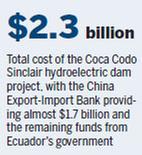
The total cost of the project was $2.3 billion. The China Export-Import Bank provided almost $1.7 billion and the remaining funds were from Ecuador's government.
The first four of the eight turbines became operational in April last year, while the remaining four turbines came online in November. The project has created 18,000 jobs.