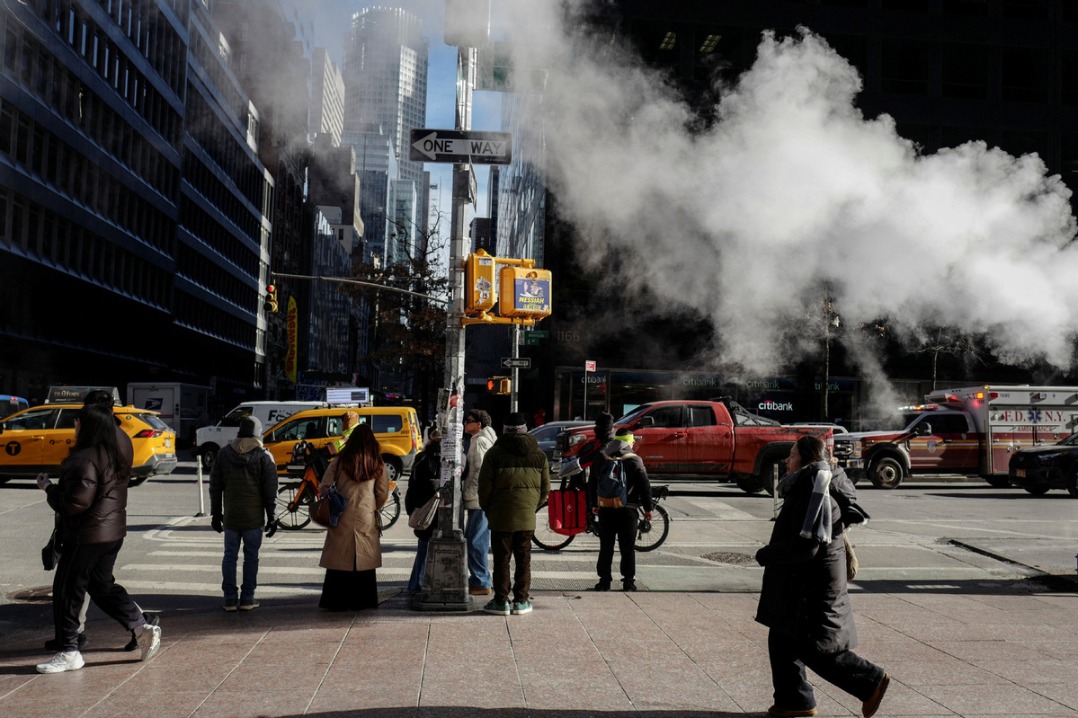
US citizens sweat over high costs of heating










PHILADELPHIA — Madeline Marchiano realizes that this winter's runaway heating prices mean she cannot afford to raise her thermostat enough to warm her entire South Philadelphia row house.
So Marchiano, who also lacks the budget to replace drafty old windows, avoids the colder rooms.
The heating bill is yet another high cost faced by many people in the United States like Marchiano, who says prices are "outrageous" for groceries and other staples.
"I try to survive," said the 61-year-old, who lives on a fixed income. "Like everyone else, I worry about bills."
Even before winter started, consumer advocates sounded the alarm on higher heating costs in light of torrid electricity demand growth and costly revamp of pipes and other infrastructure that have led to utility rate hikes.
US households are expected to spend $995 on heating this winter, an increase of 9.2 percent from last year, according to a December forecast from the National Energy Assistance Directors Association.
Of course, the final tally will depend on the weather. So far, the 2025-26 season has been a bear in Philadelphia, with forecasts of an arctic blast and a potential blizzard expected to boost usage further.
Through mid-January, the average temperature in Philadelphia was 2.3 C, the sixth-coldest since 2000 and about 6 degrees colder than the winter of 2023-24, said Chad Merrill, a meteorologist at AccuWeather.
The state of Pennsylvania bars utilities from shutting off low-income consumers during the winter months. But consumers who fall behind can face a shutoff once the moratorium ends at the end of March.
"It catches up to you," Luz Laboy, who assists low-income consumers through a maze of assistance programs, said of consumers who do not pay winter bills. She works at the Hunting Park Neighborhood Advisory Committee, an NGO in North Philadelphia.
Qualifying consumers are eligible for federal assistance through the US Low Income Home Energy Assistance Program, or LIHEAP, which pays an annual stipend, as well as crisis funding that provides grants of up to $1,000.
Other Pennsylvania programs allow consumers with large balances to establish a monthly payment plan or to apply to repair broken radiators.
Jose Rosario, 75, a retiree who lives on his monthly Social Security check of $1,038 and pays $375 to rent his basement apartment, came to the NGO for help to complete his LIHEAP application and manage a $4,000 gas balance.
More fraught
Laboy said this winter's number of applicants for LIHEAP is about the same as last year, but the process has been more fraught.
"It is a lot more stressful this year," she said, noting the program was delayed by the US government shutdown.
President Donald Trump's administration eliminated the Washington LIHEAP staff in the spring and had initially sought to zero out funding. But Congress ultimately maintained funding for the program.
Seth Blumsack, a professor of energy and environmental economics at Pennsylvania State University, tied this winter's increase in natural gas prices mainly to costs associated with replacing aging infrastructure.
This is also a factor behind higher electricity rates, though a bigger driver is the growth of energy-guzzling data centers, Blumsack said.
"Electricity demand in the US is increasing ... in ways we have not seen in decades," he said, pointing to the retirement of older generation units as another factor.
The issue resonates with Pennsylvania lawmakers like Representative Heather Boyd. Boyd's most recent electric and gas bill was for $860, up from $660 the prior month, for a 130-square-meter home in suburban Philadelphia, she said at a hearing on Tuesday on energy affordability.
"When I can't pay that, my community can't pay that," she said.
Agencies via Xinhua