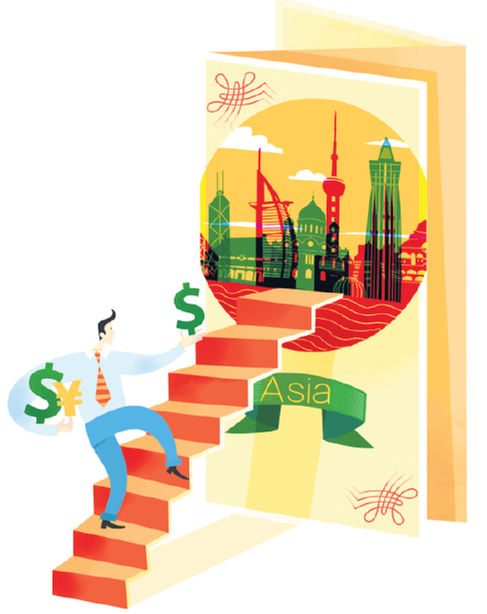
Can Asia take the next step to high income?









 |
| SHI YU/CHINA DAILY |
Today, more than 95 percent of Asians live in middle-income economies, compared to less than 10 percent in the early 1990s. This remarkable shift was driven by rapid economic growth, especially in China, India, and Indonesia.
The question now is: Can this largely middle-income region make a successful transition to high-income status?
The experience of developing countries in the last 50 years suggests this will not be easy. Many Latin American countries such as Brazil and Colombia have been middle-income economies for decades. Yet the rapid transition of the Republic of Korea and Singapore from middle to high income in only 25 years shows that it can be done.
Growth drivers tend to change as economies evolve. Accumulating physical capital remains critical as economies transition from middle to high income. But countries attempting this transition must make greater efforts to boost total factor productivity growth-or increased production from the more efficient use of inputs rather than simply using more inputs.
Over the past five decades, total factor productivity growth has accounted for almost 30 percent of economic growth for those economies that transitioned to high income status, as opposed to 10 percent for the economies that remained in the low- or middle-income category.
To boost total factor productivity, Asia's middle-income economies should focus on scaling up innovation, developing high-quality infrastructure, and enhancing human capital.
Innovation becomes more important as an economy advances. High-income economies have more than 2.5 times the research and development stock per worker as middle-income economies. Innovation breeds diversity and sophistication in production, which in turn support higher productivity and better wages.
Enhanced human capital, or a more skilled and knowledgeable workforce, is fundamental for an advanced economy. It spurs growth through greater diversity and sophistication in production, and promotes equity. A recent Asian Development Bank study found that a 20 percent increase in human capital spending per capita can boost labor productivity by up to 3.1 percent and narrow labor income inequality by up to 4.5 percent.
Middle-income economies, with an average of just 6 years of schooling, need to close the education gaps with high-income economies, which average more than 10 years at school.
But even more important is the quality of education. In globally standardized math and science tests, the proportion of top-performing 15-year-old students is on average 4-to-5 times greater in advanced economies than middle-income ones. Students with strong abilities in reading, writing and solving problems are more likely to become innovators. A one-time increase in public infrastructure investment equal to 1 percent of GDP has been shown to immediately lift economic output by 0.3 percent of GDP, and by nearly 1.2 percent after 7 years.
Different economies prioritize different types of infrastructure. Low-income economies focus first on such basic needs as water supply, sanitation and transport. As economies evolve, they attach more importance to electricity supply and advanced infrastructure such as information and communication technology.
ICT promotes innovation by fostering knowledge creation and dissemination. Middle-income economies that move to high income have 18 more internet users and 31 more mobile phone subscriptions per 100 people than other middle-income economies. By investing in ICT, economies can boost innovation and productivity, thereby lifting incomes.
To encourage innovative entrepreneurship, there must be adequate investment in education. Governments should also promote stronger intellectual property protection and rule of law, better access to finance, and effective competition policies.
Beyond adequate public spending on education, enhancing human capital requires a sound education system.
Asia needs to invest a total of $26 trillion from 2016 to 2030 in infrastructure that can withstand and mitigate climate change. To meet the needs, countries should increase public funding through fiscal reforms including tax, and by reorienting spending and borrowing prudently.
An improved investment climate will encourage private sector financing for infrastructure, as would moves to deepen capital markets and improve the planning, design and execution of infrastructure projects.
Reaching high income through sustained rapid growth can be done. In fact, it's the natural next step for a region that has already come so far so quickly.
Juzhong Zhuang is deputy chief economist, and Donghyun Park is principal economist at the Asian Development Bank.