Thucydides's Trap does not have to be inevitable









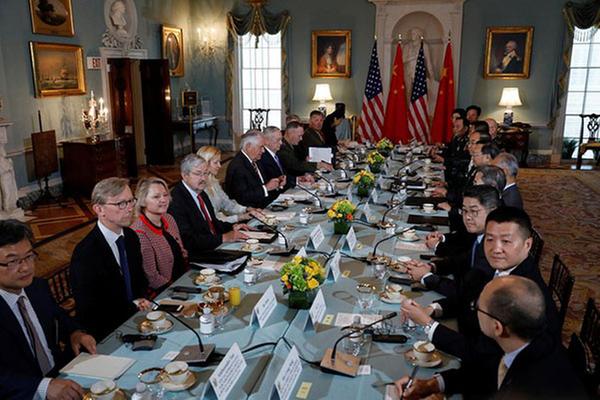 |
| US Secretary of State Rex Tillerson and Defense Secretary James Mattis meet with Chinese State Councilor Yang Jiechi and General Fang Fenghui, chief of the People's Liberation Army's Joint Staff Department prior to the US-China Diplomatic and Security Dialogue at the State Department in Washington, US, June 21, 2017. [Photo/Agencies] |
Harvard University professor Graham Allison had a question for me when I chatted with him last week about his new book: Destined for War: Can America and China Escape Thucydides's Trap?
He found that some Chinese are uncomfortable with the word "inevitable" in his description of the Thucydides's Trap.
"They say 'war is not inevitable'. I say, 'Correct, correct, it's not inevitable'," says Allison.
While Thucydides argued that the rise of Athens caused fear in Sparta and made war inevitable, Allison said Thucydides does not really mean inevitable. It was an exaggeration.
He wanted to know what the Chinese understanding of the word "inevitable" is. "Am I falling into a language trap?" he asked.
I understand Allison's concern. People, both in and outside China, have been talking a lot about the possibility of China and the United States falling into the Thucydides's Trap.
The "Destined for War" in the title of Allison's book sounds sensational, but Allison is simply trying to give a warning to the rising power and existing power. They should learn from history to better handle possible flashpoint issues, such as the Korean Peninsula, Taiwan and South China Sea. This is despite his firm belief that neither country wants a war with the other-a war that would be mutually destructive and catastrophic to the planet.
Like some other US scholars, Allison seems to believe that China will act just like the imperialist US in the 19th century if it becomes powerful enough, admitting that the US has had more unnecessary wars than necessary wars in its short history.
But China is, of course, not the US. In the last four decades, China has worked to strengthen the existing global governance institutions system such as the World Trade Organization, International Monetary Fund and the World Bank rather than undermining them. The Asian Infrastructure Investment Bank and the Belt and Road Initiative are supplementary to the current global system.
Allison believes both countries need to make some painful adjustments, admitting that the US is only "slowly" adjusting to a rising China. For example, he believes that the US does not need to support every claim of the Philippines or Vietnam in the South China Sea.
Such adjustment won't be easy for either of them, especially as the US is feeling deeply anxious about no longer being No 1 in the world in increasing number of areas, and it is showing it is unwilling to share power as much as it should be.
Making compromises or admitting mistakes is no easy job for a superpower. For example, in the past weeks, US officials and lawmakers have called on China to use more leverage to pressure the Democratic People's Republic of Korea to give up its nuclear weapon program. But Allison believes the US has set a bad example in this regard.
The US and its NATO allies pursued regime change in Libya in 2011 after Muammar Gadhafi gave up its nuclear program. The US and its allies also toppled Saddam Hussein in Iraq on the pretext of finding alleged weapons of mass destruction in 2003. Both sent the wrong message to the DPRK leaders.
There is no doubt that the US should take measures to correct its past mistakes in order to inject confidence in possible negotiation on the denuclearization of the Korean Peninsula. How about accepting China's dual suspension proposal-for the DPRK to suspend its nuclear and missile activities, and for the US and the Republic of Korea to suspend their large-scale military drills?
The author is deputy editor of China Daily USA. chenweihua@chinadailyusa.com