China is not an evil empire facing US









 |
| ZHAI HAIJUN/CHINA DAILY |
The collapse of the Soviet Union left the United States alone at the pinnacle of power. That was good for world peace but bad for the Pentagon. Since then much of the US foreign policy establishment has searched for a new enemy to justify a military buildup.
President Donald Trump doesn't appear to think much about geopolitics, his primary interest seems to be trade. But there are many hawks in the US who are presenting China as the next big threat.
Yet the Pentagon's latest report on the Chinese military suggests this is not for the purpose of protecting US territory, population and liberties, but rather to preserve Washington's dominance in Asia.
The latter may be advantageous, though US policymakers do not always do the right thing. But it's not worth the price of preserving an oversize military, let alone going to war.
In its report, Military and Security Developments Involving the People's Republic of China 2017, the Department of Defense noted that China had improved its capacity to undertake joint operations and fight short conflicts further from the mainland. Moreover, the report noted that "China has leveraged its growing power to assert its sovereignty claims over features in the East and South China Seas" and "used coercive tactics, such as the use of law enforcement vessels and its maritime militia, to enforce maritime claims and advance its interest in ways that are calculated to fall below the threshold of provoking conflict".
Perhaps most significant, the Pentagon noted that, "China's leaders remain focused on developing the capabilities to deter or defeat adversary power projection and counter third-party intervention including by the United States-during crisis or conflict." That includes limiting the US' technological advantage.
None of which is surprising, or particularly threatening to the US; of course, Washington would prefer a docile China which accepts the US' lead. But rising powers rarely agree to remain a vulnerable second.
Nevertheless, the US has a much larger military and spends roughly four times as much on its armed forces. The US has more than six times as many nuclear warheads deployed and more stockpiled. The US possesses 10 carrier groups, while China has one rudimentary aircraft carrier.
Most important, Beijing has only modest ability to project power, especially to attack the continental US. In contrast, the US military has multiple means to strike China.
Finally, Washington augments its power through alliances with most of the world's other industrialized states and projects it by means of multiple bases along China's eastern periphery. China is essentially alone and is surrounded by countries with which it has been at war over the last century. Some territorial disputes could turn violent.
In short, in the near-to mid-term, at least, in any real sense US has little to fear from China. Even if Beijing desired to threaten the US homeland, conquer US territories, or interdict US commerce, it has little ability to do so. What China seeks is to end Washington's dominance along the former's coast, an objective more defensive than offensive.
And economics is on Beijing's side. It is far costlier to project power than deter its use. How much is Washington willing to spend to maintain the overwhelming military superiority necessary to impose its will on China throughout the latter's own region. Such a military is going to grow less affordable over time.
The Congressional Budget Office predicts trillion dollar annual deficits within a decade, and rising outlays on entitlements in future years. Are Americans prepared to sacrifice domestic needs for defense not of their own nation, but of allied states which underfund their own militaries?
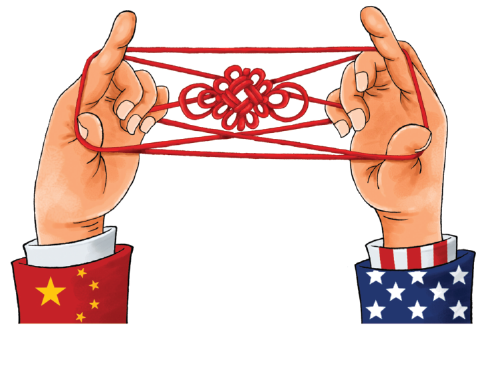
The US and China will inevitably have disagreements. However, they have no vital interests in conflict. Indeed, there is no serious cause for conflict if Washington is willing to accommodate China's rise. The US government's primary duty is to protect Americans' interests, not Washington's influence.
The author is a senior fellow of Cato Institute.