



Scientists say tiny algae eat pollutants









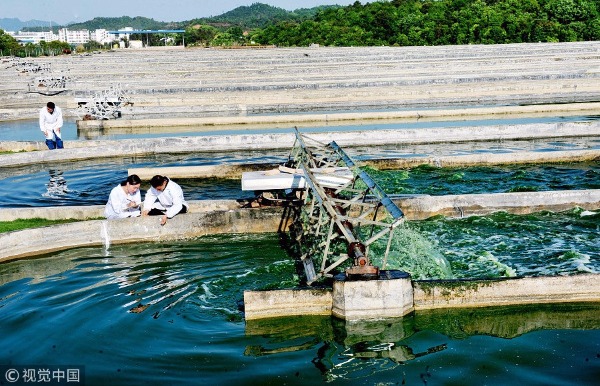
Chinese scientists have discovered a new strain of microalgae — microscopic, single-cell photosynthetic organisms that produce oxygen — capable of absorbing 90 percent of the greenhouse gas and industrial fumes that are components of smog, while producing high-quality algae oil for a wide range of products.
Wang Qiang, the lead scientist behind the project at the Chinese Academy of Sciences' Institute of Hydrobiology, said the microalgae have recently entered a test phase for cleaning emissions produced by the refineries of Sinopec, China's largest oil and gas company.
"Our microalgae's highest consumption efficiency for nitrogen oxides — a key ingredient for smog — can reach around 96 percent," he said. "This new microalgae can greatly reduce industrial emissions and curb air pollution in a cost-effective and environmentally friendly way."
A traditional nitrogen oxide removal installation requires high energy and pressure, and has an annual cost of about 640,000 yuan ($98,000) to remove 1 metric ton of gas.
But tests show the algae-based cleansing method is safer, requires less energy and produces algae biomass that can be used and sold for more than 210,000 yuan a ton, he said.
"Once the microalgae population grows to a certain volume, we can extract the oil from the microorganisms to produce biofuel, fish feeds, fertilizers, health supplements and a wide range of products," Wang said.
For example, DHA is a common substance traditionally extracted from fish oil that can be added to infant formula to promote healthy brain growth. However, companies are extracting the same ingredient from microalgae to reduce overfishing and to avoid potential contaminants found in fish oil due to pollution, he said.
Microalgae were Earth's first organisms capable of photosynthesis, the process of converting water and carbon dioxide into oxygen and carbohydrates by using sunlight, Wang said. Microalgae began this process 3 billion to 3.5 billion years ago, and they could turn into crude oil once buried underground for millions of years.
"Around 60 to 75 percent of the oxygen on Earth came from these tiny organisms that comprise less than 1 percent of Earth's total plant biomass," he said. "Moreover, microalgae are the foundation that supports the food chain for aquatic life. It is fascinating how life on Earth is dependent on these simple beings."
Scientists around the world have been trying to maximize the potential of microalgae for years. In June, scientists in the United States made a mutant strain of microalgae that can grow as fast as its wild variant but produce more than double the oil, according to Nature Biotechnology, an international science journal.
In September, biologists from New York University Abu Dhabi in the United Arab Emirates engineered a new form of microalgae that can grow rapidly in desert conditions. They said the organism can be used to sustainably produce biofuels, animal feed and other bio-based products on barren land, according to the university.
However, a key challenge with microalgae is cultivation and harvesting using a cost-efficient method, said Wang. The world currently produces only around 100,000 tons of microalgae a year, "not nearly enough to satisfy energy or manufacturing needs", he added.
Wang estimated that the total market value of algae-based products could exceed trillions of dollars.
In addition, he said, public and government officials often have the misconception that microalgae cause algae blooms, the rapid, uncontrollable growth of algae that turns seawater or freshwater into a toxic, pea-green soup that can destroy marine ecosystems.
"However, the real cause of algae blooms is nutrient-rich wastewater and fertilizers," said Wang. "We hope the public can learn more about the benefits that microalgae have for the environment and human health."
Contact the writers at zhangzhihao@chinadaily.com.cn


- Battle Beats | When duty calls
- China expects over 2.05 million daily cross-border trips during Spring Festival holiday
- Xinjiang through my eyes: Maierdan's cafe of memory
- Chinese researchers build quantum key distribution chip network covering 3,700 km
- Hong Kong sectors voice strong support for Jimmy Lai's sentence
- Mainland official extends greetings to Taiwan compatriots ahead of Chinese New Year











