Blame the privileged for the anger in US









Many blame today's populist rebellion in the West on the far right, which has won votes by claiming to be responding to working-class grievances, while stoking fear and promoting polarization. But, in blaming leaders who have seized on popular anger, many overlook the power of that anger itself, which is aimed at elites whose wealth has skyrocketed in the past 30 years, while that of the middle-and lower-income groups has remained stagnant.
Two recent analyses get to the heart of the issues at play, particularly in the United States, but also in the rest of the world. In his new book Tailspin, journalist Steven Brill argues that US institutions are no longer fit for purpose, because they protect only a few and leave the rest vulnerable to predatory behavior in the name of free market. According to Brill, this is an upshot of the US' meritocracy: the best and brightest had the chance to climb to the top, but then essentially pulled the ladder up behind them, as they captured democratic institutions and used them to entrench special privileges for themselves.
Author Matthew Stewart agrees, arguing that, "the meritocratic class has mastered the old trick of consolidating wealth and passing privilege along at the expense of other people's children". Stewart shows that in the mid-1980s, the share of US wealth held by the bottom 90 percent of the population peaked at 35 percent; three decades later, they owned just 20 percent, with almost all of what they lost going to the top 0.1 percent. The 9.9 percent between these two groups-what Stewart calls the "new American aristocracy"-comprises what used to be called the middle class. In 1963, the 90 percent needed to increase their wealth sixfold to reach the level of the 9.9 percent; by the 2010s, they needed 25 times their wealth to reach that level.
Much of the US population is working harder than ever, yet has suffered a decline in living standards, compounded by high levels of household debt and, in many cases, lack of health insurance. The top 10 percent have easy access to higher education that will enable their children to have the same privileges as them; the bottom 90 percent must work much harder to cover sky-high tuition fees, and typically graduate with a heavy debt burden. The top 10 percent receive first-rate medical care; the bottom 90 percent often do not, or must pay an exceptionally high price for it.
Taxation is supposed to level the playing field. But US Republicans have long pushed to lower taxes on the rich, arguing that lowering marginal tax rates will promote investment, employment and economic growth, which will cause the wealth to "trickle down" to the rest of society. In fact, tax cuts for the rich further entrench their advantages, exacerbating inequality.
Making matters worse, the poor pay more indirect taxes (on land, real estate and consumer goods), and the bottom 20 percent of the US population pays more than twice what the top 1 percent pays in state taxes. Add to that the challenges posed by automation and robotization, not to mention increasingly frequent and intense natural disasters, and it is not hard to see why so many people are so furious.
Not wise to divert anger to immigrants, trade
According to Stewart, the 9.9 percent is "the staff that runs the machine that funnels resources from the 90 percent to the 0.1 percent," happily taking its "cut of the spoils". But the inequality that this machine generates can have serious consequences, as it spurs social discontent and, as we are seeing in the US today, erratic policymaking. As the Austrian historian Walter Scheidel argues, inequality has historically been countered through war, revolution, state collapse or natural disaster.
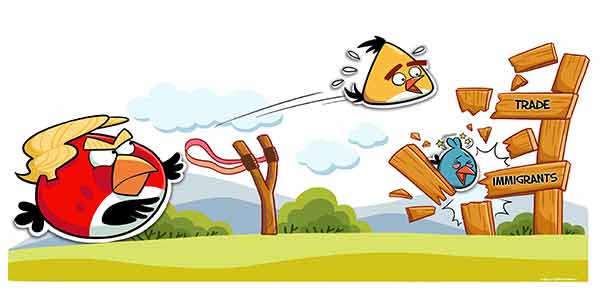
Avoiding such a dramatic event would require the 10 percent to do a much better job of advancing the interests of the 90 percent, in terms of income, wealth, welfare and opportunities. Yet a combination of economic myopia and political polarization has led many instead to try to divert popular anger toward immigrants, China, and trade (including with close allies). As a result, the entire world is now caught in an escalating protectionist war that nobody will win.
It is true that, historically, internal contradictions and imbalances have often led to interstate conflict. But that is not inevitable. Rather, the outcome depends on the quality of leadership. In the US, for example, George Washington, Abraham Lincoln and Franklin D. Roosevelt succeeded in strengthening their country because they recognized the need to address internal divisions in the light of America's core values, global position and long-term goals.
US President Donald Trump has exploited popular anger to advance his own interests. But he did not create that anger; America's elites have done that over decades, creating the conditions for a figure like Trump to emerge. Now that Trump is in charge, the conditions of the 90 percent are set to deteriorate further. His approach to trade, in particular, will not only fail to help the people he purports to represent; it will also destroy the sense of fairness and stewardship that has historically bound the masses to their leaders.
Blaming outsiders is politically expedient. But the only way to "make America great again" is by addressing its internal injustices. No import tariff or border wall can do that.
Andrew Sheng is distinguished fellow at the Asia Global Institute at the University of Hong Kong and a member of the UNEP Advisory Council on Sustainable Finance. And Xiao Geng, president of the Hong Kong Institution for International Finance, is a professor at the University of Hong Kong.
Project Syndicate