Focus on services trade in Sino-European cooperation









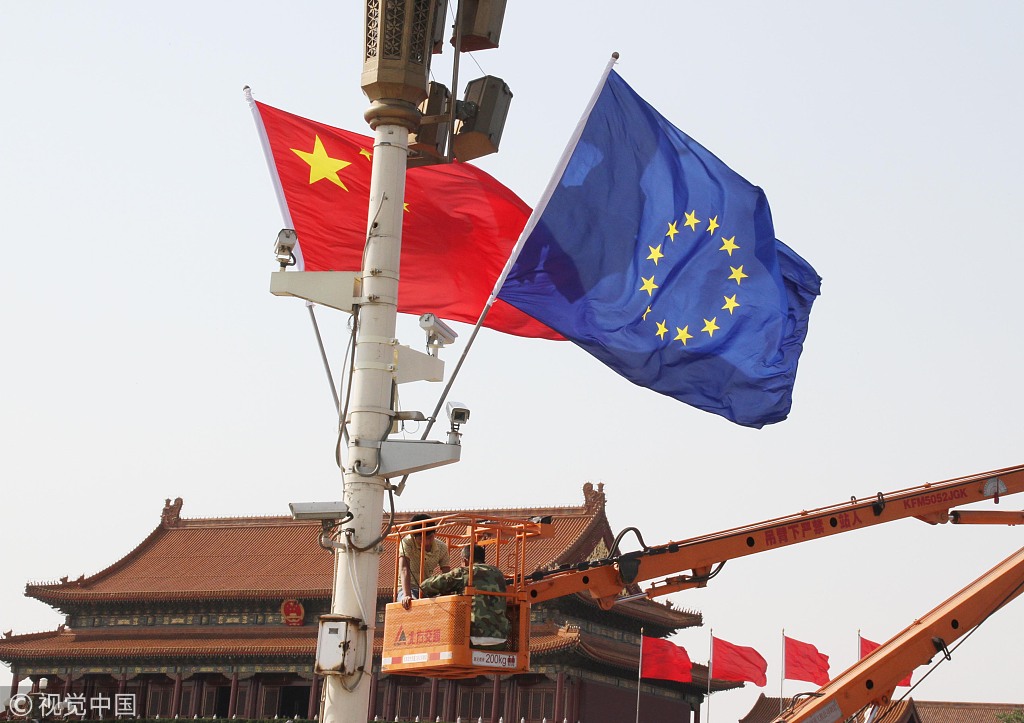
If breakthrough is made, EU will be the first to enter China's market with 1.3 billion consumers
Against the background of increasing trade protectionism, populism and unilateralism, China and the European Union are facing the major task of strengthening economic and trade cooperation, safeguarding the multilateral trading system, and responding to the trend of deglobalization.
The rapid development of services trade has become a prominent feature of economic globalization. At present, the GDP of China and the EU (27 countries) accounts for 36.6 percent of the world's total, and their trade volume accounts for 44.1 percent of the world's total. Focusing on services trade to deepen Sino-European economic and trade cooperation will have a major impact on China's economic restructuring and upgrading, as well as on the economic recovery of the EU and economic globalization.
Services trade is key to deepening China-EU economic cooperation
On the one hand, the complementarity of the Chinese and European economies is mainly reflected in bilateral services trade. For example, the EU has unique advantages in the fields of information technology, smart manufacturing, life sciences, energy and environmental technologies, health services, tourism and education, for which there is huge demand in China. In the future, with the acceleration of China's economic transformation and the changes in the EU's internal and external environment, this complementarity will be significantly enhanced.
On the other hand, Sino-European services trade will release tremendous potential. It is estimated that by 2020, the total size of China's consumer market will reach 50 trillion yuan ($7.52 trillion), of which services-based consumption will account for about 50 percent. China's consumption growth from 2016 to 2021 is expected to be equivalent to the size of the UK consumption market in 2021. If a major breakthrough is made in the liberalization and facilitation of China-EU services trade, the EU will be the first to enter China's services trade market with 1.3 billion consumers, thus realizing the potential of China's economic transformation and the EU's economic development and employment.
Promote the liberalization and facilitation of investment and trade
Deepening Sino-European services trade cooperation depends on further enhancing the institutional arrangements for liberalization and facilitation of trade and investment in the services industries of both sides, and to benefit China-Europe economic and trade relations. However, the talks between China and the EU only focus on a bilateral investment treaty and not a free trade agreement, which leads to great difficulty and limited results.
The disagreements between China and the EU such as the openness of services trade that are encountered in the bilateral investment treaty negotiations need to be resolved within the framework of the FTA. To this end, it is recommended that the China-EU investment treaty negotiations and services trade treaty negotiations be combined as soon as possible to achieve an overall breakthrough of investment and trade in the services sector.
The key lies in that China needs to open up the services industry market to the EU, and the EU needs to liberalize services export market to China, such as reducing and eliminating hidden technical trade barriers and lifting restrictions on high-tech exports.
In general, if the level of China-EU trade liberalization and facilitation is significantly improved, the proportion of China-Europe services trade to China's total services market is expected to increase to more than 20 percent, which means that the services trade between China and Europe will reach 177 billion euros ($207.16 billion), 2.6 times the current volume.
Delivering the keynote speech at the opening of the Boao Forum for Asia annual conference in April, President Xi Jinping proposed to relax market access for the services industry, create a more attractive investment environment, strengthen intellectual property protection, and take the initiative to expand imports. And relevant policies have been implemented.
In the next few years, while China further expands its services market, it needs the EU to take pragmatic action to open up the market, especially relaxing restrictions on services export to China, such as reducing and eliminating hidden technical trade barriers, and lifting restrictions on high-tech exports except those related to national security.
Promote trade cooperation under Belt and Road Initiative framework
With the basic mission of promoting free trade, the initiative, focusing on capacity cooperation and services trade and supported by infrastructure construction, has become a new platform to oppose trade protectionism and build an open world economy. For China and Europe, the initiative not only provides significant opportunities for deepening bilateral cooperation, but also creates opportunities for potential third-party markets.
Most of the countries linked to the Belt and Road Initiative are developing countries and their demand for services trade such as financial insurance, information, communications and environmental protection will increase while accelerating capacity cooperation.
To this end, on the basis of promoting cooperation between the initiative and European development strategies, China with the advantage in production capacity and the EU in the services industry will jointly promote capacity cooperation and the integration of services trade and develop third-party markets for mutual benefits.
The author is president of China Institute for Reform and Development. He contributed this article to China Watch Institute, a new think tank platform powered by China Daily.