Protectionism name of the game US plays









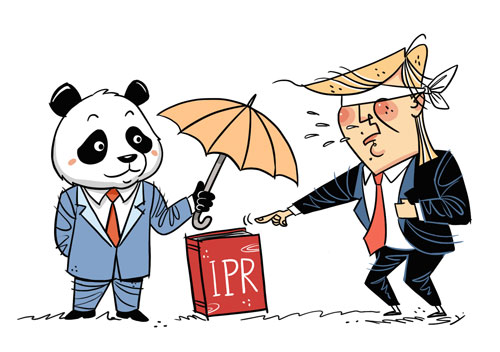
The United States has accused China of "coercive technology transfer" and "infringing upon" its intellectual property rights and interests, but without presenting any evidence. To reach a preconceived conclusion, the US is on a "fault-finding mission" that gives short shrift to facts and logic.
For instance, the report of the investigation against China under Section 301 of the US Trade Act of 1974 is nothing but another example of the US' customary tactics of using IPR as a pretext to take protectionist measures.
The report says China uses rubber stamps to force US enterprises to transfer technology. But the fact is, China replaced the approval system with a negative list four years ago, and has not made technology transfer a prerequisite for foreign enterprises to get the green light for doing business in China.
The report also accuses China of invading the US business network. But all the evidence it cites are from so-called anonymous experts, US law enforcement departments or private sources. And its conclusion that China is lax about IPR protection is mostly based on the perception or intuition of nameless stakeholders.
As a matter of fact, the US has benefited from its technological cooperation with China, especially from the Chinese market. Statistics show the US pockets the fattest surplus in global IPR trade. In 2016, the total global IPR royalty hit $272 billion, and 45 percent of that went to the US, 24 percent to the European Union and 14 percent to Japan. The IPR royalty China paid soared from $1.9 billion in 2001 to $28.6 billion last year, and its annual IPR trade deficit has crossed $20 billion.
Many Chinese enterprises in such key sectors as semiconductors, telecommunications and higher-end equipment manufacturing rely on imported parts and components, and have to pay huge amounts as royalty to the technology owners abroad. Thanks to its strong innovation capability and fast-developing technology sector, the US sits right on top of and exercises excessive say in the global industrial value chain.
Take smartphone manufacturing for example. In their cooperation with US partners, the labor-intensive Chinese enterprises' interest ratio is very low as they just assemble the parts, creating limited value added. In contrast, the US enterprises, such as Qualcomm, Intel, IBM and Apple not only own the core technologies and thus make a lot more profits, but also set the global technological standards and industrial rules.
Still, China has greatly improved IPR protection and the technology transfer system, which US enterprises and entrepreneurs have recognized.
China is also catching up with the industrialized countries in research and development. On average, its R&D input has increased more than 10 percent a year since 2012 to reach 1.75 trillion yuan ($264 billion) last year, second only to the US. And the number of patent applications in China totaled 1.38 million last year, a year-on-year increase of 14.2 percent. In fact, China has accounted for the highest number of patent applications in the world for seven consecutive years.
Besides, China got over 30,000 patents recognized by the Patent Cooperation Treaty last year, the highest after the US and Japan.
That some foreign enterprises have submitted their patent applications in China speaks volumes of China's effective IPR protection. According to the State Intellectual Property Office, US enterprises obtained 23,679 patent licensing in China last year, with Qualcomm topping the list.
Effective IPR protection, elevated to the level of a national strategy, has helped improve China's business environment. The country has also increased the punishment for IPR violations, established IPR courts nationwide and conducted special campaigns to strengthen IPR protection and create a fair and transparent business environment, in which both national and foreign enterprises are treated equally.
Thus it is clear that the US' desperate efforts to project itself as an IPR victim to get the upper hand in its trade disputes with China, which constitute an abuse of intellectual property institutions, are aimed at paving the way for unilateral and protectionist actions.
The author is a researcher in economics at the Chinese Academy of Macroeconomic Research.