



Staying agile in treacherous waters









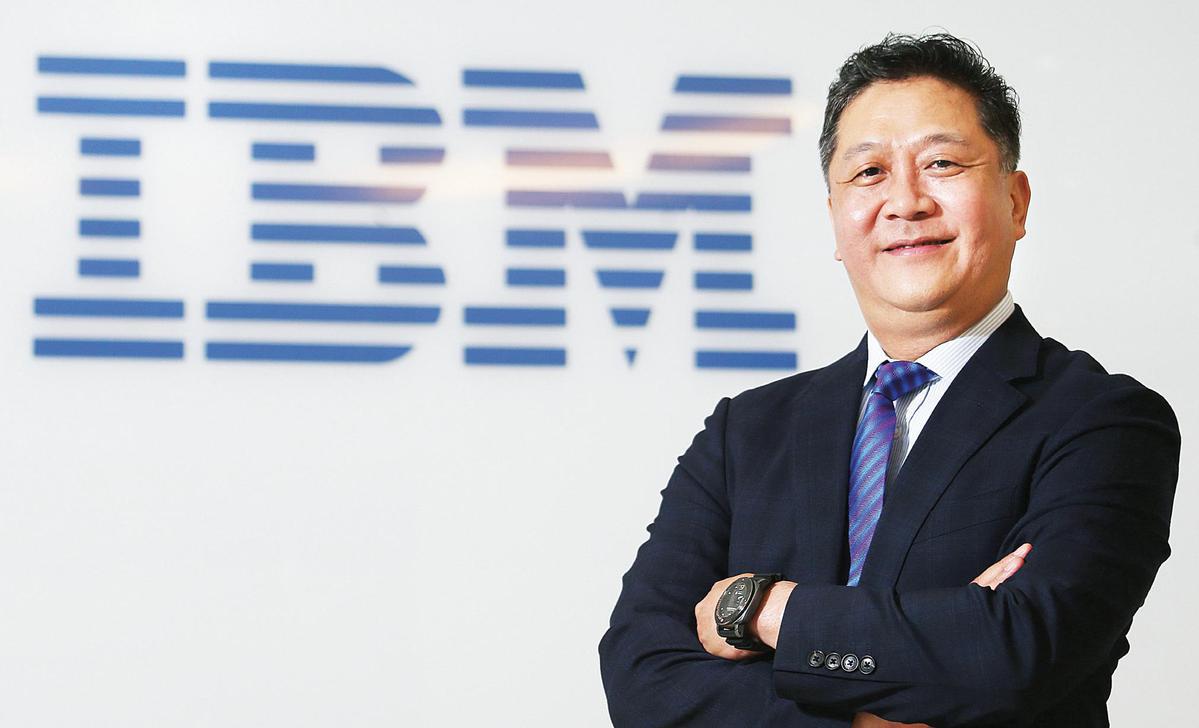
Tech titan IBM prides itself on a 107-year history that has withstood the turbulent winds of change in the corporate landscape. Group executive Francis Ngai tells Evelyn Yu their 'end-to-end' road map and a 'first-mover' advantage are the trump cards.
Francis Ngai Yi-cheong is among the rare breed of the so-called "loyal corporate soldiers" in the modern workplace — rising through the ranks from a sales representative to general manager of IBM China/Hong Kong.
He has been with the "Big Blue" for well over three decades since 1987, and can probably lay claim to being one of the best persons to tell the transformation story of the US-based tech giant.
When Ngai joined IBM in the 1980s, he sold mainframes — bulky-sized computers used primarily by large organizations for critical applications and bulk data processing, and other hardware products to the public sector — the group's core business back then.
Building itself into a dominant server and hardware supplier, IBM grew to become a service and consultancy provider in the late 1990s and early 20th century — the peak of the "dot age" with internet startups mushrooming across the globe.
It was around that time that IBM acquired PwC Consulting — in 2002 — and quickly repositioned itself to offer not just products, but industry expertise to enterprises.
Today, with disruptive technologies like artificial intelligence, cloud and internet-of things, reshaping the corporate world landscape, the century-old company is morphing itself into a cognitive solutions and cloud platform provider.
Strategic imperatives, whereby IBM refers to its new businesses, including cloud, analytics, mobile, social and security services as against traditional hardware sells, raked in $36.5 billion, or 46 percent of the group's revenue last year, according to its annual results.
It is Ngai's prime responsibility to promote its flagship cloud and AI business in Hong Kong and on the Chinese mainland to make smarter business.
While Amazon still holds pole position in cloud services, commanding more than one-third of the global market share as of the first quarter of 2018, according to Synergy Research Group, IBM came in third after Microsoft, with a relatively stable market share of 8 percent.
As Amazon continues to enjoy leadership status in public cloud and a big client base of small and medium-sized enterprises, thanks to its relatively low price in public cloud, IBM has a reputation of winning big contracts with governments and big corporations worldwide.
The Australian government had just clinched a $1-billion deal with IBM for bundled products and services, including blockchain, AI and cloud, for the next five years.
Winning big contracts
Established in 1911 in New York City, IBM boasts enduring stability for its hardware, and its close and continuous partnerships with various government departments and big corporations are among the pluses that have earned the company big contracts, reckons Ngai.
IBM's presence in Hong Kong could be dated back to 1957 when it set up a four-person office in Wing On Life Building, Central, to market office products, including electric typewriters, time systems and electric typing calculators, bulky objects that were delivered to customers in rickshaws.
Today, IBM cloud is used by many big enterprises, including Hang Seng Bank, and many of its clients in Hong Kong are using hybrid clouds — a combination of private cloud that's designated to a single organization and public cloud where client store their data in the provider's data center shared with other clients, and that is the trend.
After acquiring data center operator Softlayer in 2013, IBM now runs 56 data centers globally, and is expecting potential acquisitions to grow its base, says Ngai. The group is dedicated to providing more added value service for clients with multiple clouds from multiple providers. IBM offers one-stop services in management and maintenance of such accounts.
The launch of IBM's AI arm, IBM Watson, which is named after its first chief executive Thomas Watson, was perfectly timed on the tailwinds of the digital transformation of corporations.
Various industries in Hong Kong are leveraging IBM Watson to roll out chatbots/virtual assistants to help enhance engagement and experience, including Hang Seng Bank's HARO for retail banking customers; Sino Group's BT-1 for employee IT services and support; and Towngas' Tinny that is offering AI-backed customer services.
Custom-made AI solutions to various business scenarios hinged on the industrial expertise across different sectors, and it's the trend of many AI providers to boost their consultancy services, according to Ngai, and the incorporation of consultancy in IBM years ago has given it first-mover advantage.
"The deep knowledge about our clients is our differentiator. We have people who know about supply chains, credit cards or cyber securities, when there is a project. Whether it's mobile apps or virtual banks, we have an end-to-end road map," says Ngai, adding that IBM has more than 300 consultants in Hong Kong.
Responding to recent reports of cases where IBM Watson Health had been giving "unsafe and incorrect" treatment advice for cancer, Ngai explains that machine learning of AI-backed engines over the vast volume of cases does give AI an edge in speed and accuracy over human beings. Yet, he acknowledged that the intelligence of AI could be "biased" at this stage, and no human being, or machine, is infallible. "For example, the red color under sunshine and red color in the dark room can be very different."
IBM has been undertaking several initiatives to remove the bias of circumstances, so its AI products could be more intelligent and nuanced, Ngai tells China Daily.
Pushing for change
For a century-old big corporate manned by over 380,000 employees globally, IBM is like a giant vessel for which making any sudden turn or changing course would not be easy even in calm waters.
The "Big Blue", somehow, has managed to stay agile in a treacherous business environment. Pushing for change, or building an open and innovative environment will be at the fore of IBM's management, says Ngai.
Ngai's office, located on the 12th floor of PCCW Tower in Taikoo Place, could barely live up to being an "office", as it is a big window seat area wrapped up by some flimsy plastic clapboards in the middle of the office area. In this way, Ngai says his employees could easily come to talk to him after knocking on the clapboards, as there is no "door" as well.
Starting as a sales person after graduating from the Chinese University of Hong Kong as a statistics major for IBM in 1987, he left the company briefly for four years in 2000. After rejoining the company in 2004, he has been taking up multiple posts, ranging from executive assistant to the chairman to director of commercial business of IBM Greater China Group.
He has also been working on telecommunication, distribution, cloud and AI business in Hong Kong and on the mainland.
The full spectrum of IBM's business is what makes him stay with the group. He wants to be sure his employees can enjoy the same learning curve that fosters both skills and innovative mentality as he did.
Job rotation is very common in IBM, Ngai reveals, and it is their human resources practice to have each employee roll out his or her career progression plan in three and five years, and it's the management's key responsibility to ensure that employees can achieve their goals.
In 2017 alone, IBM received 9,043 US patents, ranging from AI, could computing, blockchain, quantum computing to cybersecurity and other technologies that help to build smarter business.
Contact the writer at evelyn@chinadailyhk.com


- Hong Kong's new year fairs bloom with festive spirit
- Battle Beats | When duty calls
- China expects over 2.05 million daily cross-border trips during Spring Festival holiday
- Xinjiang through my eyes: Maierdan's cafe of memory
- Chinese researchers build quantum key distribution chip network covering 3,700 km
- Hong Kong sectors voice strong support for Jimmy Lai's sentence











