Auto sector grapples with trade policy shifts









Three years ago, the Association of Global Automakers launched “Here for America”, which set out to tell how the US auto industry was a beneficiary of open investment policies, reduced trade barriers and the ability to export vehicles around the world.
However, “in today’s environment of high tariffs and managed and centrally planned trade, that original mission seems kind of quaint,” John Bozzella, president and CEO of the Washington-based body representing US operations of international automakers and suppliers, said on Tuesday.
Speaking at the “US Automotive Industry Needs Free Trade” discussion at The Heritage Foundation, Bozzella said the “misapplied 232 tariffs” are driving up costs in the auto industry, and the uncertainty in the current trade policy is causing headwinds for the sector, whose future lies in exports.
In April 2017, on the basis of Section 232 of its Trade Expansion Act of 1962, the US administration initiated investigations against steel and aluminum products from numerous countries, including Mexico, Canada and China.
As a result, the Trump administration announced in March that it would impose a 25 percent tariff on imported steel and a 10 percent tariff on aluminum imports from most countries.
“Tariffs on steel and aluminum as a result of the 232 investigation have already increased the cost of auto production in the United States, making us less competitive to other auto sectors around the world,” Bozzella said.
Not only is the cost of production going up, the cost of vehicles will also go up, he said, adding “We’re seeing the challenges of misapplied 232 tariffs and their impact on the auto industry.”
Bozzella suggested that the US Congress “does have to look at questions like whether (Section) 232 is appropriately applied in the case of steel and aluminum, and especially in the case of autos”.
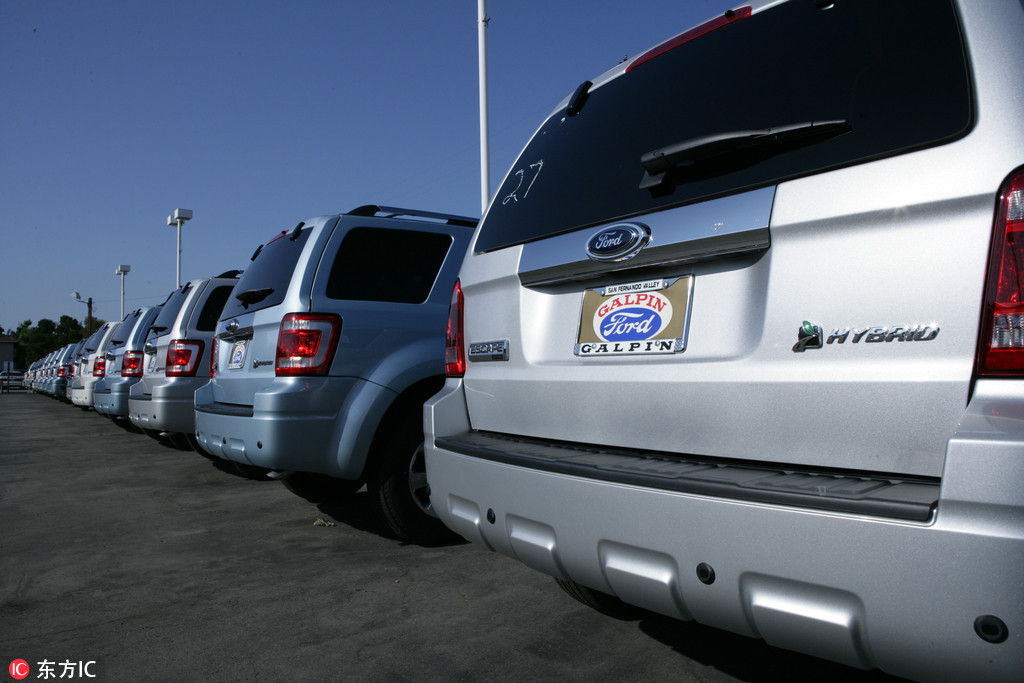
James Hackett, CEO of Ford, said last month at a Bloomberg conference in New York that US steel and aluminum tariffs would cost the automaker $1 billion in 2018 and 2019.
The only Ford exports that have been hurt have been vehicles built for the Chinese market, due to China’s move to increase tariffs to 40 percent after the United States slapped 25 percent tariffs on Chinese-built vehicles entering the United States, said Joe Hinrichs, Ford executive vice-president and president of global operations Hinrichs, Reuters reported.
Bozzella noted that the future for the US auto industry lies in exports, so reducing barriers to trade, and providing more opportunities and access to markets around the world will be key.
“But I do have to observe that the uncertainty in the current trade environment creates some significant headwinds for the US auto industry,” he said.
The US has maintained an auto trade surplus with China, according to Bozzella.
“In 2017, the US exported almost 260,000 cars and trucks built in the United States to China,” he said. “We export way more cars built here in America by Americans to China than we import from China.”
That trade could change as a result of the tariffs imposed under the US Section 301 investigation on Chinese imports, which are affecting the auto industry on both sides, Bozzella warned.
“There are consequences to the current strategy if we can’t resolve those trading issues. And we could see significant impact in states like South Carolina and Alabama, which are export engines of vehicles from the United States to China,” he said.
In the panel discussion, Bozzella mentioned that Tesla Inc, facing massive tariffs on vehicles built in California to be exported to China, has made the decision to build a plant near Shanghai.