
<tt id="6hsgl"><pre id="6hsgl"><pre id="6hsgl"></pre></pre></tt>
          <nav id="6hsgl"><th id="6hsgl"></th></nav>
          国产免费网站看v片元遮挡,一亚洲一区二区中文字幕,波多野结衣一区二区免费视频,天天色综网,久久综合给合久久狠狠狠,男人的天堂av一二三区,午夜福利看片在线观看,亚洲中文字幕在线无码一区二区
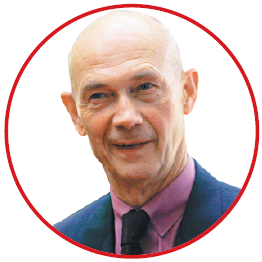
          Pascal Lamy
          Former director-general of the World Trade Organization
          BORN:

          April 8, 1947 in Levallois-Perret, France

          CAREER:

          1981-83: Adviser to French Economics and Finance Minister Jacques Delors

          1983-84: Deputy chief of staff, Office of the Prime Minister

          1985-94: Chief of staff and representative of European Commission President Jacques Delors

          1994-99: Member of the executive committee, then director-general, Credit Lyonnais

          1999-2004: European trade commissioner, Brussels

          2005-13: Director-general, World Trade Organization

          2016-present: President, French committee of the Pacific Economic Cooperation Council

          2018-present: Distinguished professor, China Europe International Business School

          How reform path led to China's WTO entry
          Pascal Lamy sees challenges ahead but believes world can avoid descent into protectionism
          ANDREW MOODY
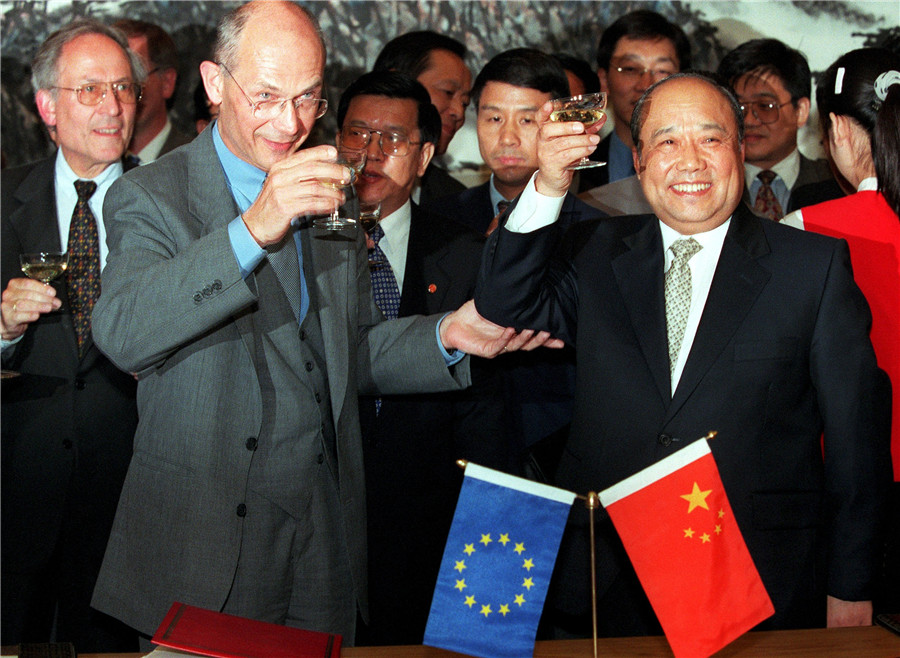
          Lamy proposes a toast to Shi Guangsheng, China's foreign trade minister, after they signed the Agreement of China's Accession to the WTO in Beijing on May 19, 2000. [ALAIN BUU/GAMMA-RAPHO/GETTY IMAGES]

          Lamy has consistently called for WTO reform, even while head of the organization, but he argues that the central issues are complex.

          "Agreeing on WTO reform is one thing, but agreeing on what you should put in that box called reform is another," he said. "China has to compromise in some areas, the US will have to compromise on others. What the EU and, to some extent, Japan are trying to do for the moment is talk to the US, talk to China, so at the end of the day everybody is around the same table."

          Despite the current trade turbulence, Lamy said he does not believe the world will descend into 1930s style protectionism.

          "We have reached the stage of globalization which makes deglobalization extremely unlikely. Globalization exists because it is efficient. Deglobalization would be inefficient. Part of the Western population believes globalization hasn't worked for them. Does this mean that deglobalization is the way? I don't think so," he said.

          Lamy, who makes three or four trips to China each year, said he was delighted to take up his role as distinguished professor at CEIBS, where he will work on projects fostering greater understanding between China and Europe during his three-year tenure. Other holders of the title include former French prime ministers Jean-Pierre Raffarin and Dominique de Villepin, and renowned economist Wu Jinglian.

          "This was one of the reasons I accepted the role," Lamy said. "I am also not too arrogant to think that as well as teaching young students and the faculty I can still learn something every day. Teaching is a good way to learn and interact with these Chinese people. So it is a good trade-off for me."

          As for reform and opening-up, Lamy said he believes China still faces challenges, particularly in the opening of its financial sector, which was particularly problematic for other Asian countries during the financial crisis of the late '90s.

          "A financial system is very fragile and something which needs a lot of care. You have only got to look back to the global financial crisis in the US, which contaminated the rest of the world," he said. "China can't manipulate its financial system like it was socks or soy. There are some fragilities in the system that need a cautious approach."

          After 40 years of change, Lamy sometimes finds it hard to reconcile the China he first visited in 1986 with the one today.

          "It's more than a contrast. It is a totally different country. Each time I come here, I find it's a different country. There is no doubt the main asset of the Chinese success is to do with growth. No other country on this planet has been successful in growing its economy at such speed for such a long time. This is something that is atypical to China."

          Lamy acknowledged that there remains ongoing debate as to what particular aspects of reform and opening-up have delivered success.

          "Whether it is because China borrowed Western recipes, as some say, or whether it is because China has remained China with its Chinese characteristics, is an extremely interesting but very open question," he said. "Even in China."


          |<< Previous 1 2 3   
          Pascal Lamy
          Former director-general of the World Trade Organization
          BORN:

          April 8, 1947 in Levallois-Perret, France

          CAREER:

          1981-83: Adviser to French Economics and Finance Minister Jacques Delors

          1983-84: Deputy chief of staff, Office of the Prime Minister

          1985-94: Chief of staff and representative of European Commission President Jacques Delors

          1994-99: Member of the executive committee, then director-general, Credit Lyonnais

          1999-2004: European trade commissioner, Brussels

          2005-13: Director-general, World Trade Organization

          2016-present: President, French committee of the Pacific Economic Cooperation Council

          2018-present: Distinguished professor, China Europe International Business School

          How reform path led to China's WTO entry

          Pascal Lamy sees challenges ahead but believes world can avoid descent into protectionism
          ANDREW MOODY
          Lamy proposes a toast to Shi Guangsheng, China's foreign trade minister, after they signed the Agreement of China's Accession to the WTO in Beijing on May 19, 2000. [ALAIN BUU/GAMMA-RAPHO/GETTY IMAGES]

          Lamy has consistently called for WTO reform, even while head of the organization, but he argues that the central issues are complex.

          "Agreeing on WTO reform is one thing, but agreeing on what you should put in that box called reform is another," he said. "China has to compromise in some areas, the US will have to compromise on others. What the EU and, to some extent, Japan are trying to do for the moment is talk to the US, talk to China, so at the end of the day everybody is around the same table."

          Despite the current trade turbulence, Lamy said he does not believe the world will descend into 1930s style protectionism.

          "We have reached the stage of globalization which makes deglobalization extremely unlikely. Globalization exists because it is efficient. Deglobalization would be inefficient. Part of the Western population believes globalization hasn't worked for them. Does this mean that deglobalization is the way? I don't think so," he said.

          Lamy, who makes three or four trips to China each year, said he was delighted to take up his role as distinguished professor at CEIBS, where he will work on projects fostering greater understanding between China and Europe during his three-year tenure. Other holders of the title include former French prime ministers Jean-Pierre Raffarin and Dominique de Villepin, and renowned economist Wu Jinglian.

          "This was one of the reasons I accepted the role," Lamy said. "I am also not too arrogant to think that as well as teaching young students and the faculty I can still learn something every day. Teaching is a good way to learn and interact with these Chinese people. So it is a good trade-off for me."

          As for reform and opening-up, Lamy said he believes China still faces challenges, particularly in the opening of its financial sector, which was particularly problematic for other Asian countries during the financial crisis of the late '90s.

          "A financial system is very fragile and something which needs a lot of care. You have only got to look back to the global financial crisis in the US, which contaminated the rest of the world," he said. "China can't manipulate its financial system like it was socks or soy. There are some fragilities in the system that need a cautious approach."

          After 40 years of change, Lamy sometimes finds it hard to reconcile the China he first visited in 1986 with the one today.

          "It's more than a contrast. It is a totally different country. Each time I come here, I find it's a different country. There is no doubt the main asset of the Chinese success is to do with growth. No other country on this planet has been successful in growing its economy at such speed for such a long time. This is something that is atypical to China."

          Lamy acknowledged that there remains ongoing debate as to what particular aspects of reform and opening-up have delivered success.

          "Whether it is because China borrowed Western recipes, as some say, or whether it is because China has remained China with its Chinese characteristics, is an extremely interesting but very open question," he said. "Even in China."

          主站蜘蛛池模板: 乱人伦人妻中文字幕无码久久网| 91亚洲国产成人久久精品| 国产精品一区二区三区四| 亚洲人成网网址在线看| mm1313亚洲国产精品无吗| 国产一级黄色片在线播放| 亚洲国产精品久久久久4婷婷| 国语精品一区二区三区| 久久综合九色综合欧洲98| 未满十八勿入AV网免费| 欧美另类精品xxxx人妖| 老色鬼在线精品视频在线观看| 大肉大捧一进一出好爽视频mba | 一区二区三区激情都市| 人妻熟妇乱又伦精品视频中文字幕| 中文有码字幕日本第一页| 国产chinesehdxxxx老太婆| 色老99久久九九爱精品| 高清性欧美暴力猛交| 日韩在线视频一区二区三| 高潮videossex潮喷| 欧美成人怡红院一区二区| 又爽又黄又无遮掩的免费视频 | 亚洲人成无码网站18禁| 国产精品二区中文字幕| 亚洲欧美一区二区三区在线| 深夜视频国产在线观看| 精品av国产一区二区三区| 一区二区三区精品自拍视频| 久久精产国品一二三产品| 国产精品线在线精品| 亚洲亚洲人成综合网络| 亚洲一本大道在线| 亚洲成人av综合一区| 午夜成人精品福利网站在线观看| 国产日韩精品秘 入口| 高清无码午夜福利视频| 亚洲色大成网站WWW久久| 秋霞在线观看片无码免费不卡| 精品中文人妻中文字幕| 97久久综合区小说区图片区|