'Moon garden' a success for Chang'e probe









Experiment marks first time live matter has been grown on the lunar surface

The "moon garden" onboard the Chang'e 4 probe has ended its operation as planned, and the data it collected will be "invaluable in improving the experiment and possibly make the moon habitable for humans", the project's chief engineer said.
Xie Gengxin, dean of the Institute of Advanced Technology at Chongqing University and chief designer of the experiment, told China Daily on Friday that the experiment was not meant to last over the lunar night, so they terminated their roughly 9-day test on Jan 12. China National Space Administration confirmed on Friday that the experiment had stopped.
The agency also confirmed shoots of cotton had sprouted in its special canister, marking the first live matter ever to be grown on the moon. After the experiment, the shoots would gradually decompose in their enclosed canisters, and would not affect the lunar environment, it said.
Six living things were placed inside the canister-cotton, rapeseed, potato, thale cress, yeast and fruit flies-aiming to form a simple yet self-sufficient micro-ecosystem in about a liter's worth of growth space, the university said earlier. The plants were kept alive by sunlight on the moon's surface redirected into the canister where they were growing.
However, when the lunar night came, Xie said the surface temperature could drop well below -100C, and the Chang'e 4 lunar lander had to enter "sleep mode" on Jan 13, so no power was available for the biological experiment.
Chang'e 4 was launched atop a Long March 3B rocket on Dec 8, and successfully landed on the moon on Jan 3. This is China's fourth lunar mission and the world's first-ever expedition on the moon's far side, most of which never faces Earth.
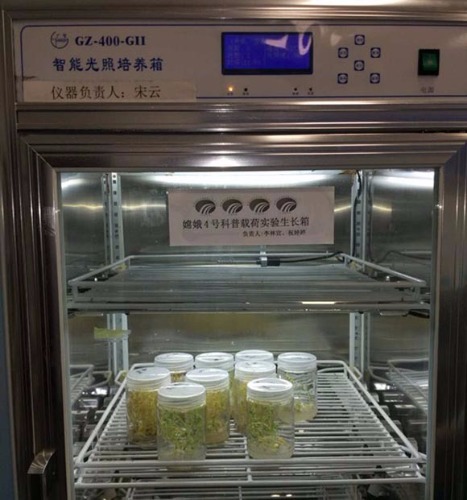
The biological experiment was initially designed to last more than 100 days, but it required an additional power source like an external battery pack, Xie said. The battery was eventually scrapped to save valuable travel weight and space for the lunar probe, "which are completely valid reasons".
Other cut equipment included cameras, so the team had to make do with fewer and less advanced cameras than they hoped. "Due to the limited and fixed camera angles, we only have an image proving the cotton sprout, and not the other organisms," he said.
"It is a pity that we don't have picture evidence of what happened to them," he said. "But the data we've collected will be invaluable in improving the experiment and possibly make the moon habitable for humans," he said.
Despite limited equipment and resources, Xie said he considered the experiment a success and "we're happy to achieve what we did in such a short amount of time."
"Growing the first living plant on the moon proves our experiment is feasible, and we have a good picture of how to expand and improve the project in the future," he added.
Xie said the experiment has provided valuable experience and confidence for scientists trying to make space habitable. It also drew massive public interest, which led to more opportunities for people to learn and stay curious about science and space.
He added that China might consider publishing data related to the biological experiment in the future as a growing effort to expand global collaboration for the nation's space program. "This will in turn lead to more cooperation and innovations."
Li Jinzeng, a researcher from the National Astronomical Observatories of the Chinese Academy of Sciences, said the brief flourishing of China's "moon garden" marks a major milestone in the road toward setting up a lunar base and expanding exploration into deep space.
"The lunar missions are laying down the foundation for future Mars missions and possibly ones beyond the Solar system," he said. "An innovative feat like the garden, even if it were just a small step, can still have great significance for future space exploration."
Tan Yingzi in Chongqing contributed to this story.




- China records 697 million border crossings nationwide in 2025
- Think tank forum between KMT and CPC to be held on Feb 3: spokeswoman
- Senior CPC official urges high-quality Party building to support 15th Five-Year Plan start
- China revises drug administration regulations to spur innovation, tighten oversight
- China's humanoid robot connects to satellite in pioneering trial
- Chinese premier urges integrity, anti-corruption efforts in government work