After-school tuition fills downtime for students









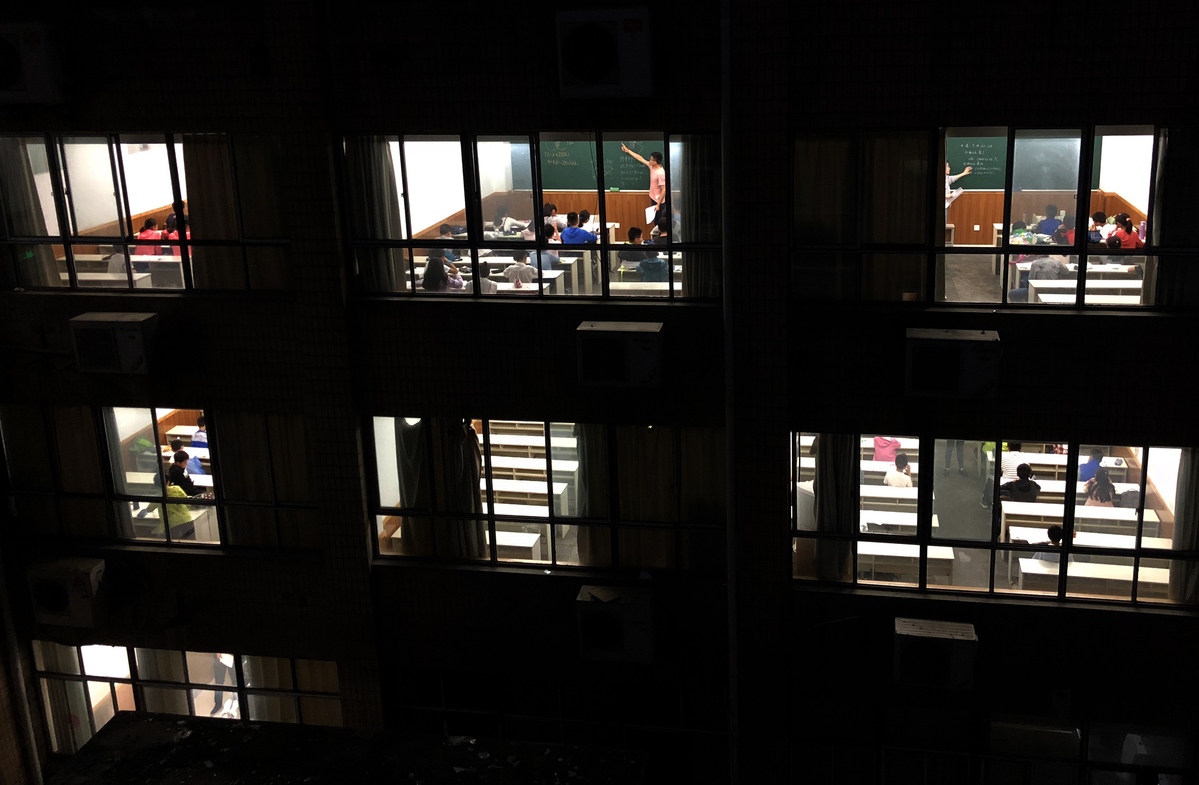
More parents are sending their children to private establishments since the government cut class hours in public schools. Zou Shuo reports.
"Tsinghua and Peking universities have to admit students, so why shouldn't one of them be my child?"
That's what many "tiger parents" think when they send their offspring to as many after-school classes as possible, starting at an early age to give their child a head start and gain entry to prestigious universities such as those mentioned above.
In recent years, the government has moved to ease the academic burden on primary and middle school students by cutting class hours, reducing the number of homework assignments, making tests easier and downplaying the importance of exam scores.
In response, ambitious parents have usurped the measures by sending their children to extracurricular classes designed to help them stand out from their peers.
In 2016, there were about 180 million school-age children in China, and more than 137 million of them were taking after-school classes or off-campus training, producing a market worth more than 800 billion yuan ($117 billion), according to a report by the Chinese Society of Education.
After-school tutoring, usually an expensive exercise, has become such a financial, physical and psychological burden for children and their parents that last year the government introduced a key reform to regulate providers of extracurricular education.
The Ministry of Education held three news conferences related to the regulation of after-school classes last year, while other issues in the sector each averaged just one media briefing across the 12 months.
Guidelines
In February, the ministry and three other government departments issued a guideline to regulate after-school education.
The measure prohibited middle schools from using entrance exams to evaluate prospective students and they were also banned from taking a child's extracurricular qualifications into consideration during enrollment. It also forbade after-school training establishments from exam-oriented tuition methods or hiring teachers from public schools.
These establishments must not teach anything outside the national syllabus, and must submit their course plans, enrollment targets and class hours to local education authorities for approval.
In August, the General Office of the State Council, China's Cabinet, attempted to ease the heavy workloads of primary and middle school students by issuing a similar guideline aimed at regulating cram schools.
The guideline highlighted activities such as teaching students materials that are too advanced for their school grade in core subjects such as Chinese, math and English. Also, teachers at cram schools must hold recognized teaching certificates and are forbidden from giving students homework. Moreover, classes must end by 8:30 pm.
Certificates and licenses will be reviewed annually, and local government websites will publish lists of certified establishments and name those that fail to meet standards, the guideline added.
The ministry also issued several notices outlining the progress it has made in regulating cram schools, and put pressure on local authorities by naming provinces judged to have made slow regulatory headway.
In its latest notice, issued this month, the ministry said 269,911 after-school institutions, or 98.9 percent of the 272,842 establishments that were found to be problematic, had completed rectifications by Dec 30.
In addition, 401,050 institutions had been assessed as part of a national campaign targeting unlicensed operators and extracurricular programs that put students under too much pressure.
Last month, an online management platform was launched to tighten scrutiny of providers of after-school education, and to allow education authorities nationwide to blacklist poorly-managed outfits and receive public complaints about training programs.



- Why do China's cultural and creative products go viral?
- Aviation sci-fi park Nantianmen to open in 2027
- Chinese researchers make breakthrough in green cooling technology
- Former head of national forestry and grassland body under investigation
- A new lease of life: Providing dialysis access in rural China
- China's grain output hits new high in 2025