Decisive stage in fight against COVID-19









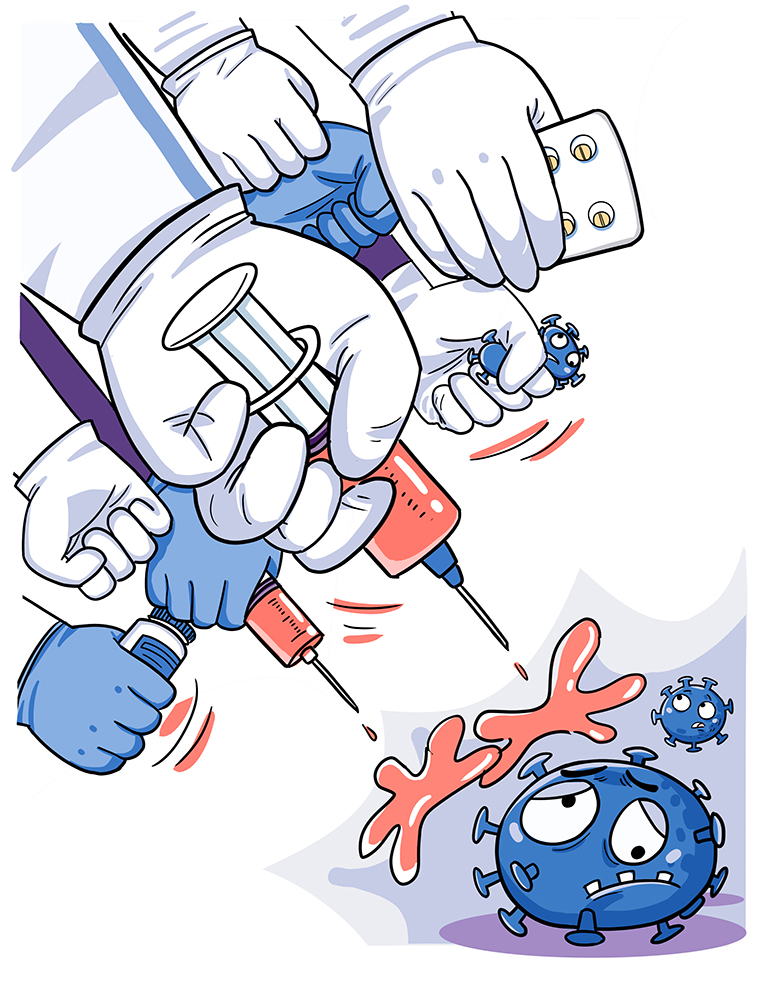
The people's war against the novel coronavirus (COVID-19) epidemic is entering a decisive stage in China. Statistics show that the epidemic has been kept in check. Nationwide, except for Hubei province, the growth rates of confirmed infections, suspected cases, and patients under medical observation are all showing a steady decline.
More positive signs
The epicenter of the epidemic has essentially been confined to Hubei province, the cities of Wuhan, Xiaogan and Huanggang in particular. The confirmed cases in other regions in China are relatively few and mainly imported ones from Hubei. On the whole, Hubei has witnessed the majority of confirmed cases, severe cases and deaths.
The increase in the number of severe cases around China is slowing down and the rehabilitation rate has surpassed the death rate. As a key indicator to the severity and fatality of the epidemic, severe cases received the most meticulous treatment and care.
The mortality rate of COVID-19 is on a steady decline. As shown by the daily ratio between accumulated deaths and severe cases. The mortality rate has been decreasing significantly in Hubei and remains low in other regions of China.
With deeper understanding of the coronavirus and enhanced effectiveness of medical treatment, the number of cured patients continues to rise. Besides, the number of cured patients has begun to exceed the number of deaths.
Top priority
The central government is mobilizing and coordinating steady supplies of medical equipment and materials for the frontline areas such as Wuhan where tailored and targeted measures have already been adopted to build up local capacity in patient admissions and treatment.
First, a precisely tailored system has been established to leave no patient unattended or under-attended.
Second, a three-level quarantine model has been put in place to improve the allocation of medical resources, which allows patients to receive the most appropriate treatment depending on their condition.
Third, the central government is mobilizing more resources from all over China to reinforce Wuhan in the war against the epidemic. Moreover, 19 provinces and municipalities have each been assigned to help a specified area in Hubei.
China's whole-of-government approach and efficient social mobilization system are the basic guarantee for victory in the battle against the novel coronavirus.
TCM's advantages
Although there is still no one-size-fits-all cure for COVID-19, China's government department in charge of epidemic prevention, medical institutions and medical researchers have joined hands in optimizing the epidemic control strategy and patient treatment plans. These have been continually refined and have proven increasingly effective in detecting, confirming and treating infected people at the earliest opportunity, as well as helping severely ill patients recover and reducing mortality rates.
Apart from Western medicine and medical treatment, medical institutions in China are also exploring what role traditional Chinese medicine can play in the fight against the virus. Eight patients, including six severe cases, were cured and discharged from Jinyintan Hospital in Wuhan on Feb 3 after receiving TCM and traditional Chinese-Western hybrid treatment by experts from Guang'anmen Hospital and Xiyuan Hospital, two preeminent hospitals affiliated to the China Academy of Chinese Medical Sciences.
Thus, the 5th edition of China's Guidelines for COVID-19 Treatment advises medical institutions to "give full play to TCM treatment, enhance traditional Chinese-Western hybrid approaches, and set up joint traditional Chinese-Western diagnosis and treatment mechanisms".
Turning point
In general, strong epidemic control, effective medical treatment for patients and enhancing the rehabilitation rate are three interrelated key missions of China's war against the novel coronavirus. Only when all of them are achieved, can China win the war at the earliest time.
Above all, a decrease in the number of new confirmed and suspected cases will be the most direct indicator of the turning point having been reached and clear proof of the effectiveness of the prevention and control measures.
Next, as the biggest threat to public health, severe cases and virus-caused deaths are people's main fears. A decreasing number of severe cases and deaths will indicate that medical treatment is effective and that the severity of the epidemic is in check.
Finally, the ultimate victory will be achieved when all infected COVID-19 patients are cured.
The situation in Hubei and other regions is expected to be further improved with enhanced national strategy and measures. Nevertheless, the turning point of the epidemic will depend on the effectiveness of the current prevention and control measures, as well as the cooperation of the general public.
But as Professor Chen Wei, academician of Chinese Academy of Engineering and researcher at the Institute of Military Medical Sciences of the People's Liberation Army Academy of Military Sciences, warns, although the turning point may be coming, the possibility of the epidemic recurring will remain, and thus it is necessary to plan for the worst and make the fullest preparations for a long-term fight against it.
Lessons ring true
Although the epidemic continues, China is well-positioned to win the ultimate victory against it. The seriousness of the epidemic and the unknowns surrounding the virus offer China and the world a number of important lessons regarding international cooperation on global public health emergencies.
First, a globalized world featuring more densely-populated metropolitan areas with higher population mobility poses unique challenges for epidemic prevention and control. Although megacities have generally established full-fledged public health emergency response mechanisms, economic, political, social, and security concerns all magnify the sensitivity of decision-makers and the public to the outbreak of infectious diseases. Therefore, emergency response mechanisms, social mobilization systems and reserve systems for strategic assets must be institutionalized in mega-cities.
Besides, the competence of community-level officials and individuals' public health awareness need to be improved through more training courses and public education programs.
Second, China's cross-regional medical supply systems and coordinating networks for medical experts are playing a decisive role in the current war against COVID-19 epidemic. Rallying more than 20,000 medical professionals and coordinating huge amounts of medical materials to reinforce Wuhan's public health system at short notice is not only a result of the full functioning of the central and local governments, but also thanks to efficient logistics and appropriate resources allocation, including human resources. China should share its challenges and good practices with the international community.
Last but not least, international cooperation proves increasingly important in the war against the novel coronavirus. In partnership with China, the World Health Organization has been closely monitoring the epidemic and coordinating a concerted international response. National governments across the world have also extended a helping hand.
More than 30 countries, including developing countries with medical supply shortages such as Pakistan and Myanmar, have donated medical materials to China. Such acts of international humanitarianism indicate that in times of global emergency, international solidarity and coordination, rather than extreme rhetoric and excessive reaction, is what is needed for the well-being of the international community. As the Chinese saying goes, "Saving him to whom you're tied from the river is saving yourself."
The authors are researchers at the Shanghai Institutes for International Studies. This is an excerpt of their report "China's Fight Against COVID-19 Epidemic". The views don't necessarily represent those of China Daily.