China and the global COVID-19 economy









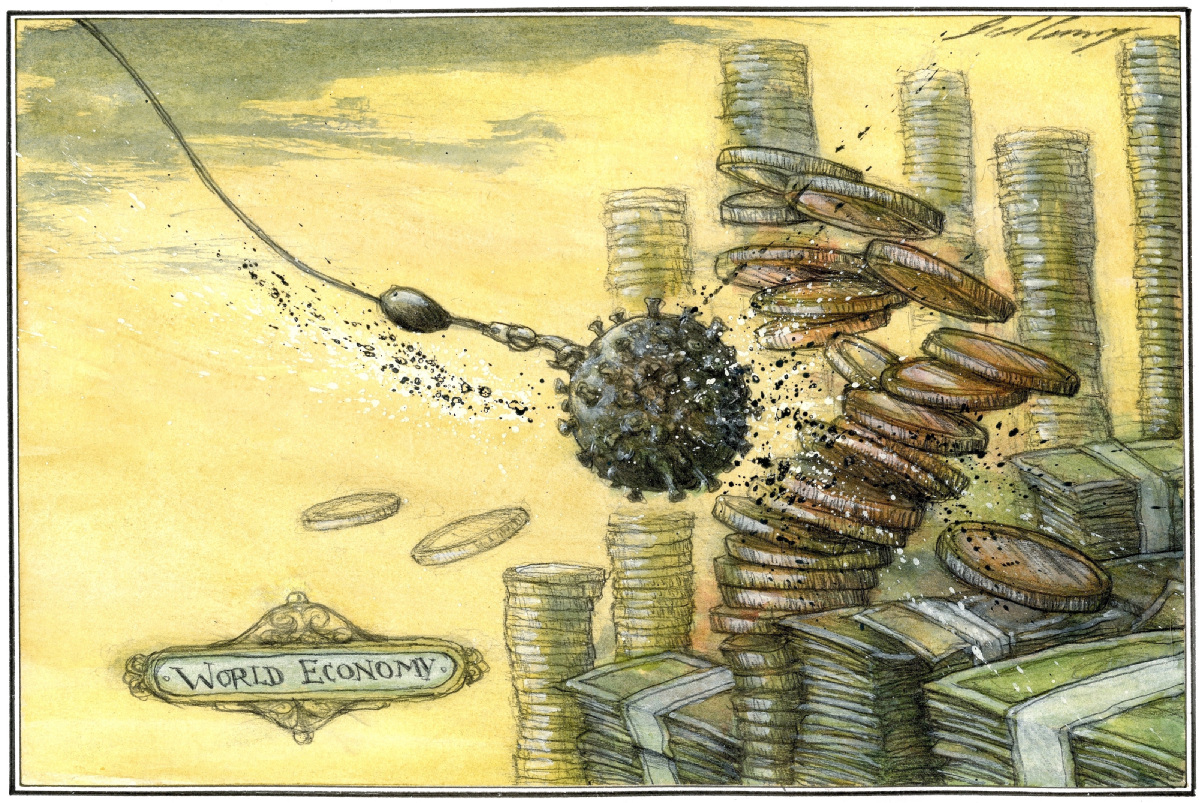
The ongoing situation has economic consequences, and once the markets recover, all will be right with the world. It's a comforting thought that ignores the nature of COVID-19.
The COVID-19 crisis is not an economic crisis. It's a health crisis, and that is something very different from an investment perspective. The most important feature of the crisis is the difference in health responses. This issue was highlighted during my panel discussion with John Ross, former director of economic and business policy of London, at the Renmin University Global Think Tanks COVID-19 International Cooperation Forum.
China, most of Asia, Singapore, Australia and New Zealand have attempted to suppress and aggressively control the spread of COVID-19. They used intensive tracking and testing coupled with very strong quarantine lockdown and isolation strategies. The total lockdown of Wuhan, a city with a population larger than that of Australia, is an example of this approach, as is the South Korean response.
In contrast, the Swedes applied the most clearly acknowledged strategy of herd immunity. Put crudely, this means the disease is able to run freely through the community so the survivors develop immunity. This is suitable for managing the spread of a seasonal flu, but this approach has resulted in very high mortality rates when applied to the management of COVID-19.
By design or by accident, the herd immunity approach has been adopted by the United States, the UK and much of Europe. This may be a result of reckless indifference, as may be the case in the United States, or poor health systems, as in the UK. In either case, the impact is the same with a high mortality rate and a continuing large reservoir of infected people.
This is the nub of the problem when considering the establishment of global trade activity. It's easy for each country to re-establish its domestic economy but the real problems come when a country with a COVID-19 containment approach wants to interact with a country with a COVID-19 herd immunity approach. Each one of their tourists, each shipment from that country, every movement of people for whatever reason, carries personnel who threaten to reignite COVID-19 in the countries which have it under control.
The Australian situation is a precursor example of the dilemma. Australia's largest single source of coronavirus infections and of at least 22 deaths came from passengers on a single ship, the Ruby Princess. This shows how a single source of infection can threaten the success of the entire containment policy.
Every day under normal circumstances, hundreds of ships are loaded or unloaded in the port of Singapore, Shanghai or Sydney. There is inevitable close interaction between customs staff, agents, stevedores and crew members. The risk of infection stemming from herd immunity countries is high.
The modern economy relies on the movement of people, be they tourists, fee-paying students or business people. The movement is channeled through airports where foot traffic is high and deliberately compressed so the passenger dwell time for shopping is enhanced. Support staff in all positions from check-in to immigration and retail are in inevitable close contacts despite enhanced self-check in procedures. The risk of infection from herd immunity countries is high.
The suggested COVID-19-free passport is an inadequate solution to this difference in health strategies. The passport could only be issued to people who have contracted COVID-19 and recovered. In countries where COVID-19 has been successfully suppressed there are very few people who qualify for the COVID-19-free passport because they have not been infected. This classic Catch-22 does nothing to free up people exchanges between herd immunity and COVID-19 containment camps.
This division in COVID-19 health management approaches applies a greater constraint and risk to the resumption of international trade in all its forms than is realized at first glance. For countries with COVID-19 containment approach there can be no return to the laissez-faire of international trade. The long-term investment and economic impacts are substantial. Border security has involved the management of illegal immigration but now its long-term policy focus will include the management of COVID-19 infection.
COVID-19 responses in some countries have increased demands for a decoupling from China. This brings its own range of economic adjustments which are reasonably well understood. However, pressure to decouple from China takes on a new health dimension because COVID-19 containment countries may prefer to concentrate their trade with countries that have a like-minded COVID-19 containment approach.
The risk associated with trade and people-to-people movement from herd immunity countries may pose too large a health and economic risk to enable a return to previous trade levels, let alone to increase trade as a substitute for reducing trade with China.
The proposed travel-bubbles between countries with demonstrated success in suppressing COVID-19 may provide a more realistic model for trade and business relations than the idea that global trade will quickly return to normal. Smart investors are beginning to factor in these trade restrictions when making investment decisions. Ultimately the choice between trade and COVID-19 management models and infection risk will be a new and important consideration in the post-COVID-19 structure of the international economic recovery.
Daryl Guppy is an international financial technical analysis expert. He has provided weekly Shanghai Index analysis for Chinese mainland media for more than a decade. Guppy appears regularly on CNBC Asia and is known as "The Chart Man." He is a national board member of the Australia China Business Council. The article reflects the author's opinion, and not necessarily the views of CGTN.