Women's group helps Zhejiang sort trash









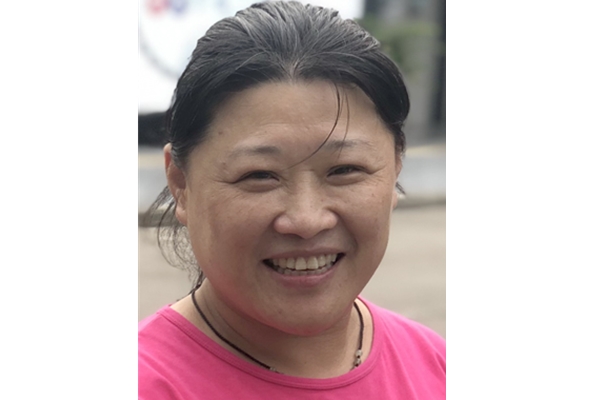
"I'm the team leader of the Camellia Sisters volunteer group in my community," said Bai Jianlan, 43, smiling proudly at the camera in her pink volunteer T-shirt.
Named after the city flower of Jinhua, Zhejiang province, the local volunteer group consists of only women and is playing a remarkable role in the city's efforts to step up household waste sorting.
Shanghai was the first major city in China to start mandatory waste sorting last year, but Zhejiang had initiated rural waste recycling at least five years earlier. Seventy-six percent of its administrative villages have now joined, according to the provincial department of agriculture and rural affairs.
Duanyan village, southeast of downtown Jinhua, is known for producing only 38 grams of waste per person daily, as little as the weight of an egg, which is then incinerated or disposed of in landfills.
Located near a wetland, the previously poverty-stricken village was struggling to find a way to transform without causing pollution.
"After several field studies, I found the change of many villages started from the improvement of their environment," said Yu Hai, Party secretary of the village, who has been promoting waste sorting in the village since 2016.
"Waste classification is simple and easy in our village now, as we have made it into a habit," Yu said.
Drawing on its successful experience in rural waste management, Jinhua started to promote a practice that features a fixed time and location for urban residents to drop off their trash in June 2019.
The Camellia Sisters in Jindong district, where Bai lives, are part of a grassroots management team made up of garbage sorting staff, community-elected inspectors and volunteers.
They are organized as a network, reaching out to the communities to teach their neighbors the proper household recycling practice and to ensure it is carried out by every family.
Bai said that at first it was hard to roll out the waste sorting project because people had no idea what it was or what it was for.
"I threw out trash like this for 70 years, so what's the problem?" she said, quoting an older lady who once refuted her.
The Camellia Sisters meet frequently to discuss feasible measures and problems related to their work.
"Another idea is to talk to children," said Bai, adding that she encourages kids to remind their parents or grandparents to keep recycling when she sends little gifts to model households every month.
According to statistics from the Jinhua government, the city has removed at least 96 percent of outdoor trash bins in its urban areas, down from more than 300,000 to about 12,000, as residents now drop off waste at designated trash sorting stations from 6 am to 9 am or 6 pm to 9 pm.
After the waste bin was removed outside her apartment, which is on the first floor, Bai Jianlan was relieved that flies would not swarm into her home every time she opened her door.
"We used to take out trash anytime we wanted. From fruit peels to shrimp shells, it's smelly, especially in summer," she said.
Equipped with a smart surveillance system and recycling machines, the standardized trash sorting stations look nothing like dirty dumps and are built to make sure residents won't have to take their trash more than 100 meters.
"I had to tell people again and again during the early days how to drop off their trash," said Chen Hongxiang, a garbage sorting worker who is paid to correct residents who fail to sort garbage properly. "But now, everyone is doing great."
Jinhua has been approved as a provincial pilot for "waste revolution" and has officially pledged to minimize its waste starting this year.
Bai said she is very supportive of waste sorting.
"The government has invested in labor, built garbage stations and staffed for this. In the end, it benefits us," she said.
Bai expressed happiness about the devotion of the members of her group. When the volunteers aren't able to show up for their shifts, they ask their husbands or even mothers-in-law to fill in.
"It did not take long for the number of our members to grow from only three to 30-about three months," she said.





- HK bets on integrated hub to enhance TCM profile
- China widens net in battle against graft
- New US dietary guidelines trigger widespread concern
- China eyes space leap with record satellite filings
- Team formed to investigate the loss of 29 cultural relics
- Investigation into school uniforms confirms safety of waterproof layer