



RCEP trade pact shows multilateralism has to be revitalized









China's goal is to see that multilateralism triumphs over unilateralism. To confirm this, when the African Continental Free Trade Agreement came into operation on May 30, China was the first nation outside the continent of Africa to endorse the pact. This is a testament to show that China embraces multilateralism concept. This is because China believes that people, and by extension, nations have often been at war with one another for various reasons. But it is cooperation that has kept the global economy running.
Following the Second World War, the United Nations and the Bretton Woods institutions have been the pillars of cooperation and multilateralism globally. While China agrees with the UN and Bretton Woods by embracing multilateralism, the United States under the leadership of anti-multilateralism President Donald Trump, whose thinking and ways portray the character of negating integration and preferring isolationism with the "America First" mantra, prefer the path of unilateralism.
So, as Trump's unilateralism and isolationism administration draw to a close, it was timely for China to reach out, so to speak, and convince the South East Asian nations on the ASEAN platform to implement the Regional Comprehensive Economic Partnership.
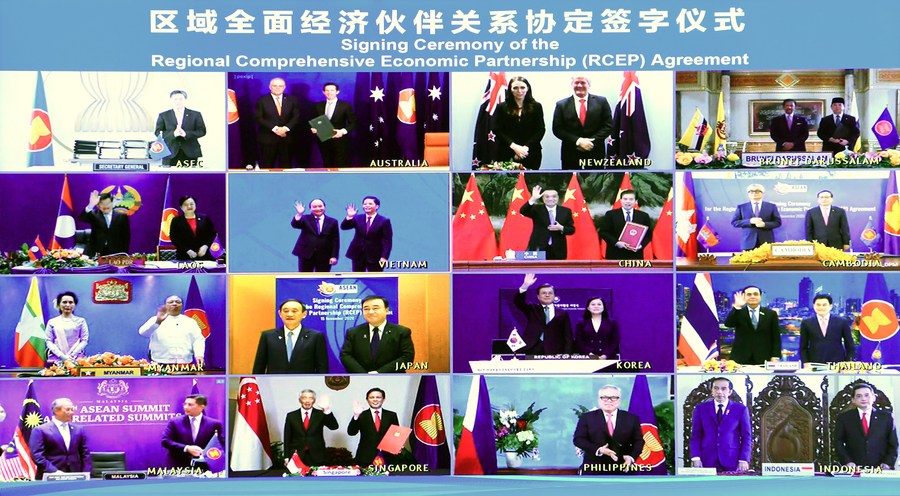
After eight years of talks reflecting their determination to strengthen economic unity and promote free trade, on Sunday China scored a "victory" when the long-awaited free trade pact was signed between 15 Asia-Pacific nations, regardless of political differences. It also makes China the champion of globalization and multilateral cooperation promoter.
In the spirit of cooperation, China's priority is to put on trade ties with Asian nations. This is because during China's trade war with the US, trade with Asian and European nations now accounts for 70 percent of China's overall trade. On top of that, China is now ASEAN's biggest trading partner in the first quarter of 2020, giving China bargaining power when dealing with the US. All these wins are as a result of the fact that the US' trade wars and its economic threats pushed Beijing to diversify its trade options and lessen dependence on the US market.
So, now that the new trade pact is inaugurated after a retreat by the US from sweeping trade agreements that reshape worldwide relationships, China and other Asian nations under the RCEP will tend to use the new trade pact to inject the "economic vitality" that Asian nations require to recover from the COVID-19 pandemic-induced slump.
The RCEP will act as a vital trade instrument that will continue to power worldwide growth and recovery, as well as pull the economic center of gravity toward the continent of Asia. No wonder the trade pact is currently referred to as the biggest free-trade pact globally, sealing a pact that excludes the US and extends China's message of building a community of shared future for mankind.
The RCEP pact encompasses close to one-third of the world's population and covers a market of 2.2 billion people, or nearly 30 percent of the world's population, with a combined GDP of $26.2 trillion, or about 30 percent of global GDP. It is projected to add $186 billion to the world economy via improved regional trade. It is an unprecedented regional trading pact that includes a diverse mix of developed, developing and least-developed economies in the region.
The pact aims to liberalize trade and investment across the Asia-Pacific region by lowering tariffs that will likely be eliminated on 86 percent of industrial goods exported from Japan to China and laying out new rules on government procurement, competition and policy for e-commerce.
RCEP has created the first free trade that would bring together the three Asian giant economies that include South Korea, China and Japan. For the fact that Korea and Japan are natural allies of the US makes it quite interesting that these three nations would come together at a time Trump is moving in all directions for the exclusion and isolation of China using similar allies (South Korea and Japan) in the East Asian region.
There are three things that struck my mind when I saw this move. First, since the US is presently focused on domestic concerns, including the necessity to combat the pandemic and rebuild its economy and infrastructure, the inclusion of Japan and South Korea reveals that the rest of the world will not wait around for the US. The European Union also has pursued trade negotiations at an aggressive pace. As other nations have signed novel agreements, with this move, US exporters may slowly lose ground.
Second, it sends a signal that RCEP nations have chosen the path of multilateralism over unilateralism and to open their market instead of resorting to protectionist measures during this hard time.
Third, it also sends another strong message that affirms ASEAN's leading role in supporting the multilateralism trading system, creating a novel trading structure in the region, enabling sustainable trade facilitation, revitalizing supply chains disrupted by coronavirus pandemic and providing a novel impetus that will help the post-COVID-19 recovery globally.
The US' unilateral trade policy under the Trump administration, combined with COVID-19, has brought Asia-Pacific economies closer. The RCEP has echoed the necessity for Asia-Pacific economies to be in one accord after the Trump administration's trade war and unilateral trade policies. Guaranteeing stability in regional supply chains also has turned out to be much more imperative as the coronavirus pandemic has brought ruin to worldwide supply chains. Therefore, with the way it stands now, the RCEP pact is anticipated to assist South Korea, China and Japan to finally reach a trilateral trade agreement after years of struggling to bridge their differences.
Although it is not clear how the US will respond to the novel trade agreement, however, now that Joe Biden is set to be sworn into office on January 20, the region is watching to see how the US foreign policy plays out on trade issues, since the United States' trade with China has turned out to be fraught issues.
Although it might not be anytime soon Biden will want to focus more on the handling of the COVID-19, however, I believe that after the COVID-19 pandemic situation has subsided, Biden will push hard to rejoin the Trans-Pacific trade agreement and roll back most of the sanctions imposed on China by the Trump regime given the fact that the United States-Mexico-Canada Pact the revised version of the North American Free Trade Pact under the Trump administration, covers slightly less economic activity.
Also, since the Trans-Pacific trade agreement has been promoted by former US president Barack Obama under which Biden served as vice-president, and as a new economic integration in Asia involving China, it can motivate and add pressure to Biden into thinking that the US needs to return to the Trans-Pacific trade agreement.
In conclusion, the RCEP free trade treaty creates a momentum of free trade and puts out the message that the global economy is returning to globalization, away from the protectionism and isolationism concept pushed by the Trump administration.
Ehizuelen Michael Mitchell Omoruyi is executive director of the Center for Nigerian Studies at the Institute of African Studies, Zhejiang Normal University.
The views don't necessarily reflect those of China Daily.
If you have a specific expertise and would like to contribute to China Daily, please contact us at opinion@chinadaily.com.cn , and comment@chinadaily.com.cn





