Oral traditions key to First Nations' history










Most Chinese visitors arriving in Canada via Vancouver have seen the Jade Boat bronze sculpture on display at the city's international airport. While they probably recognize the installation's Indigenous root and artistic import, few realize they are interacting with an important part of the culture of First Nations – their oral traditions. The old woman and the animal figures paddling the boat are all drawn from Haida oral lore.
Oral traditions are stories, histories, teachings and other knowledge that are orally transmitted from generation to generation. For thousands of years, First Nations in North America have relied on storytelling and other forms of oral communication to pass on vital information and maintain their identity. Almost all First Nations have their own creation stories, reflecting their belief about their origins and their place in the universe. For instance, the Haida believe humans were washed ashore in a clamshell and coaxed into leaving safety by the trickster raven. First Nations people also keep oral accounts of their history, their connection to the land and their commerce with other people. In addition, they often teach proper behavior and survival skills by regaling their young with spellbinding tales.
Stories related to a shared experience or collective memory are often told by a hereditary chief or an elder on formal occasions. When teaching in northern British Columbia, I had the honor of hearing hereditary chief Joseph Gosnell relate how he survived residential school and carried on the Nisga'a way of life by learning the Nisga'a language and fishing and trapping as his ancestors did. To learn his native tongue, he would hike tens of miles to hear elders speak it. He and his friends went on fishing trips as far down the coast as Vancouver Island, a fishing ground for the Nisga'a since time immemorial. It occurred to me years later in telling the audience of his story, Gosnell was sharing a collective memory of oppression and Nisga'a resilience in his capacity as knowledge-keeper.
Other stories are told in a less formal setting, usually in a small circle and at a time of the year, winter, when there are more leisure hours. This does not mean they are trivial. In fact, most have a lesson to teach. One story I heard from a Nisga'a elder tells of two youths at play mistreating a salmon, thereby incurring the ire of God. Salmon are an important part of the Nisga'a diet and are to be treated accordingly. Yet the two boys in their boredom amused themselves by setting the back of the poor salmon on fire before releasing it. As punishment God let the Tseax volcano erupt, leaving two Nisga'a villages buried under lava and 2,000 people dead. The story teaches kids respect for life and living in harmony with nature.
As exotic and intriguing as these oral traditions may sound, they mirror the same kind of imagination that inspires mythologies in other cultures. For example, the Haida creation story reminds one of the Chinese lore of N? Wa (mother of all humans) mass-producing human beings by spinning mud off a rope. The belief among the bear clans their ancestors learned from the Bear what plants are safe to eat is analogous to the Chinese mythology of Shen Nong, the god of agriculture, trying numerous kinds of herbs in order to find out their healing or poisonous properties. What sets Indigenous oral traditions apart from the rest is they remain dependent on mouth-to-mouth transmission, as the First Nations never evolved a written system to record them.
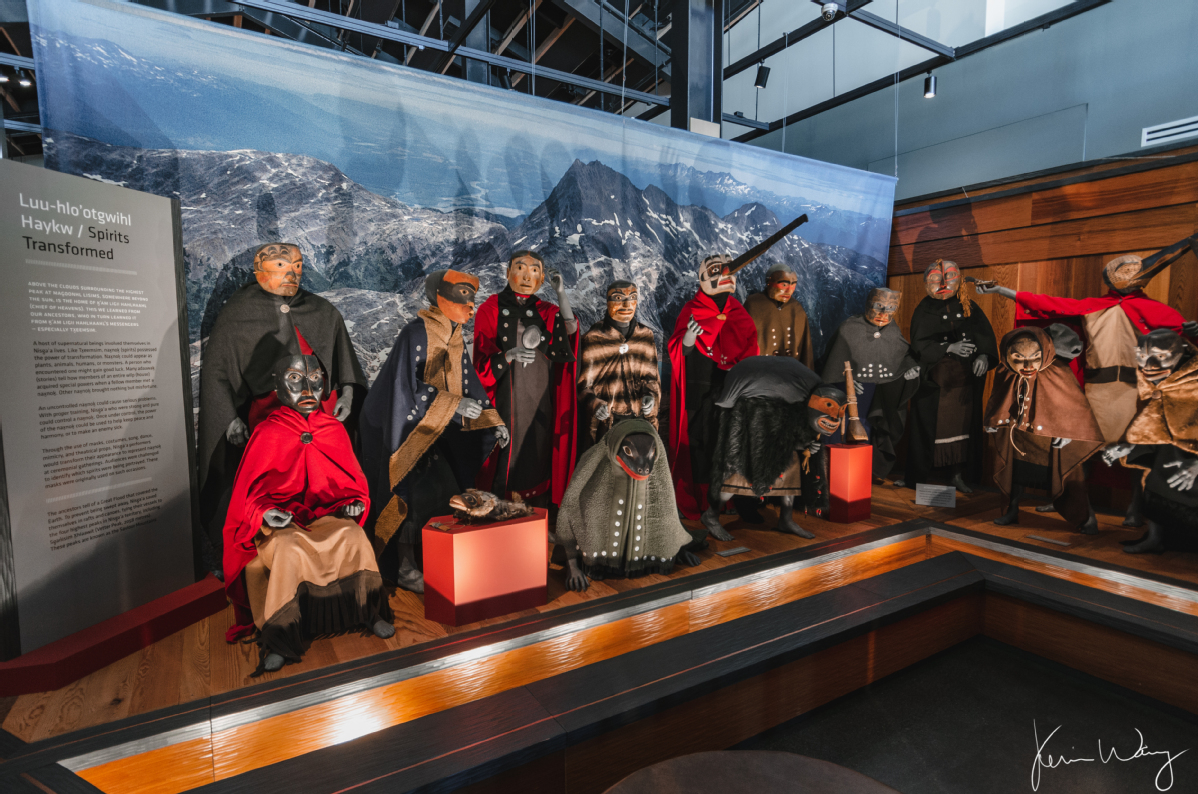
Such dependence makes these oral traditions particularly vulnerable to manipulations. From the mid-19th century to late 20th century, colonial legislation aimed at assimilating Indigenous peoples - the Indian Act and residential schools among the most notorious -forced the First Nations, Inuit and Metis to abandon their cultures and adopt the white man's way of life. State-sponsored, church-run residential schools took children from their homes and forbade them from speaking their languages or practicing their customs. A direct result of such a horrendous practice is today only 3 to 5 percent of all Indigenous people in Canada are fluent speakers of their languages, leaving their oral traditions, an important repository of culture and identity, at risk of dying.
Fortunately, efforts to reclaim and revitalize First Nation oral traditions are underway. Indigenous communities are seeking funding and sharing resources to help the young learn the language of their ancestors. Elders and chiefs continue their role as knowledge-keepers and speak in their native tongue at major gatherings. Outside Indigenous communities, oral traditions and Indigenous perspectives are gaining increased recognition, and there is a greater urgency to record and preserve First Nation languages that are critically endangered and require immediate action. After one and a half centuries of colonization and destruction, the First Nations eventually got a reprieve to repair the damage and revive their cultures, with evidence sprouting everywhere as works of art taking inspiration from age-old oral traditions began dotting public spaces in the early 1980s.
Canada's rugged landscape and Indigenous culture attract millions of visitors every year. As they explore the awe-inspiring natural beauty and the rich legacies of the past, visitors gain important insight by learning the stories behind them. The oral traditions of the First Nations provide a wealth of information about the land and the people who have been dwelling in it for millennia. What is learned will be nothing short of a revelation.
The author is a teacher in British Columbia, Canada.
The opinions expressed here are those of the writer and do not necessarily represent the views of China Daily and China Daily website.
If you have a specific expertise and would like to contribute to China Daily, please contact us at opinion@chinadaily.com.cn, and comment@chinadaily.com.cn.