


Health services ready for a booster shot










Editor's Note: During this year's two sessions-the annual meetings of the National People's Congress and the National Committee of the Chinese People's Political Consultative Conference-China Daily will publish a series of stories focusing on the achievements the country made in various fields during the 13th Five-Year Plan (2016-20). They show how the country met its development goals in different fields in the face of numerous challenges.
Experts say COVID-19 experience could provide impetus to further improve disease control measures
With bustling restaurants, packed cinemas and campuses gearing up for a new semester this month, hopes for a return to normal life are running higher than ever in China.
Over winter and early spring, the country stamped out a slew of domestic outbreaks of COVID-19. More than 2,000 infections were registered, however, a major resurgence of the novel coronavirus was prevented, a testament to the effectiveness of the country's disease control strategies.
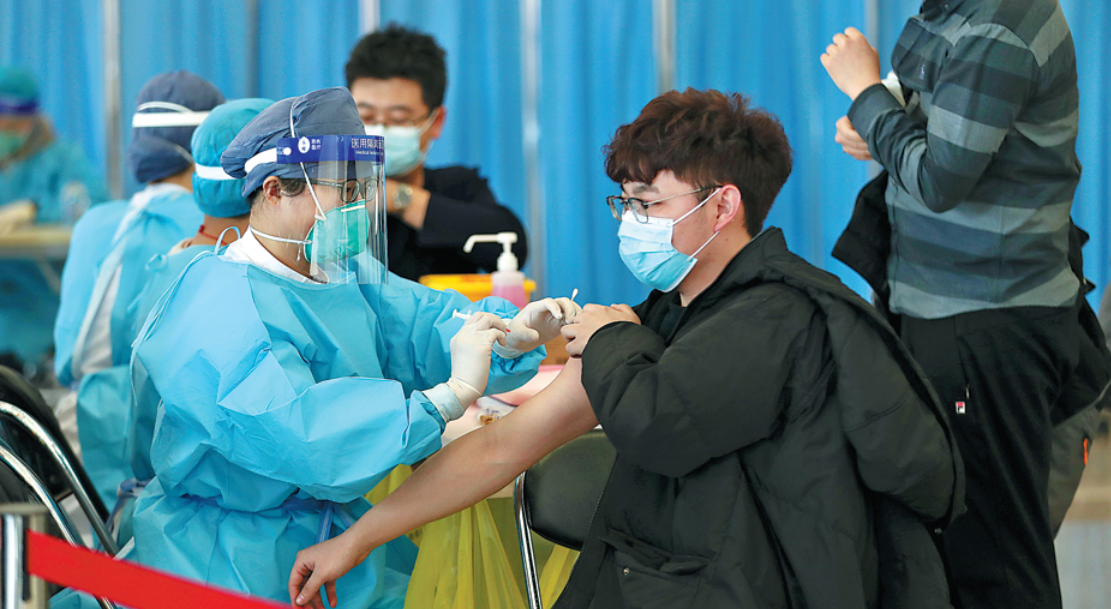
As summer approaches, four domestically developed vaccines have been approved for use and are being gradually rolled out nationwide. More vaccine candidates are in the pipeline to bolster mass inoculation.
No new local cases have been reported since Feb 15, official data shows. "Now we have entered the last stage of the suppression (of local outbreaks)," Gao Fu, director-general of the Chinese Center for Disease Control and Prevention, said in a recent article.
However, both short-term and long-term challenges in fighting the disease still abound. "Looking into the future, there will still be many uncertainties this year," Gao said, pointing to risks such as reinfection, the long-term health impacts on recovered patients and new variants of the virus. In the long-run, major improvements in the country's public health system are expected. Ma Xiaowei, minister of the National Health Commission, said, "The history of humankind is shaped by fights against infectious diseases ...the sudden COVID-19 outbreak has sounded the alarm again."
Zhang Wenhong, leader of the Shanghai team of medical experts treating COVID-19 cases, said:"Mass immunization will take time. Though China is now capable of reining in the virus, we have sacrificed many aspects of our normal lives. This Spring Festival, about 100 million stayed put instead of returning to their hometowns.
"China must strengthen its public health system to achieve a true return to normalcy," he said.
In a nod to the urgency and significance of this undertaking, the Communist Party of China Central Committee has listed "strengthening capabilities in coping with public health emergencies" as a key task in the draft of a landmark document setting the tone for the country's development.
Proposals for the 14th Five-Year Plan (2021-25) for National Economic and Social Development and the Long-Range Objectives Through the Year 2035, released in early November, will be reviewed during this year's two sessions-the country's largest annual political event. To achieve the goal, experts said concerted efforts should be made to empower disease control authorities, intensify surveillance of infectious diseases and train more public health professionals.
Focal point
Wu Xifeng, dean of the School of Public Health at Zhejiang University, said major points of contention in controlling the outbreak are the rights and responsibilities of disease control and prevention centers.
"A widespread point of view is that in the face of the epidemic, disease control centers merely followed orders issued by higher authorities and were immersed in churning out work in laboratories," she said.
However, Wu said that the China CDC had independently contributed a great deal to early knowledge about the virus. "The China CDC swiftly decoded and released the genome sequencing data, which enabled global scientists to create testing kits and begin developing treatment and vaccines," she said.
The pandemic has underscored the significance of improving communication and coordination between CDC agencies and other government departments, she said.
Shu Yuelong, dean of Sun Yat-sen University's School of Public Health in Shenzhen, Guangdong province, said at the heart of empowering China CDC is granting it the right to obtain, analyze, supervise and, in some cases, publish a wide array of information vital to coping with a viral outbreak.
That includes information from government departments-including health, customs, agriculture, forestry, education and transportation-as well as test results from thirdparty agencies and findings from research laboratories.
"Only through thorough information sharing can we quickly come up with a science-based and rational evaluation of an emerging health crisis and then unite all forces to stamp it out during the golden window of opportunity," he said.
Gao, head of the China CDC, said the key to reform is to maintain the technical prowess and authority of the center's officials and experts rather than give the agency administrative powers.
China's four-tier disease control network took shape around 2000 to mainly focus on technical work. For years, agencies at the provincial, city and county levels have been under the direct supervision of regional health authorities and receive guidance from the CDC.
Gao said during an interview with China Youth Daily that disease control experts are entitled to put forward suggestions, but are unable to be deeply involved in making final decisions. "Suggested steps include allowing disease control institutions to have the final say in their area of expertise, exerting more control over lower-level divisions and reducing health authorities' micromanagement and direct oversight over the disease control network," he said.





