


Health services ready for a booster shot










Efficiency is key
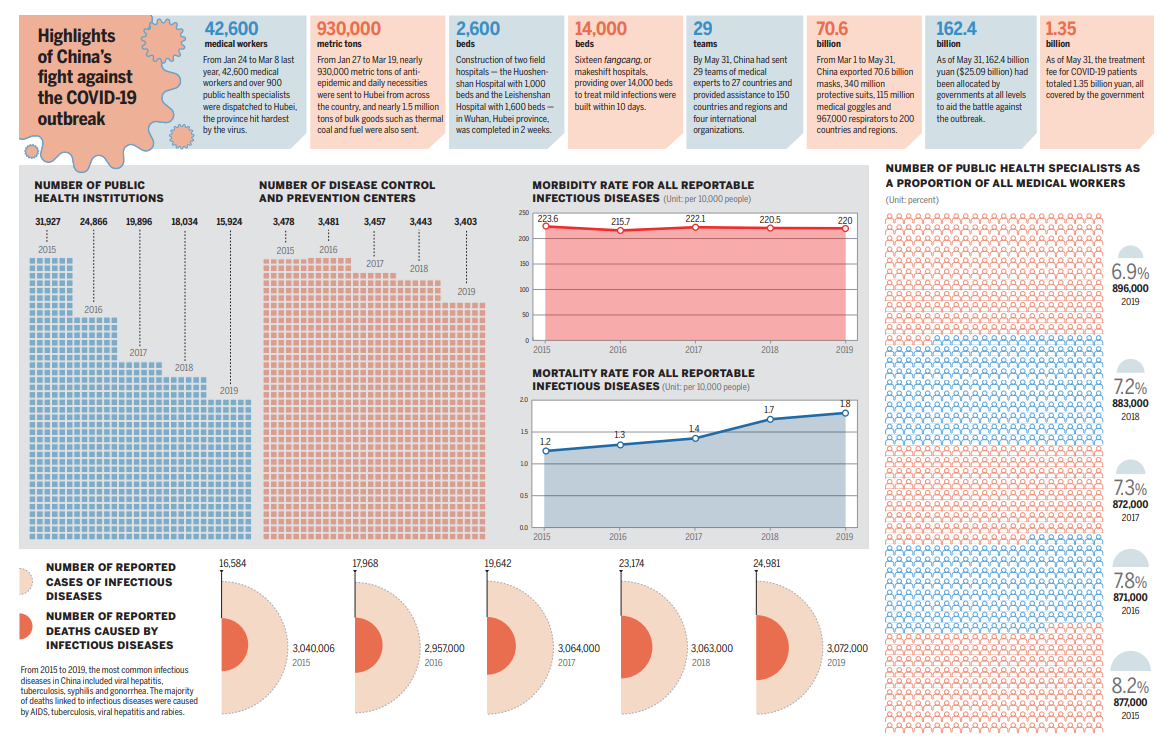
The COVID-19 pandemic has also directed attention to the country's surveillance and reporting system for infectious diseases.
Following the severe acute respiratory syndrome outbreak in 2003, China CDC set up the world's largest online direct reporting system for contagious illnesses, shortening the length of time between detecting a new case at the grassroots level to notifying the center from five days to four hours.
Liang Wannian, former director of the National Health Commission's institutional reform department, said the country's response to 40 reportable infectious diseases cataloged under the system has been satisfactory.
However, there is still room to improve the system's efficiency in monitoring and sending alerts on new and mysterious diseases.
Wu, from Zhejiang University, said to efficiently mobilize resources to tackle and emerging threat, novel disease in the system can not be overlooked.
In 2003, the first case of H7N9 influenza, which was a new disease not included in the online system, was logged on March 25. Alert to the abnormal situation, the China CDC in early April added two separate categories for H7N9 cases in the system to facilitate case reporting and data collection.
While hailing the CDC's swift calibration of the system at that time, Wu suggested the method needs more improvement to be more sustainable.
"Simply expanding the classification of contagious diseases is not going to stop us from being caught off guard when the next major outbreak hits," she said.
Instead, new technologies such as big data and blockchain should be deployed to explore convenient and comprehensive methods of gathering and processing data on infectious diseases, such as integrating the massive amount of information stored by medical institutions, Wu added.
Health authorities have already taken action to sharpen the China CDC's ability to send early alerts. Health Minister Ma Xiaowei said at a conference that more routes for obtaining information will be set up, including from public opinion, reports from medical workers and research findings. "A smart multi-point trigger system for early warnings will be built," he added.
Talent cultivation
At the same time, Ma pointed to the issue of the brain drain in the public health sector in China, calling for improvements in talent cultivation, as well as the working conditions, salaries and welfare of public health workers.
According to an article published in the Chinese Journal of Preventive Medicine, the number of employees in the disease control network peaked in 2004 at 210,000 and has been declining since. In 2018, the number dropped to about 188,000. The article was co-written by four experts from Peking University's School of Public Health.
Liang, the former health official, said it is essential to intensify "core competitive" training for public health workers.
"Their core skills consist of disease monitoring, analysis of data, formulation of public health measures and evaluation of implementation results," he said. "Improving these skills will be conducive in raising their salaries, brightening their career prospects and helping them win more social recognition."
The COVID-19 pandemic could provide the impetus to draw more well-trained young people into the field. Gao Xuehuan, who graduated from Fudan University's School of Public Health last year, told Xinhua News Agency that working for a CDC agency used to be at the bottom of his job list.
But the outbreak had tugged at his heartstrings. Last March, before he obtained his master's degree, he accepted an offer at a CDC unit in his hometown in Anhui province and has been busy since then.
He Na, dean of the school, said about 24 percent of its students ended up in CDC agencies after graduation, but there is a high chance of them quitting three to five years later."Merely expanding enrollment of public health majors while neglecting their career development will not stop CDC professionals from changing careers," he said. "The key is to increase the attraction and the sense of achievement of the position."





