Experts: Biden 'hesitant' to change many of Trump's policies on China









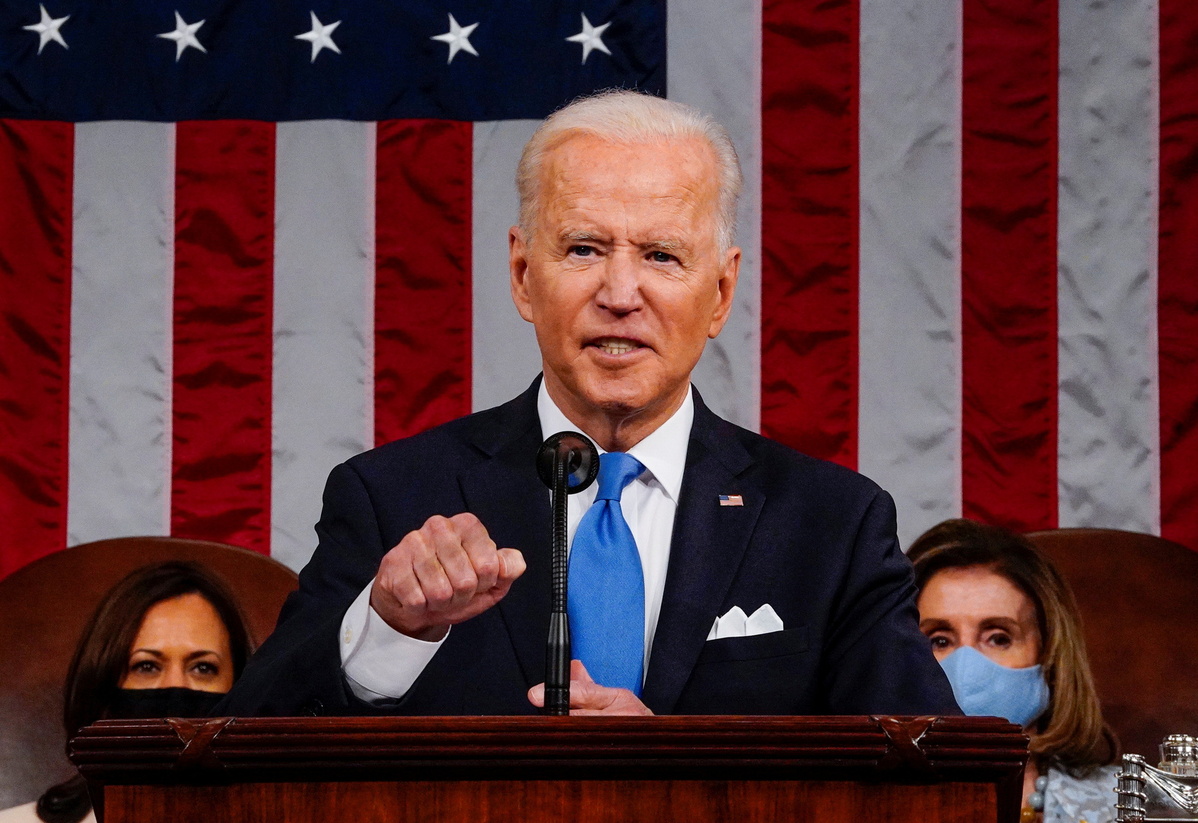
US President Joe Biden has largely continued many of his predecessor's confrontational policies toward China but also has sought de-escalation, as both countries will benefit by working together or be harmed otherwise, experts said in reviewing the first 100 days of his presidency.
The American researchers said that from tariffs to human-to-human exchanges, the Biden administration has yet to initiate any substantive rollbacks, and that among the three aspects — "adversarial, competitive and cooperative" — of US-China relations as described by Biden's top diplomat Antony Blinken, competition is dominant while cooperation has yet to ramp up.
"Despite his stated desire to change the US approach toward Beijing, Biden has been hesitant to quickly undo several of his predecessor's China policies," noted Paul Haenle, the Maurice R. Greenberg Director's Chair at the Carnegie-Tsinghua Center at Tsinghua University.
On matters that Beijing considers its sensitive core interests, the administration has picked up where Donald Trump left off, most recently easing restrictions governing US officials' engagement with Taiwan, Haenle wrote in an article published Wednesday.
He noted, however, that the Biden team has sought to improve the overall tenor of the relationship by toning down the "antagonistic and adversarial" rhetoric while maintaining a competitive tone, indicating that the administration wants to avoid continuing further down the road of tit-for-tat escalations while still appearing tough on China.
"While no one expected the administration to make drastic changes to the bilateral status quo right away, the danger moving forward is that the Biden administration could fail to meaningfully differentiate its approach from that of the Trump team and may end up with little flexibility to adjust course," Haenle wrote.
Norman J. Ornstein, an emeritus scholar at the American Enterprise Institute based in Washington, said Biden has declared to undo whatever Trump did, though their worldview is "drastically different".
"It is difficult to make a complete turnaround in policy, including foreign policy, and so we've seen caution on the trade front and caution in other areas when it comes to relations with China," Ornstein said at a webinar on Tuesday.
David Dollar, senior fellow at the John L. Thornton China Center of the Brookings Institution, also agreed that when it comes to China, Biden is largely continuing Trump's approach but with some "important nuances".
While Biden has emphasized rebuilding partnerships with allies attempting to counter China, most of them are not interested in a new Cold War, according to Dollar.
The US allies have deeper trade and investment relations with China than the US does, evidenced by the fact that since Biden's election, the EU, Japan, South Korea, Australia, New Zealand and ASEAN all have signed new economic agreements with China, Dollar noted.
"There is some contradiction between the US confronting China and working multilaterally, so it is likely that over time, Biden's China policy will have to become either less confrontational or more unilateral," Dollar wrote.
While some experts commended the Biden team for eliminating the counterproductive containment rhetoric toward Beijing and vowing to enhance cooperation with China on climate change, others said the administration lacks a practical China strategy.
Michael Swaine, director of the East Asia program at the Quincy Institute for Responsible Statecraft, said that the Biden administration has thus far failed to present a "realistic strategy" toward Beijing that reflects a recognition of the "urgent need" to stress shared leadership and military restraint over primacy and zero-sum rivalry, and prize constructive cooperation over zero-sum economic and technological competition.
Rachel Esplin Odell, a research fellow on East Asia at the Washington-based think tank, said that among the "most disappointing" aspects of Biden's China policy so far is his failure to take swift action to revitalize the people-to-people exchanges with China that were gutted in the final year of the Trump administration.
"These exchanges are essential for enhancing mutual understanding and preventing conflict," Odell said, adding that Washington also needs to take steps toward reopening the China's consulate in Houston, which was closed in July.
Ryan Hass, a senior fellow in the foreign policy program at Brookings, said that the relationship will stay tense for a while, but some things are unfolding on the positive side of the ledger.
"We no longer are spending our time analyzing tweets for clues as to the future direction of American policy toward China," because there are "real meaningful, serious conversations" taking place behind closed doors again about the future of the relationship, Hass said.
"I expect that this process will intensify when there are new ambassadors that arrive in each of our respective capitals," said Hass, who served as the National Security Council's China director from 2013 to 2017.
Whether each side likes the other or not, there is a "fair degree of interdependence" between the two countries, meaning that "both the United States and China will benefit by working together or be harmed if things go south", he said at "Biden's First 100 Days: US-China Relationship at a Crossroads", a webinar sponsored by the US-China Education Trust and AmCham China on Tuesday.
"Neither side is really going to be able to make significant progress on many of these global challenges unless both the United States and China are moving in a similar direction, whether it's global economic recovery, climate change, building a global public health surveillance network, any of these things," Hass said.