Mind the gap









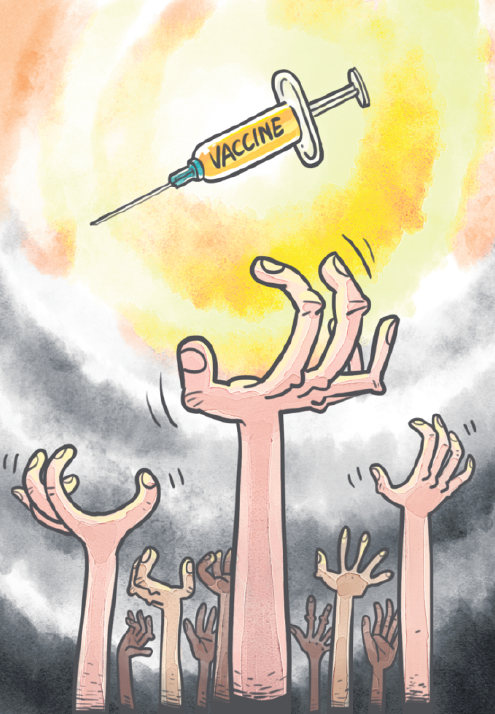
Actions on both the supply and demand sides are imperative to close the vaccine divide as soon as possible
The novel coronavirus outbreak is far from over. While the successful development of COVID-19 vaccines has inspired hope that the pandemic will soon come to an end, a speedy global vaccination rollout faces several hurdles. One of these hurdles is the unequal access to vaccines that developed and developing countries have, the so-called vaccine divide.
As of June 1, about 18 percent of the global population had been inoculated with at least a single dose of a COVID-19 vaccine. However, the distribution is very uneven across regions and economies. In developed nations, more than 36 percent of the population has received at least one dose on average, while in developing countries and developing Asia, excluding China, the figure is 7 percent and 8 percent, respectively. For all the African countries combined, the figure is even more dismal, less than 2 percent.
There are both supply side and demand side factors hindering the uptake of vaccines in developing countries. Bottlenecks in vaccine production and related supply chains and export bans by some countries have limited the overall global vaccine supply. Developing countries' low secured purchases and orders of vaccine doses further constrain their access. According to data from Duke University's Global Health Innovation Center, as of the middle of May, the confirmed number of vaccine doses procured or ordered per person was 5.1 for high-income countries, but only 0.7 for upper-middle-income countries and just 0.4 for low- and lower-middle-income countries combined.
On the demand side, budget constraints are a major barrier. For the 92 low- and lower-middle-income countries supported by COVAX, a global initiative to promote fair access to vaccines, vaccinating 70 percent of the population to establish herd immunity is a very expensive undertaking. It would require spending the equivalent of at least one-third of these countries' combined public health expenditure, at $10 per dose-which is half the marked price of a Pfizer vaccine in high-income countries-even if COVAX can achieve its original target of vaccinating 20 percent of these countries' populations for free.
Limited capacity for vaccine storage, distribution and administration is another key constraint. Even when supplies are available, many low- and lower-middle-income countries face significant challenges in administering the vaccines because of inadequate health infrastructure and trained health workers. The public's vaccine hesitancy, due to misinformation and inadequate knowledge on the safety and efficacy of the vaccines, or cultural and religious beliefs, exacerbates these challenges, as shown by several global surveys on people's willingness to take COVID-19 vaccines.
The large vaccine divide poses a significant threat to the world's economic recovery, since the virus knows no borders. The global community should act urgently to assist low- and lower-middle-income countries to ramp up their vaccination campaigns, not only out of a sense of moral responsibility, although there is that, but also because it is in every country's own interest to do so, especially in view of the continued emergence of new variants of the virus, some of which may render existing vaccines ineffective. According to recent estimates of the International Monetary Fund, closing the vaccine divide will cost the global community $50 billion, but bring $9 trillion cumulative gains in terms of avoided economic losses.
Closing the vaccine divide requires both supply- and demand-side actions.
In the immediate term, vaccine-surplus rich nations should urgently share their excess stockpiles of vaccine doses with the vaccine-deficit poorer countries through COVAX. They should also lift any export restrictions on the vaccines and related raw materials. As an immediate step, the global community should support COVAX's call to equip it to deliver 2 billion doses (1.8 billion of which will go to the 92 low- and lower-middle-income countries) in 2021 in both vaccine supplies and needed funding. It should also work toward a transparent global arrangement (through the World Health Organization or G20) to make the prices of COVID-19 vaccines more affordable for the low- and lower-middle-income countries).
Low- and lower-middle-income countries should mobilize all their available financial, institutional and health sector resources to address demand-side constraints, including putting in place necessary logistics for vaccine storage, distribution and administration. They should also address vaccine hesitancy through effective awareness campaigns to inform the public of the importance, efficacy and safety of the vaccines, especially in rural areas, using new technologies such as targeted messaging through mobile devices and social media.
As many believe the virus is likely to be around for some time, paying for vaccination drives will not be one-off spending. Closing the vaccine divide also requires longer-term solutions. The global community should pitch in for a greater role of the global initiative, COVAX, by helping increase its vaccination target from the original 20 percent of the populations in low- and lower-middle-income countries to 50 percent, with more funding support from public and private donors.
It should also help to build developing countries' capacity to manufacture safe and effective COVID-19 vaccines. Reaching a global agreement on a temporary waiver of the vaccines' intellectual property rights will be a significant step in this regard. Voluntary licensing and technology transfers will also go a long way. Ample supply will bring down vaccine prices.
Developing countries, especially low-and lower-middle-income countries, on the other hand, should scale up investments in infrastructure and capacity for vaccine distribution and administration, in broad public health systems, with the support of bilateral donors and multilateral development banks.
At the G20 Leaders' Global Health Summit and World Health Assembly held in May and the World Vaccine Conference in June, governments were united in recognizing the urgency of closing the vaccine divide. The time to translate words into more action is now.
Zhuang Juzhong is joint chief economist at the International Finance Forum and former deputy chief economist of the Asian Development Bank. Jade Tolentino is a consultant for the International Finance Forum. The authors contributed this article to China Watch, a think tank powered by China Daily. The views do not necessarily reflect those of China Daily.