



CECEP eyes BRI markets in new energy









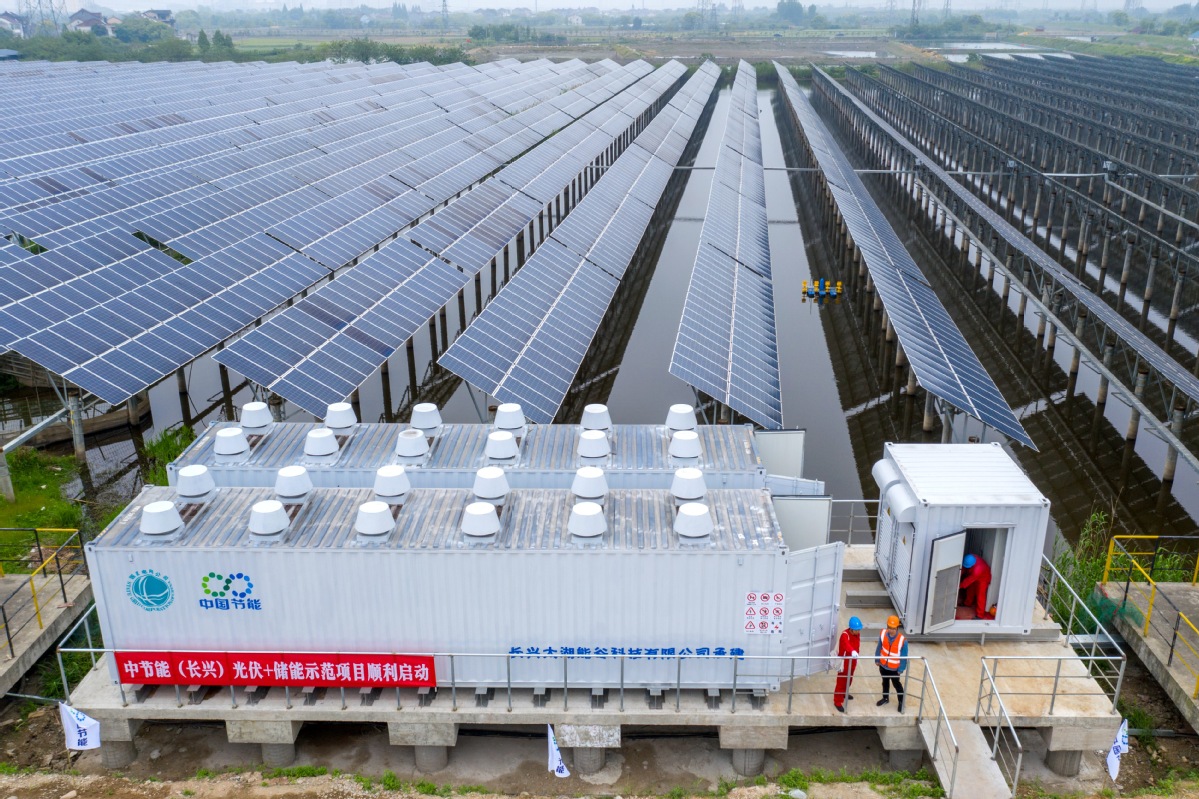
China Energy Conservation and Environmental Protection Group, or CECEP, a centrally-administered State-owned enterprise, will widen its market presence in businesses like new energy and environmental protection in markets involved in the Belt and Road Initiative during China's 14th Five-Year Plan period (2021-25), said the group's top executive on Thursday.
The planned diversification fits in with a global trend of continually deploying resources to further bring down carbon intensity, enhance the functions of the carbon trading system and make technological breakthroughs in related fields.
"The next decade will be critical for governments and businesses across the world to respond to climate change," said Song Xin, chairman of Beijing-headquartered CECEP.
He said the group will introduce new technologies and solutions to seize more civil and environmental protection projects in economies participating in the BRI in the coming years, while attracting foreign investment, and advanced energy conservation and environmental protection technologies to benefit both home and global markets.
After decades of growth, CECEP's footprint now spans 107 countries and regions. Economies in Central and Eastern Europe, Southeast Asia, South Asia and Africa are its key markets. Its services cover investment, engineering, mining, development, trade, consulting, design and technology.
With China aiming to peak carbon dioxide emissions by 2030 and achieve carbon neutrality by 2060, the nation's carbon pledges, backed by its technology accumulation and complete industrial chain, will play a major role domestically and internationally in innovation, which should help meet its objectives, said Song.
This will in turn push SOEs, Chinese private companies and multinationals to not only abide by the zero-emissions target but innovate to claim leadership in emission-reduction technologies and services, he said.
In the first half, the central SOE's sales revenue and net profit soared by 31 percent and 41 percent year-on-year, respectively. It is supported by more than 700 subsidiaries, including seven companies listed on the Shanghai and Shenzhen stock exchanges.
CECEP's installed capacity of green power reached 13.2 million kilowatts across the world between January and June, up 2.92 percent year-on-year. In the meantime, it generated 11.69 billion kWh of power, up 26.41 percent year-on-year, equivalent of reducing carbon dioxide emissions by 8.9 million metric tons and saving 3.57 million tons of standard coal.
The group treated 9.64 million tons of solid waste in both China and abroad in the first half, surging 47.93 percent year-on-year, data from the company showed.
China has already promoted the use of renewable energy globally on a large scale to ensure that clean energy accounts for a large proportion of the overall energy mix in a market-oriented way at lower costs, said Jing Chunmei, a researcher at the Beijing-based China Center for International Economic Exchanges.
International advisory firm Brunswick Group published a study earlier this year that to increase reliance on low-carbon alternatives, China will make a major push to develop new energy sources.
"Renewable energy will become the mainstay of an increase in energy and electricity consumption, rather than the incremental complementary role it has now. China's ability in cost control, in terms of unit production cost, will continue to provide companies with an advantage if they bid for projects in overseas markets," Jing said.
Zhou Lisha, a researcher with the State-owned Assets Supervision and Administration Commission (SASAC), which operates under the aegis of the State Council, China's Cabinet, said dealing with carbon emissions requires imaginative solutions.
Digital technology needs to be used throughout the life cycle of energy production and consumption to improve energy efficiency, especially in high-emission industries like power generation, manufacturing, construction, steel and petrochemicals, Zhou said.



















